Kooikerhondje

Lively and affectionate, sensitive to a harsh voice.
Adult weight
9.1–14 kg
20–30 lb
Lifespan
8–15 yrs
Class · Companion
also Sport, Field

What it's like

In temperament the Kooikerhondje is friendly, alert and energetic. It is affectionate and lively with its own people, often reserved with strangers, and tends to be sensitive to a harsh voice.

Day to day
Activity
A good daily walk and play
Intelligence
Needs daily brain work
Handler demand
Needs steady training
With people
Affection
Affectionate on its own terms
Loyalty
Sticks close to its people
Independence
Cooperative, with its own ideas
Around the home
Sensitivity
Needs a calm, predictable home
Voice
Barks to alert, then settles
Prey drive
Chases; needs managing
Breed explains only about 9% of how individual dogs differ in behaviour1. Meet the dog. A good breeder breeds for temperament as well as health, and matches each puppy's personality to the right home2,3.
Is a Kooikerhondje right for you?
Take the breed matcher

Living with one

It has a coat of medium length. Most of the shedding comes when the seasons change. Plan on brushing a few times a week, plus daily brushing through the seasonal moult. It needs plenty of exercise compared with other breeds.

Size and growth

A Kooikerhondje is a small dog, heavier than a Pug and lighter than a Cocker Spaniel. It is one of the heaviest small breeds.

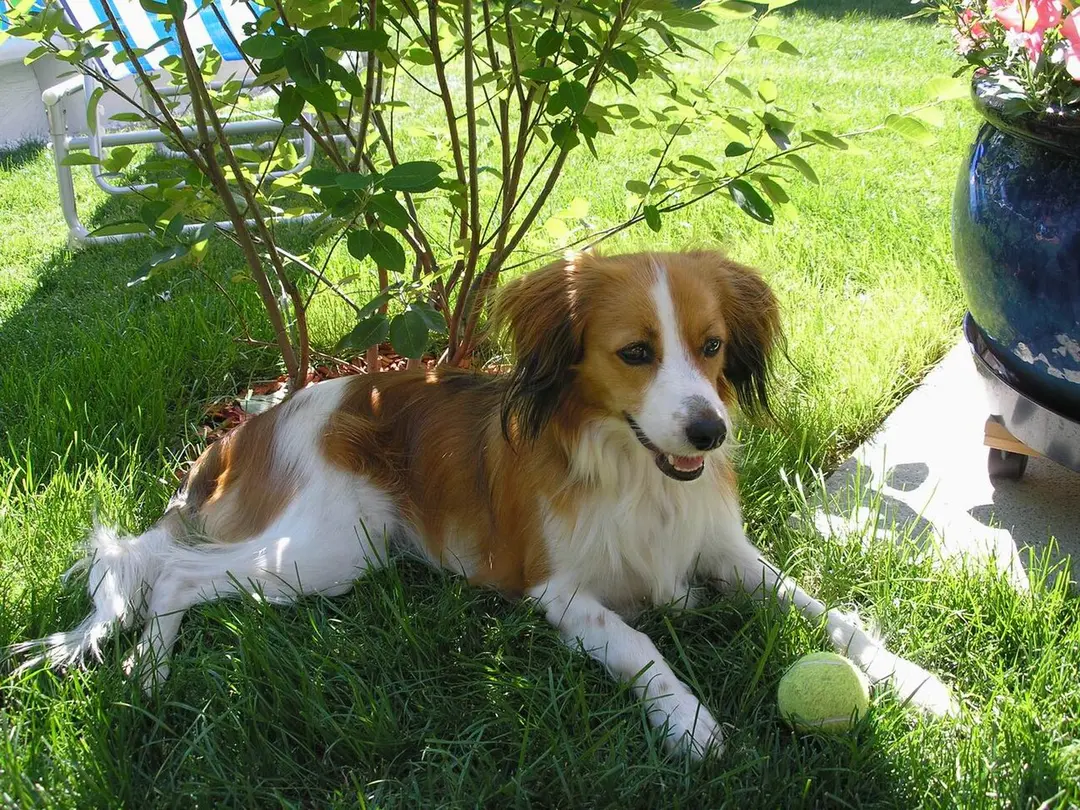
It is a compact, spaniel-like dog with a medium-length, straight or slightly wavy coat of clear orange-red patches on white. Long black tips on the ears, known as earrings, are a prized feature, and the well-feathered tail with its white plume is carried level or slightly raised. That plume is the flag that draws the ducks.

Puppy growth

Reference curve · community data appears as owners log
By about 5 months, a male Kooikerhondje puppy is already as heavy as a grown Cavalier King Charles Spaniel. They grow fastest between 3 and 4 months old.
Fully grown
10 mo
Both sexes, at 99% of adult weight7
Male
Female
Shaded: expected range
0510152m4m6m9m12m18m
0510152m3m4m6m9m12m18m
Age
Male
Female
2 months
2.3–3.4 kg 5.1–7.5 lb
2.6–3.8 kg 5.7–8.4 lb
3 months
3.1–4.7 kg 6.8–10.4 lb
3.3–4.9 kg 7.3–10.8 lb
4 months
4.4–6.6 kg 9.7–14.6 lb
4.5–6.7 kg 9.9–14.8 lb
5 months
5.5–8.2 kg 12.1–18.1 lb
5.4–8.1 kg 11.9–17.9 lb
6 months
6.3–9.5 kg 13.9–20.9 lb
6.1–9.2 kg 13.4–20.3 lb
7 months
7.0–10.4 kg 15.4–22.9 lb
6.7–10.0 kg 14.8–22.0 lb
8 months
7.4–11.1 kg 16.3–24.5 lb
7.1–10.7 kg 15.7–23.6 lb
9 months
7.8–11.7 kg 17.2–25.8 lb
7.5–11.2 kg 16.5–24.7 lb
10 months
8.1–12.1 kg 17.9–26.7 lb
7.8–11.7 kg 17.2–25.8 lb
11 months
8.3–12.4 kg 18.3–27.3 lb
8.0–12.0 kg 17.6–26.5 lb
12 months
8.5–12.6 kg 18.7–27.8 lb
8.2–12.3 kg 18.1–27.1 lb
15 months
8.8–13.2 kg 19.4–29.1 lb
8.7–13.0 kg 19.2–28.7 lb
18 months
9.1–14 kg 20–30 lb
9.0–13.5 kg 19.8–29.8 lb

Lifespan

No vet study has measured how long Kooikerhondjes live yet. The 8–15 years shown is a reference range, not a measured one.

Where it comes from

The Kooikerhondje works the Dutch duck decoys, luring curious ducks down a pipe into a trap with its waving tail rather than hunting them. During the Second World War Baroness van Hardenbroek van Ammerstol sent a pedlar out with a picture of the type, and on a Friesland farm he found Tommy, the founding bitch. Recognition followed in 19714.

The Kooikerhondje takes its name from the kooiker, the man who managed a Dutch duck decoy. Small orange-and-white spaniels of this type appear in Dutch paintings of the seventeenth century, including works by Jan Steen. One story says a dog of this kind woke William of Orange when Spanish troops raided his camp in the sixteenth century, but this is a legend rather than a known fact. By the nineteen-thirties the type had almost disappeared, so the modern breed was rebuilt from very few dogs. The breed still works at some decoys, which are now often used to catch ducks for ringing and study rather than for the table.

Breed standard

The Kooikerhondje is judged against standard no. 314, in group 8, Retrievers, Flushing Dogs and Water Dogs4.

Questions people ask

General guidance for dogs rather than a measured Kooikerhondje figure: most females have a first season somewhere between six and fifteen months, and cycles then settle to roughly every 180 days. Smaller breeds tend to start earlier and larger ones later, so a small breed is most likely at the early end.
Track your own Kooikerhondje
Log a minute a day and watch them sit on these curves. Free.

Sources

Something wrong on this page?
Parts of this page were written by AI ·