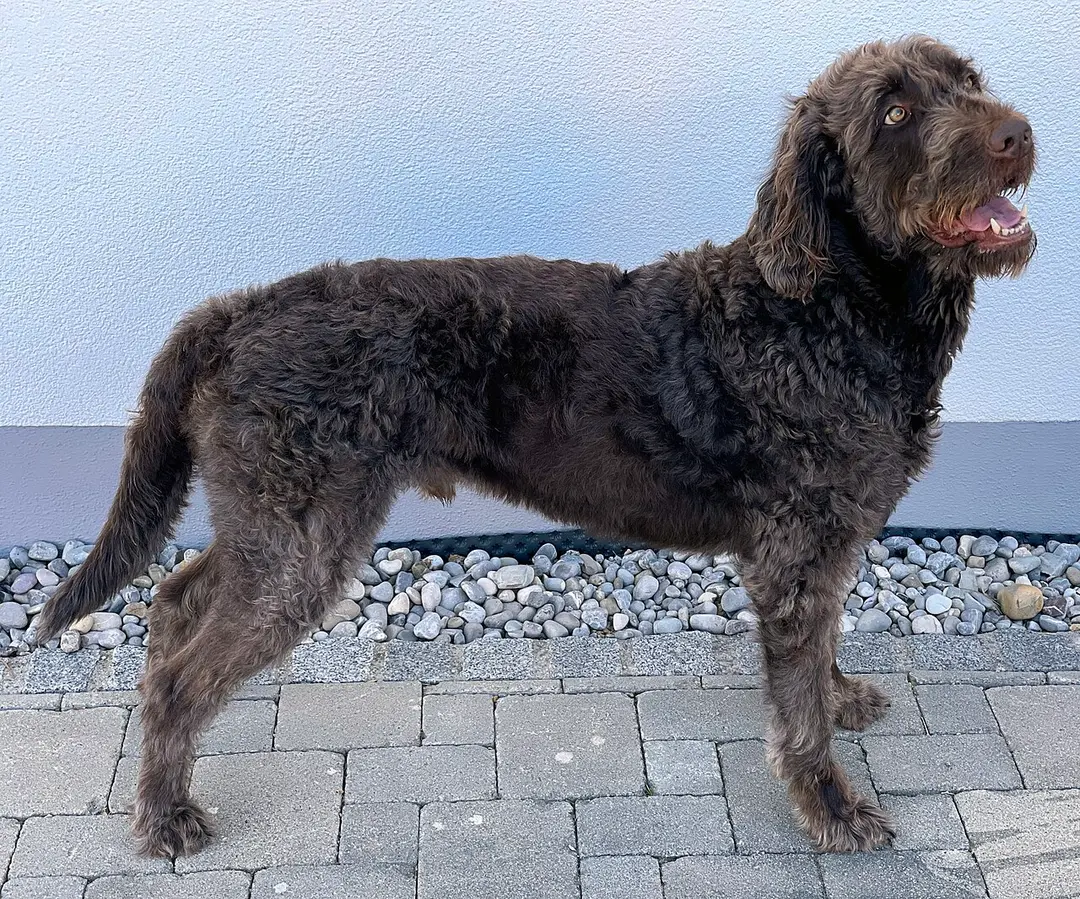
Labradoodle

Friendly, energetic and sociable, often quick-witted.
Adult weight
7–30 kg
15–66 lb
Lifespan
12–15 yrs
Class · Family
also Sport, Companion

What it's like

Labradoodles are typically friendly, energetic and sociable, often combining the Labrador's eagerness to please with the Poodle's quick wits. A low-shedding coat is not guaranteed, especially in first crosses, where puppies in a single litter can differ widely in coat and looks.

Day to day
Activity
A good daily walk and play
Intelligence
Needs daily brain work
Handler demand
Needs steady training
With people
Affection
A lap or leaning dog
Loyalty
Bonded to its family
Independence
Keen to work with you
Around the home
Sensitivity
Average
Voice
Barks to alert, then settles
Prey drive
Chases; needs managing
Breed explains only about 9% of how individual dogs differ in behaviour1. Meet the dog. A good breeder breeds for temperament as well as health, and matches each puppy's personality to the right home2,3.
Is a Labradoodle right for you?
Take the breed matcher

Living with one

The heat study found no clear difference from a Labrador.

Size and growth

A Labradoodle is a medium dog, about the weight of a grown Border Collie.

It is built like an athletic retriever, with a rounded head and a shaggy, teddy-bear face. Coats run from loose, straight hair through soft waves, called fleece, to tight Poodle-like wool, in cream, apricot, gold, red, chocolate, black and parti-colours. Size depends largely on whether a Standard or Miniature Poodle was used.

Varieties

ALA divides this breed by size. Pick the variety your dog is for a band that fits.
Variety
Weight
Height
Miniature
7–13 kg (registry figure)7
35–42 cm (registry figure)7
Medium
13–20 kg (registry figure)8
43–52 cm (registry figure)8
Standard
21–30 kg (registry figure)9
53–63 cm (registry figure)9

Puppy growth

Reference curve · community data appears as owners log
By about 5 months, a male Labradoodle puppy is already as heavy as a grown Pug. They grow fastest between 3 and 4 months old.
Fully grown
11 mo
Both sexes, at 99% of adult weight11
Male
Female
Shaded: expected range
01020302m4m6m9m12m18m
01020302m3m4m6m9m12m18m
Age
Male
Female
2 months
1.5–6.5 kg 3.3–14.3 lb
1.7–7.2 kg 3.7–15.9 lb
3 months
2.2–9.6 kg 4.9–21.2 lb
2.4–10.2 kg 5.3–22.5 lb
4 months
3.3–14.0 kg 7.3–30.9 lb
3.4–14.6 kg 7.5–32.2 lb
5 months
4.2–17.9 kg 9.3–39.5 lb
4.3–18.5 kg 9.5–40.8 lb
6 months
5.0–21.4 kg 11.0–47.2 lb
5.1–21.7 kg 11.2–47.8 lb
7 months
5.6–24.0 kg 12.3–52.9 lb
8 months
6.0–25.9 kg 13.2–57.1 lb
6.0–25.6 kg 13.2–56.4 lb
9 months
6.3–27.2 kg 13.9–60.0 lb
6.3–26.9 kg 13.9–59.3 lb
10 months
6.5–28.0 kg 14.3–61.7 lb
6.5–27.7 kg 14.3–61.1 lb
11 months
6.7–28.6 kg 14.8–63.1 lb
6.6–28.3 kg 14.6–62.4 lb
12 months
6.8–29.1 kg 15.0–64.2 lb
6.7–28.7 kg 14.8–63.3 lb
15 months
7.0–29.8 kg 15.4–65.7 lb
6.9–29.6 kg 15.2–65.3 lb

Health and lifespan

In UK vet and lab records, the conditions below turn up more often in Labradoodles than in crossbreeds. Addison's disease stands out as much more likely. The most serious, mouth melanoma, can shorten a life and is more likely. These are figures for the breed as a whole, not a prediction for your dog.
Listed by likelihood level, highest first, then by how serious it is, then by name.
  • Addison's disease
    Much more likely
    Impact: serious
  • Mouth melanoma
    Lab-confirmed cases
    More likely
    Impact: life-limiting
  • Ear canal inflammation
    More likely
    Impact: minor
Lab-confirmed: compares dogs whose tumour samples went to a lab with dogs seen in general practice, so the figures run higher than vet-record ones.

Lifespan

No vet study has measured how long Labradoodles live yet. The 12–15 years shown is a general figure without a published source.

Where it comes from

The Labradoodle, a Labrador Retriever and Poodle cross, began in 1989 as an experiment by Wally Conron of the Royal Guide Dogs Association of Australia, who had been asked for a non-shedding guide dog for a blind woman in Hawaii with an allergic husband. Only one pup of that first known litter, Sultan, passed the allergy test. Conron later said he had "released a Frankenstein's monster".15

The Labradoodle's later history belongs largely to breeders. After Wally Conron's early crosses drew attention, Australian breeders from the late nineteen-eighties, notably at Rutland Manor and Tegan Park, began breeding Labradoodle to Labradoodle over several generations. Some brought in Cocker Spaniels and other breeds, and the result became known as the Australian Labradoodle, a more consistent type. Elsewhere, many Labradoodles are still first crosses between a Labrador and a Poodle, and the Kennel Club does not recognise it as a breed. Bred originally as a guide dog with a low-shedding coat, the Labradoodle now lives mainly as a companion, though some work as assistance and therapy dogs.

Breed standard

One registry divides it into three varieties by size, each with its own weight range.

Questions people ask

General guidance for dogs rather than a measured Labradoodle figure: most females have a first season somewhere between six and fifteen months, and cycles then settle to roughly every 180 days. Smaller breeds tend to start earlier and larger ones later, so a medium-sized breed is most likely somewhere in the middle.
Track your own Labradoodle
Log a minute a day and watch them sit on these curves. Free.

Sources

Uncited on this page: Lifespan — no reviewed source yet, so it is a general reference figure rather than a published one.
Something wrong on this page?
Parts of this page were written by AI ·