Labrador Retriever

Friendly and outgoing, keen to work alongside people.
Adult male
29–36 kg
65–80 lb
Adult female
25–32 kg
55–70 lb
Lifespan
13.1 yrs
Handler demand
Suits a first-time owner
Class · Family
also Field, Sport

What it's like

The breed is friendly, outgoing and keen to work alongside people. Its steady nature has made it a common choice as a guide dog for blind people. Breeders now often distinguish heavier show lines from lighter, faster working lines, which still dominate field trials.

Owners who rated their dogs' everyday behaviour found Labradors friendlier than most with people and with other dogs, and less independent-minded. They were about average on calmness, and fewer owners than usual said they howl often. Breed is only a small part of any one dog's personality, so meet the dog before you decide.
Day to day
Activity
Needs lots of exercise
Intelligence
Learns readily, likes games
Handler demand
Suits a first-time owner
With people
Affection
A lap or leaning dog
Loyalty
Friendly with everyone
Independence
Keen to work with you
Around the home
Sensitivity
Hardy, takes a busy home in its stride
Voice
Barks to alert, then settles
Prey drive
Usually fine with small pets
Breed explains only about 9% of how individual dogs differ in behaviour1. Meet the dog. A good breeder breeds for temperament as well as health, and matches each puppy's personality to the right home2,3.
Is a Labrador Retriever right for you?
Take the breed matcher

Living with one

About one in five Labradors in one UK sample carried a gene change linked to stronger food motivation, and in a later test Labradors with it spent more time trying to reach food three hours after a normal meal than those without. The short coat moults most as the seasons change. Bred to work the field all day, it needs plenty of exercise compared with other breeds.

Size and growth

A Labrador Retriever is a large dog, about the weight of a grown Golden Retriever. Males end up clearly heavier than females.

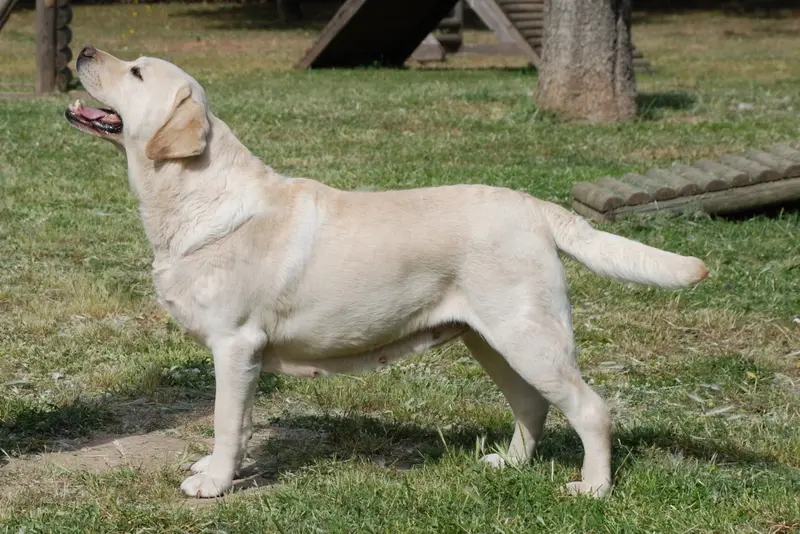
It is a strongly built, short-coupled dog with a broad head, brown or hazel eyes, a deep chest and a thick tail that tapers from a wide base. The short, dense coat has a weather-resistant undercoat and comes in solid black, yellow or liver.

Two types

The two types differ in height only, so there is one growth curve, on the record's own band (breed club figure)8.

UK / FCI type

FCI 122
Height at the withers
Males
56–57 cm
Females
54–56 cm6
Publishes no weight.

American type

AKC standard
Height at the withers
Males
57.2–62.2 cm
Females
54.6–59.7 cm9
Its weights are the ones used on this page.

Puppy growth

Reference curve · community data appears as owners log
By about 5 months, a male Labrador Retriever puppy is already as heavy as a grown Border Collie. They grow fastest between 4 and 5 months old. The chart follows Labrador Retrievers themselves, not a general size band. Most males grow into the size large-breed puppy foods are made for.
Fully grown
12 mo
Both sexes, at 99% of adult weight10
Male
Female
Shaded: expected range
0102030402m4m6m9m12m18m
0102030402m3m4m6m9m12m18m
Age
Male
Female
2 months
6.0–7.4 kg 13.2–16.3 lb
5.1–6.5 kg 11.2–14.3 lb
3 months
9.4–11.6 kg 20.7–25.6 lb
7.9–10.1 kg 17.4–22.3 lb
4 months
13.5–16.7 kg 29.8–36.8 lb
11.4–14.6 kg 25.1–32.2 lb
5 months
17.9–22.0 kg 39.5–48.5 lb
15.1–19.3 kg 33.3–42.5 lb
6 months
21.7–26.7 kg 47.8–58.9 lb
18.3–23.4 kg 40.3–51.6 lb
7 months
24.6–30.3 kg 54.2–66.8 lb
20.8–26.6 kg 45.9–58.6 lb
8 months
26.6–32.7 kg 58.6–72.1 lb
22.5–28.7 kg 49.6–63.3 lb
9 months
27.8–34.2 kg 61.3–75.4 lb
23.5–30.0 kg 51.8–66.1 lb
10 months
28.6–35.1 kg 63.1–77.4 lb
24.1–30.8 kg 53.1–67.9 lb
11 months
29.0–35.6 kg 63.9–78.5 lb
24.5–31.2 kg 54.0–68.8 lb
12 months
29.2–35.9 kg 64.4–79.1 lb
24.7–31.5 kg 54.5–69.4 lb
15 months
29.5–36.2 kg 65.0–79.8 lb
24.9–31.7 kg 54.9–69.9 lb

Health and lifespan

Vets record these more often in Labradors than in crossbreeds or other dogs. Elbow joint disease (serious) and an outward-drooping eyelid (minor) are much more likely. Limb arthritis (serious), cuts and tears in the skin and fatty lumps (both minor) are more likely. These are figures for the breed as a whole, not a prediction for your dog.
Listed by likelihood level, highest first, then by how serious it is, then by name. These are 5 of 18 measured; lab-confirmed figures only fill places the vet-record studies leave empty.
  • Elbow joint disease
    Much more likely
    Impact: serious
  • Outward-drooping eyelid
    Much more likely
    Impact: minor
  • Joint wear-and-tear arthritis in the limbs
    More likely
    Impact: serious
  • Cuts and tears in the skin
    More likely
    Impact: minor
  • Fatty lumps
    More likely
    Impact: minor

Lifespan

In UK vet records, the typical Labrador Retriever lived to about 13 years, longer than the typical large breed.

Where it comes from

The Labrador Retriever comes from Newfoundland's St John's dog, which English fishermen there used to haul in lines and fetch fish that slipped off the hook. Brought to England in the early 1800s, it had nearly died out there by the 1880s, when the Earl of Malmesbury handed dogs from his line to the Duke of Buccleuch. A water dog with an otter's tail, it made its early name at field trials6,19.

The Labrador Retriever owes its modern form to a handful of British sporting estates that kept the breed going through the late nineteenth century and bred carefully for working ability. The Kennel Club recognised it as a separate breed in the early twentieth century. Black was the colour early breeders favoured; the first recognised yellow dog appeared around the turn of that century, and liver, now usually called chocolate, became established later. It was bred as a gundog to retrieve shot game, especially waterfowl, from land and water, bringing it back with a soft mouth that leaves the bird unmarked.

Breed standard

The American standard asks for a taller dog than the UK and international ones.

Questions people ask

General guidance for dogs rather than a measured Labrador Retriever figure: most females have a first season somewhere between six and fifteen months, and cycles then settle to roughly every 180 days. Smaller breeds tend to start earlier and larger ones later, so a large breed is most likely at the later end.
Track your own Labrador Retriever
Log a minute a day and watch them sit on these curves. Free.

Sources

Something wrong on this page?
Parts of this page were written by AI ·