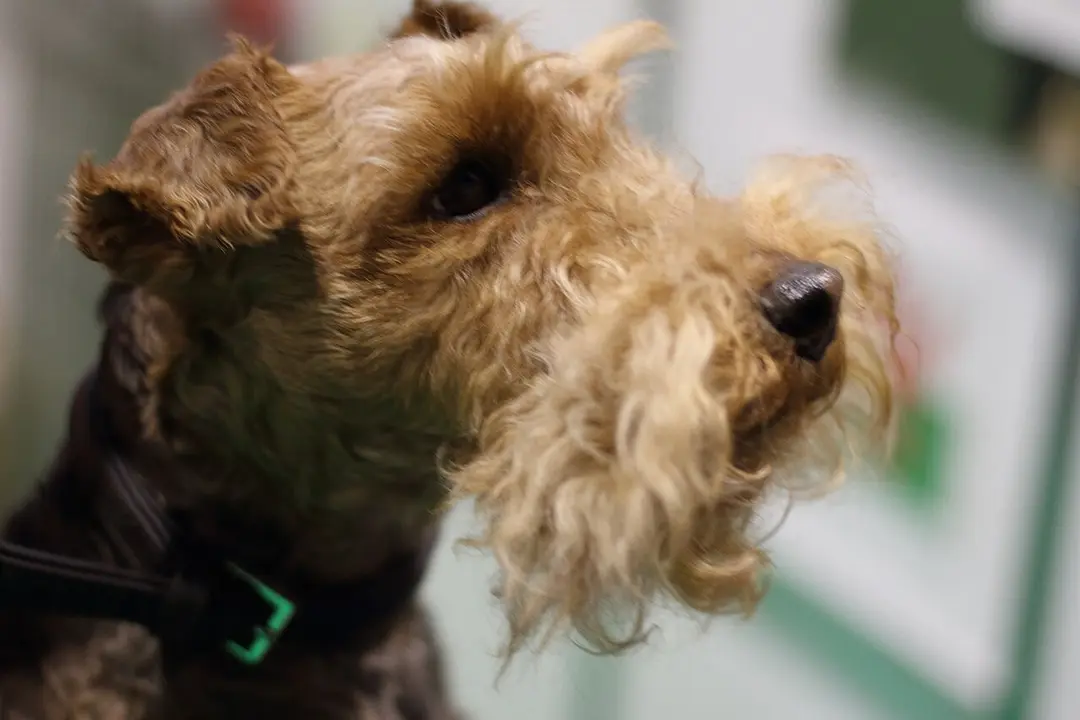
Lakeland Terrier

Bold and friendly, quick to act on its own judgement.
Adult male
6.9–8.5 kg
15–19 lb
Adult female
6.1–7.5 kg
13–17 lb
Lifespan
14.2 yrs
Class · Companion
also Field

What it's like

Lakelands are bold, lively and self-assured, friendly with people and quick to act on their own judgement. In the late nineteen-sixties a Lakeland named Stingray of Derryabah won the supreme award at both Crufts and the Westminster show in New York.

Day to day
Activity
A good daily walk and play
Intelligence
Learns readily, likes games
Handler demand
Needs steady training
With people
Affection
Affectionate on its own terms
Loyalty
Bonded to its family
Independence
Decides for itself
Around the home
Sensitivity
Hardy, takes a busy home in its stride
Voice
Barks to alert, then settles
Prey drive
Likely to chase small pets
Breed explains only about 9% of how individual dogs differ in behaviour1. Meet the dog. A good breeder breeds for temperament as well as health, and matches each puppy's personality to the right home2,3.
Is a Lakeland Terrier right for you?
Take the breed matcher

Living with one

It has a wire or harsh coat. Loose hair stays caught in the coat until it is brushed, stripped or clipped out. Plan on a brush once a week, plus hand-stripping two or three times a year. It needs a moderate amount of exercise compared with other breeds.

Size and growth

A Lakeland Terrier is a small dog, about the weight of a grown Cavalier King Charles Spaniel. Males end up a little heavier than females. Its weight is an estimate, not a published figure.

It is a compact, square-built terrier with a narrow chest, a shape that let it squeeze between the rocks of fellside earths. The coat is dense and wiry over a soft undercoat. It comes in black and tan, blue and tan, red, wheaten, red grizzle, liver, blue or black. Show dogs are hand-stripped and trimmed to a neat outline with a fuller beard and eyebrows. The small V-shaped ears fold forward and the tail is carried gaily, not curled over the back.

Puppy growth

Reference curve · community data appears as owners log
By about 3 months, a male Lakeland Terrier puppy is already as heavy as a grown Chihuahua. They grow fastest between 3 and 4 months old.
Fully grown
10 mo
Both sexes, at 99% of adult weight6
Male
Female
Shaded: expected range
02.557.5102m4m6m9m12m18m
02.557.5102m3m4m6m9m12m18m
Age
Male
Female
2 months
2.1–2.5 kg 4.6–5.5 lb
2.0–2.4 kg 4.4–5.3 lb
3 months
2.8–3.4 kg 6.2–7.5 lb
2.5–3.1 kg 5.5–6.8 lb
4 months
3.8–4.6 kg 8.4–10.1 lb
3.3–4.1 kg 7.3–9.0 lb
5 months
4.5–5.6 kg 9.9–12.3 lb
4.0–4.9 kg 8.8–10.8 lb
6 months
5.1–6.3 kg 11.2–13.9 lb
4.5–5.5 kg 9.9–12.1 lb
7 months
5.5–6.8 kg 12.1–15.0 lb
4.8–5.9 kg 10.6–13.0 lb
8 months
5.9–7.2 kg 13.0–15.9 lb
5.1–6.2 kg 11.2–13.7 lb
9 months
6.1–7.5 kg 13.4–16.5 lb
5.3–6.5 kg 11.7–14.3 lb
10 months
6.3–7.7 kg 13.9–17.0 lb
5.4–6.7 kg 11.9–14.8 lb
11 months
6.4–7.9 kg 14.1–17.4 lb
5.6–6.8 kg 12.3–15.0 lb
12 months
6.5–8.0 kg 14.3–17.6 lb
5.6–6.9 kg 12.3–15.2 lb
15 months
6.7–8.3 kg 14.8–18.3 lb
5.9–7.2 kg 13.0–15.9 lb

Lifespan

In UK vet records, the typical Lakeland Terrier lived to about 14 years, longer than the typical small breed.

Where it comes from

The Lakeland Terrier comes from the fell packs of the Lake District, where terriers went to ground after the foxes that took farmers' lambs and were bred to kill the fox below ground rather than just drive it out. The Lakeland name was agreed in 1912, and in 1928 the breed's association voted to seek Kennel Club classification8,9.

The Lakeland Terrier took shape among the working terriers of Cumberland and Westmorland, kept by farmers and huntsmen who valued courage and stamina over looks. Before the name was settled, similar dogs went by local names such as Patterdale, Elterwater and fell terriers. The breed is generally thought to share ancestry with the Border, the Bedlington and the old wire-coated terriers of the north. After recognition, breeders gradually refined it for the show ring, while working strains continued alongside.

Breed standard

The Lakeland Terrier is judged against standard no. 70, in group 3, Terriers4.

Questions people ask

General guidance for dogs rather than a measured Lakeland Terrier figure: most females have a first season somewhere between six and fifteen months, and cycles then settle to roughly every 180 days. Smaller breeds tend to start earlier and larger ones later, so a small breed is most likely at the early end.
Track your own Lakeland Terrier
Log a minute a day and watch them sit on these curves. Free.

Sources

Something wrong on this page?
Parts of this page were written by AI ·