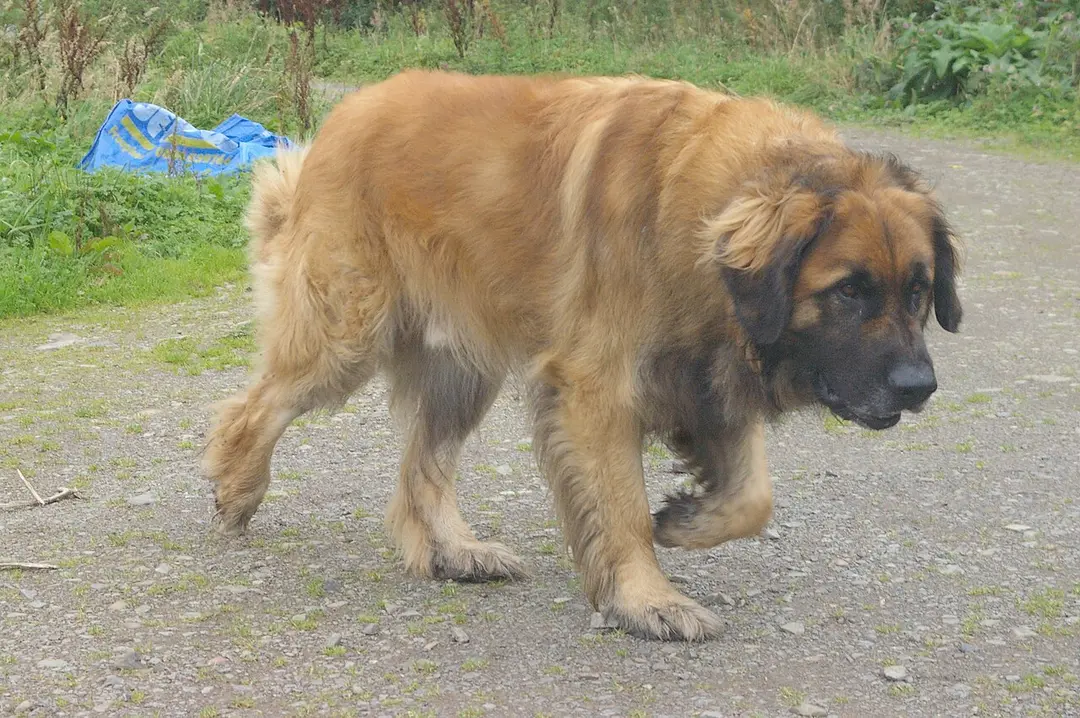
Leonberger

Calm and even-tempered, playful when young.
Adult male
50–77 kg
110–170 lb
Adult female
41–64 kg
90–141 lb
Lifespan
10 yrs
Class · Family
also Companion

What it's like

In temperament the Leonberger is calm, self-assured and even-tempered, affectionate with its family and steady with strangers. It is playful, particularly when young, but should not be nervous or aggressive.

Day to day
Activity
A good daily walk and play
Intelligence
Learns readily, likes games
Handler demand
Needs steady training
With people
Affection
A lap or leaning dog
Loyalty
Bonded to its family
Independence
Cooperative, with its own ideas
Around the home
Sensitivity
Average
Voice
Quiet
Prey drive
Usually fine with small pets
Breed explains only about 9% of how individual dogs differ in behaviour1. Meet the dog. A good breeder breeds for temperament as well as health, and matches each puppy's personality to the right home2,3.
Is a Leonberger right for you?
Take the breed matcher

Living with one

It has a long coat. Most of the shedding comes when the seasons change. Plan on daily brushing. It needs a moderate amount of exercise compared with other breeds.

Size and growth

A Leonberger is a giant dog, about the weight of a grown Great Dane. Males end up clearly heavier than females.

The coat comes in shades of lion-yellow, red, reddish-brown and sand, sometimes with black tips. Males carry a noticeable mane on the neck and chest and look clearly more masculine than females. The breed has webbed feet and is a strong swimmer, and in some countries it has been trained for water rescue.

Puppy growth

Reference curve · community data appears as owners log
By about 5 months, a male Leonberger puppy is already as heavy as a grown Labrador. They grow fastest between 4 and 5 months old. They keep growing past their first birthday, longer than a Beagle does. Most males grow into the size large-breed puppy foods are made for.
Fully grown
13 mo
Both sexes, at 99% of adult weight6
Male
Female
Shaded: expected range
0204060802m4m6m9m12m18m
0204060802m3m4m6m9m12m18m
Age
Male
Female
2 months
8.7–13.4 kg 19.2–29.5 lb
7.1–11.2 kg 15.7–24.7 lb
3 months
14.0–21.6 kg 30.9–47.6 lb
11.5–17.9 kg 25.4–39.5 lb
4 months
20.8–32.0 kg 45.9–70.5 lb
17.0–26.6 kg 37.5–58.6 lb
5 months
28.1–43.4 kg 61.9–95.7 lb
23.1–36.0 kg 50.9–79.4 lb
6 months
34.9–53.7 kg 76.9–118.4 lb
28.6–44.7 kg 63.1–98.5 lb
7 months
40.2–61.9 kg 88.6–136.5 lb
33.0–51.5 kg 72.8–113.5 lb
8 months
43.9–67.6 kg 96.8–149.0 lb
36.0–56.2 kg 79.4–123.9 lb
9 months
46.3–71.3 kg 102.1–157.2 lb
38.0–59.3 kg 83.8–130.7 lb
10 months
47.8–73.6 kg 105.4–162.3 lb
39.2–61.2 kg 86.4–134.9 lb
11 months
48.7–75.0 kg 107.4–165.3 lb
39.9–62.3 kg 88.0–137.3 lb
12 months
49.3–75.8 kg 108.7–167.1 lb
40.4–63.0 kg 89.1–138.9 lb
15 months
49.8–76.7 kg 109.8–169.1 lb
40.9–63.8 kg 90.2–140.7 lb
18 months
50.0–76.9 kg 110.2–169.5 lb
41.0–63.9 kg 90.4–140.9 lb

Health and lifespan

In UK vet records, bone cancer turns up more often in Leonbergers than in crossbreeds: it is far more likely. It can shorten a life. These are figures for the breed as a whole, not a prediction for your dog.
Listed by likelihood level, highest first, then by how serious it is, then by name.
  • Bone cancer
    Far more likely
    Impact: life-limiting

Lifespan

In UK vet records, the typical Leonberger lived to about 10 years, about average for a giant breed.

Where it comes from

The Leonberger takes its name from Leonberg, near Stuttgart, where around 1840 town councillor Heinrich Essig bred a Newfoundland bitch to one of the St Bernard hospice's "Barry" dogs, later adding a Pyrenean Mountain Dog. He wanted a dog that looked like a lion, Leonberg's heraldic beast. By the end of the 19th century it had become Baden-Württemberg's farm dog of choice, prized for guarding and for pulling carts4.

The Leonberger soon became known well beyond its home town, as Heinrich Essig, usually credited with creating the breed, sold his dogs to wealthy and aristocratic buyers across Europe; Empress Elisabeth of Austria is often named among its owners. The breed came close to disappearing in both world wars, when many dogs were lost or abandoned and some were put to work hauling carts for the army. After each war, breeders rebuilt the breed from the few dogs that survived, and today's Leonbergers descend from these post-war revivals. Long kept as an all-round family, farm and watch dog, the Leonberger is large, muscular and well balanced, with a black mask and a medium-long, water-resistant double coat.

Breed standard

The Leonberger is judged against standard no. 145, in group 2, Pinscher and Schnauzer, Molossoid and Swiss Mountain Dogs4.

Questions people ask

General guidance for dogs rather than a measured Leonberger figure: most females have a first season somewhere between six and fifteen months, and cycles then settle to roughly every 180 days. Smaller breeds tend to start earlier and larger ones later, so a giant breed is most likely at the late end.
Track your own Leonberger
Log a minute a day and watch them sit on these curves. Free.

Sources

Something wrong on this page?
Parts of this page were written by AI ·