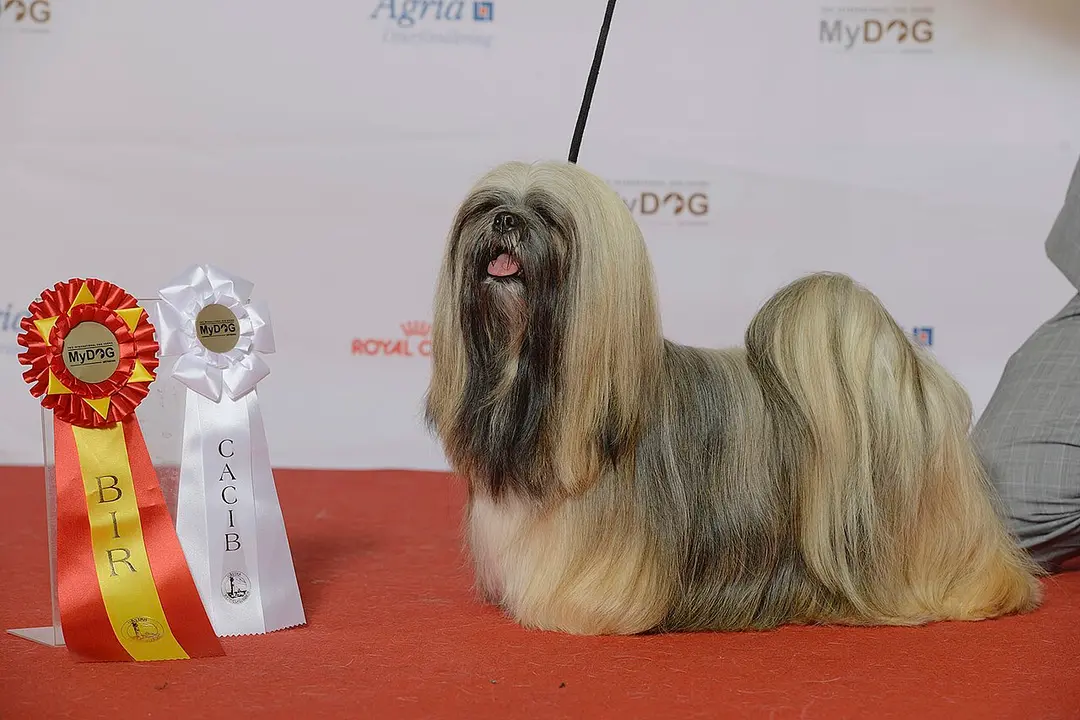
Lhasa Apso

Often comical at home, but tends to think for itself.
Adult weight
5.4–8.2 kg
12–18 lb
Lifespan
14 yrs
Class · Companion
also Lap dog, Watchdog

What it's like

In temperament the Lhasa is confident and self-possessed, and quick to warn of anything unfamiliar. With its own household it is affectionate and often comical, though it keeps a strong independent streak and tends to think for itself rather than simply obey.

Day to day
Activity
Happy with modest walks
Intelligence
Learns readily, likes games
Handler demand
Needs steady training
With people
Affection
Affectionate on its own terms
Loyalty
Sticks close to its people
Independence
Decides for itself
Around the home
Sensitivity
Average
Voice
Barks to alert, then settles
Prey drive
Usually fine with small pets
Breed explains only about 9% of how individual dogs differ in behaviour1. Meet the dog. A good breeder breeds for temperament as well as health, and matches each puppy's personality to the right home2,3.
Is a Lhasa Apso right for you?
Take the breed matcher

Living with one

A Lhasa is meant to be somewhat aloof with strangers, so reserve with visitors is normal for the breed. Long or clipped, dry the coat thoroughly after a bath, because damp hair mats even when it's clean.

Size and growth

A Lhasa Apso is a small dog, about the weight of a grown Cavalier King Charles Spaniel. Its weight is an estimate, not a published figure.

Bred as an indoor watchdog with keen hearing, it is a small, sturdy dog, longer in the body than it is tall, with a level back and a well-feathered tail carried over the back, often ending in a kink. Its coat is long, heavy and straight, hard rather than silky, over a dense undercoat. The hair falls over the eyes and forms a beard and whiskers. The breed comes in a wide range of colours, including gold, sand, honey, slate, smoke, dark grizzle, black, white and brown.

Puppy growth

Reference curve · community data appears as owners log
By about 3 months, a male Lhasa Apso puppy is already as heavy as a grown Chihuahua. They grow fastest between 3 and 4 months old.
Fully grown
10 mo
Both sexes, at 99% of adult weight8
Male
Female
Shaded: expected range
02.557.5102m4m6m9m12m18m
02.557.5102m3m4m6m9m12m18m
Age
Male
Female
2 months
1.6–2.5 kg 3.5–5.5 lb
1.7–2.7 kg 3.7–6.0 lb
3 months
2.2–3.3 kg 4.9–7.3 lb
2.2–3.4 kg 4.9–7.5 lb
4 months
2.9–4.5 kg 6.4–9.9 lb
3.0–4.5 kg 6.6–9.9 lb
5 months
3.5–5.4 kg 7.7–11.9 lb
3.5–5.3 kg 7.7–11.7 lb
6 months
4.0–6.1 kg 8.8–13.4 lb
3.9–6.0 kg 8.6–13.2 lb
7 months
4.3–6.6 kg 9.5–14.6 lb
4.3–6.5 kg 9.5–14.3 lb
8 months
4.6–7.0 kg 10.1–15.4 lb
4.5–6.8 kg 9.9–15.0 lb
9 months
4.8–7.2 kg 10.6–15.9 lb
4.7–7.1 kg 10.4–15.7 lb
10 months
4.9–7.5 kg 10.8–16.5 lb
4.8–7.3 kg 10.6–16.1 lb
11 months
5.0–7.6 kg 11.0–16.8 lb
4.9–7.5 kg 10.8–16.5 lb
12 months
5.1–7.7 kg 11.2–17.0 lb
5.0–7.6 kg 11.0–16.8 lb
15 months
5.3–8.0 kg 11.7–17.6 lb
5.2–7.9 kg 11.5–17.4 lb

Health and lifespan

Vets record these more often in Lhasas than in crossbreeds. Cherry eye and dry eye stand out as far more likely, and corneal ulcers are much more likely. Cushing's syndrome (serious) and gum disease are more likely; all but Cushing's are rated moderate. These are figures for the breed as a whole, not a prediction for your dog.
Listed by likelihood level, highest first, then by how serious it is, then by name. These are the first 5 of 6 measured.
  • Cherry eye
    Far more likely
    Impact: moderate
  • Dry eye
    Far more likely
    Impact: moderate
  • Corneal ulcers
    Much more likely
    Impact: moderate
  • Cushing's syndrome
    More likely
    Impact: serious
  • Gum disease
    More likely
    Impact: moderate

Flat face and breathing

The Lhasa Apso is one of the flat-faced breeds. In UK vet records, flat-faced dogs were more likely to have breathing and airway problems than dogs with a medium-length muzzle, and lived shorter lives on average. Noisy breathing at rest is worth raising with a vet.

Lifespan

In UK vet records, the typical Lhasa Apso lived to about 14 years, longer than the typical small breed.

Where it comes from

The Lhasa Apso comes from Tibet, where noble households and Buddhist monasteries, especially near Lhasa, kept it indoors as a sentinel, barking if an intruder slipped past the Tibetan Mastiffs outside. Apsos reached Britain in the early 1920s, at first lumped with other shaggy Eastern dogs as "Lhasa Terriers". In 1933 the 13th Dalai Lama gave the first American pair to the Cuttings of New Jersey4,16.

The Lhasa Apso's modern form was defined in Britain during the nineteen-thirties, when breeders drew up standards separating it from the Tibetan Terrier and the Shih Tzu, with which it had often been confused. Genetic studies have placed it among a small group of breeds whose ancestry appears to have diverged early from that of most modern Western breeds.

Breed standard

The Lhasa Apso is judged against standard no. 227, in group 9, Companion and Toy Dogs4.

Questions people ask

General guidance for dogs rather than a measured Lhasa Apso figure: most females have a first season somewhere between six and fifteen months, and cycles then settle to roughly every 180 days. Smaller breeds tend to start earlier and larger ones later, so a small breed is most likely at the early end.
Track your own Lhasa Apso
Log a minute a day and watch them sit on these curves. Free.

Sources

Something wrong on this page?
Parts of this page were written by AI ·