Lowchen

Outgoing and playful; inclined to bark at visitors.
Adult weight
5.4–6.6 kg
12–15 lb
Lifespan
13.9 yrs
Handler demand
Suits a first-time owner
Class · Lap dog
also Companion

What it's like

In temperament the Lowchen is lively, affectionate and alert. It is outgoing with people, quick to learn and inclined to bark at visitors, and it keeps a playful, inquisitive manner into adulthood.

Day to day
Activity
Happy with modest walks
Intelligence
Learns readily, likes games
Handler demand
Suits a first-time owner
With people
Affection
A lap or leaning dog
Loyalty
Bonded to its family
Independence
Keen to work with you
Around the home
Sensitivity
Average
Voice
Barks to alert, then settles
Prey drive
Usually fine with small pets
Breed explains only about 9% of how individual dogs differ in behaviour1. Meet the dog. A good breeder breeds for temperament as well as health, and matches each puppy's personality to the right home2,3.
Is a Lowchen right for you?
Take the breed matcher

Living with one

It has a long coat. It sheds through the year rather than in big seasonal moults. Plan on daily brushing. It needs a modest amount of exercise compared with other breeds.

Size and growth

A Lowchen is a small dog, about the weight of a grown Jack Russell. It is one of the lightest small breeds. Its weight is an estimate, not a published figure.

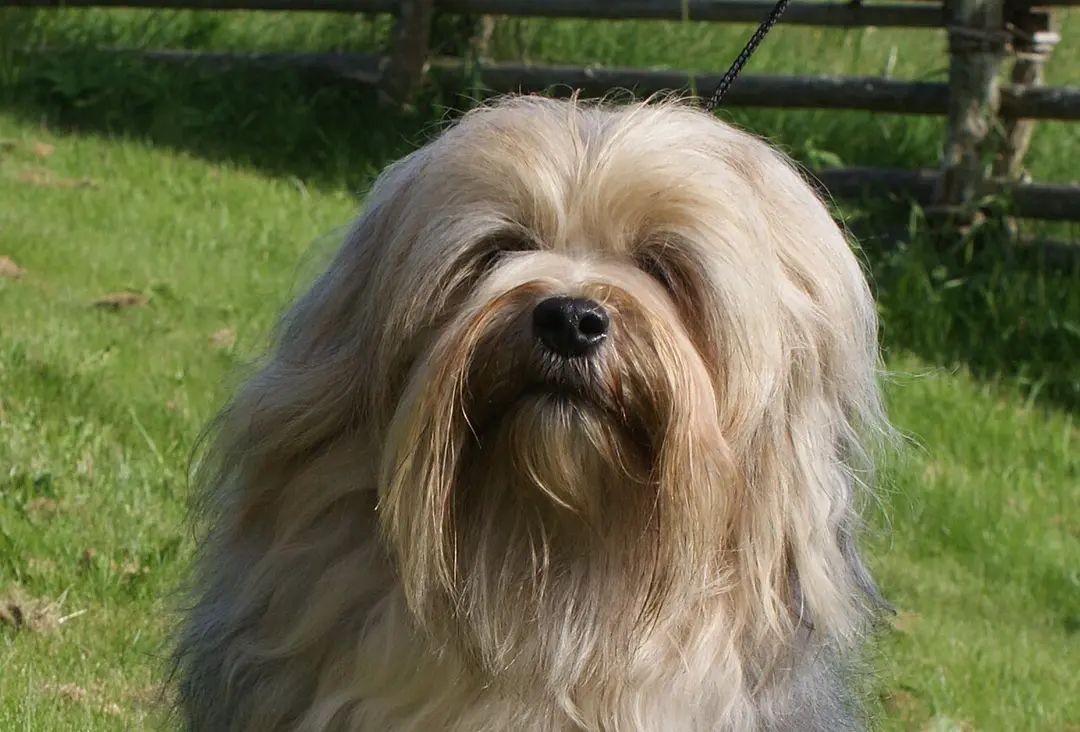
The Lowchen is compact and short-backed, with a short, broad head, dark round eyes and a proud carriage. Its long, wavy coat may be any colour and is traditionally shown in the lion clip: the body behind the ribs and the legs are clipped close, leaving a full mane over the forequarters, cuffs of hair above the feet and a plume at the tip of the tail.

Puppy growth

Reference curve · community data appears as owners log
By about 3 months, a male Lowchen puppy is already as heavy as a grown Chihuahua. They grow fastest between 3 and 4 months old.
Fully grown
10 mo
Both sexes, at 99% of adult weight6
Male
Female
Shaded: expected range
024682m4m6m9m12m18m
024682m3m4m6m9m12m18m
Age
Male
Female
2 months
1.7–2.1 kg 3.7–4.6 lb
1.9–2.3 kg 4.2–5.1 lb
3 months
2.2–2.7 kg 4.9–6.0 lb
2.3–2.9 kg 5.1–6.4 lb
4 months
2.9–3.5 kg 6.4–7.7 lb
3.0–3.6 kg 6.6–7.9 lb
5 months
3.4–4.2 kg 7.5–9.3 lb
6 months
3.8–4.7 kg 8.4–10.4 lb
3.8–4.6 kg 8.4–10.1 lb
7 months
4.1–5.1 kg 9.0–11.2 lb
4.1–5.0 kg 9.0–11.0 lb
8 months
4.4–5.4 kg 9.7–11.9 lb
4.3–5.2 kg 9.5–11.5 lb
9 months
4.6–5.6 kg 10.1–12.3 lb
4.4–5.4 kg 9.7–11.9 lb
10 months
4.7–5.7 kg 10.4–12.6 lb
4.6–5.6 kg 10.1–12.3 lb
11 months
4.8–5.9 kg 10.6–13.0 lb
4.7–5.8 kg 10.4–12.8 lb
12 months
4.9–6.0 kg 10.8–13.2 lb
4.8–5.9 kg 10.6–13.0 lb
15 months
5.1–6.3 kg 11.2–13.9 lb
5.1–6.2 kg 11.2–13.7 lb
18 months
5.3–6.5 kg 11.7–14.3 lb
5.3–6.4 kg 11.7–14.1 lb

Lifespan

In UK vet records, the typical Lowchen lived to about 14 years, longer than the typical small breed. The group was small, so treat the figure as rough.

Where it comes from

The Lowchen has a German name but is thought to be French: two such dogs are carved in stone at Amiens Cathedral, begun in the 13th century, and ladies of the Burgundian court kept it. The Löwchen Club of America credits Madame Bennert with starting, in the 1940s, to bring it back from near extinction, and says every living Lowchen traces to her successor Dr Hans Rickert's kennel4,8,9.

The Lowchen, whose German name means 'little lion', came through its mid-twentieth-century brush with extinction thanks to a small group of European breeders. Dogs were exported to Britain and North America from the late nineteen-sixties, and for a time it was listed among the rarest breeds in the world. It is usually grouped with the bichon type of small European companion dogs, though its exact ancestry is not documented. The breed was kept chiefly as a lapdog and companion. It is often said that ladies used it as a living bed warmer, but this is a story rather than a recorded fact.

Breed standard

The Lowchen is judged against standard no. 233, in group 9, Companion and Toy Dogs4.

Questions people ask

General guidance for dogs rather than a measured Lowchen figure: most females have a first season somewhere between six and fifteen months, and cycles then settle to roughly every 180 days. Smaller breeds tend to start earlier and larger ones later, so a small breed is most likely at the early end.
Track your own Lowchen
Log a minute a day and watch them sit on these curves. Free.

Sources

Something wrong on this page?
Parts of this page were written by AI ·