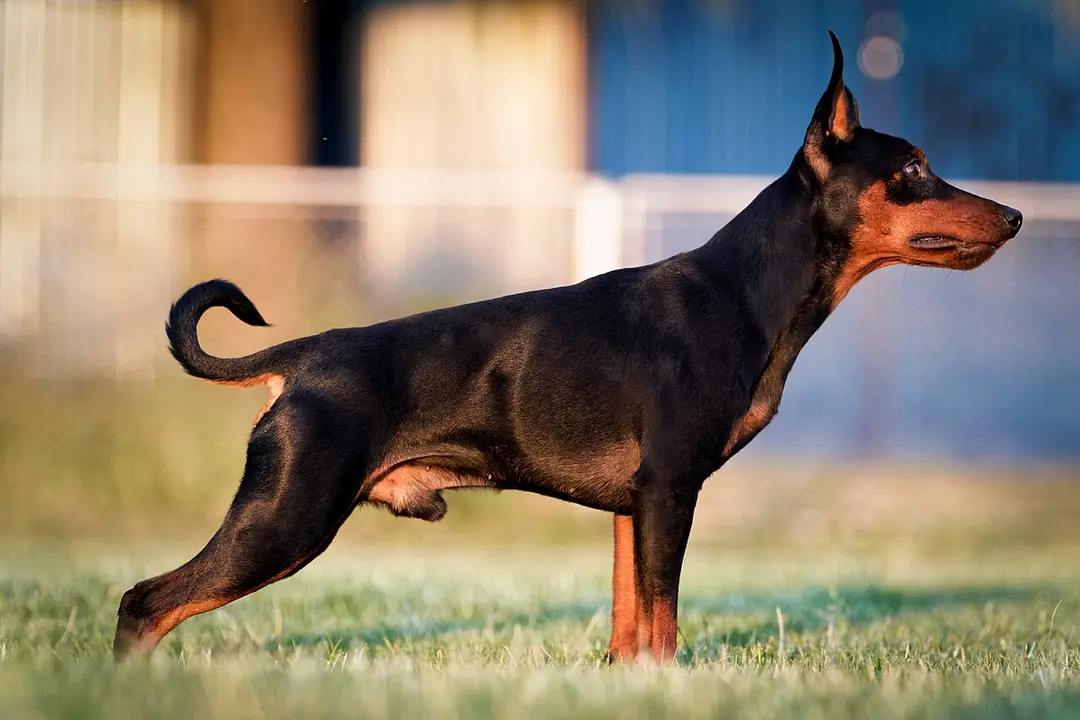
Miniature Pinscher

Confident, vocal watchdog, often an escape artist.
Adult weight
4–6 kg
8.8–13 lb
Lifespan
13.7 yrs
Class · Companion
also Lap dog

What it's like

In temperament it is alert, confident and quick, and carries itself with the assurance of a far larger dog. It is curious and energetic, tends to be reserved with strangers and makes a keen, vocal watchdog. It is often described as an escape artist, quick to find gaps in fences and doorways.

Day to day
Activity
A good daily walk and play
Intelligence
Learns readily, likes games
Handler demand
Needs steady training
With people
Affection
Likes its own space
Loyalty
Bonded to its family
Independence
Decides for itself
Around the home
Sensitivity
Average
Voice
Very vocal
Prey drive
Likely to chase small pets
Breed explains only about 9% of how individual dogs differ in behaviour1. Meet the dog. A good breeder breeds for temperament as well as health, and matches each puppy's personality to the right home2,3.
Is a Miniature Pinscher right for you?
Take the breed matcher

Living with one

It has a short coat. It sheds through the year rather than in big seasonal moults. Plan on a brush once a week. It needs a moderate amount of exercise compared with other breeds.

Size and growth

A Miniature Pinscher is a small dog, about the weight of a grown Yorkshire Terrier. It is one of the lightest small breeds.

It is a compact, square-built dog with a narrow, wedge-shaped head, dark eyes and high-set ears, carried erect or dropped. The short, hard, glossy coat lies close to the body. It comes in clear red, stag red, or black or chocolate with sharply defined rust-red markings, though not all registries accept chocolate. The old name Reh Pinscher is usually linked to the small roe deer, though the exact sense is uncertain.

Puppy growth

Reference curve · community data appears as owners log
By about 3 months, a male Miniature Pinscher puppy is already as heavy as a grown Chihuahua. They grow fastest between 3 and 4 months old.
Fully grown
10 mo
Both sexes, at 99% of adult weight6
Male
Female
Shaded: expected range
02462m4m6m9m12m18m
02462m3m4m6m9m12m18m
Age
Male
Female
2 months
1.3–1.9 kg 2.9–4.2 lb
1.4–2.1 kg 3.1–4.6 lb
3 months
1.6–2.4 kg 3.5–5.3 lb
1.7–2.6 kg 3.7–5.7 lb
4 months
2.1–3.2 kg 4.6–7.1 lb
2.2–3.3 kg 4.9–7.3 lb
5 months
2.5–3.8 kg 5.5–8.4 lb
6 months
2.8–4.2 kg 6.2–9.3 lb
7 months
3.1–4.6 kg 6.8–10.1 lb
3.0–4.5 kg 6.6–9.9 lb
8 months
3.2–4.9 kg 7.1–10.8 lb
3.2–4.8 kg 7.1–10.6 lb
9 months
3.4–5.1 kg 7.5–11.2 lb
3.3–4.9 kg 7.3–10.8 lb
10 months
3.5–5.2 kg 7.7–11.5 lb
3.4–5.1 kg 7.5–11.2 lb
11 months
3.6–5.3 kg 7.9–11.7 lb
3.5–5.2 kg 7.7–11.5 lb
12 months
3.6–5.4 kg 7.9–11.9 lb
3.6–5.3 kg 7.9–11.7 lb
15 months
3.8–5.7 kg 8.4–12.6 lb
3.8–5.6 kg 8.4–12.3 lb
18 months
4.0–5.9 kg 8.8–13.0 lb
3.9–5.9 kg 8.6–13.0 lb

Lifespan

In UK vet records, the typical Miniature Pinscher lived to about 13 and a half years, about average for a small breed.

Where it comes from

Accounts of the Miniature Pinscher's origin differ: the Kennel Club treats it as a small German Pinscher, a ratter like its larger relative, while the AKC reports that breed historians see Dachshund and Italian Greyhound in it. It was widely kept in Germany by about 1900, and its high-stepping hackney action is a British and American development rather than part of the German standard4,8,9.

The Miniature Pinscher, called the Zwergpinscher in Germany, is often mistaken for a small Dobermann, but it is usually considered the older breed and does not descend from it. It was organised under the German Pinscher-Klub in the late nineteenth century. After the First World War it reached the United States, where the American Kennel Club recognised it in the nineteen-twenties. It is often called the King of Toys. It is said to have been kept to clear stables and farmyards of rats and mice.

Breed standard

The Miniature Pinscher is judged against standard no. 185, in group 2, Pinscher and Schnauzer, Molossoid and Swiss Mountain Dogs4.

Questions people ask

General guidance for dogs rather than a measured Miniature Pinscher figure: most females have a first season somewhere between six and fifteen months, and cycles then settle to roughly every 180 days. Smaller breeds tend to start earlier and larger ones later, so a small breed is most likely at the early end.
Track your own Miniature Pinscher
Log a minute a day and watch them sit on these curves. Free.

Sources

Something wrong on this page?
Parts of this page were written by AI ·