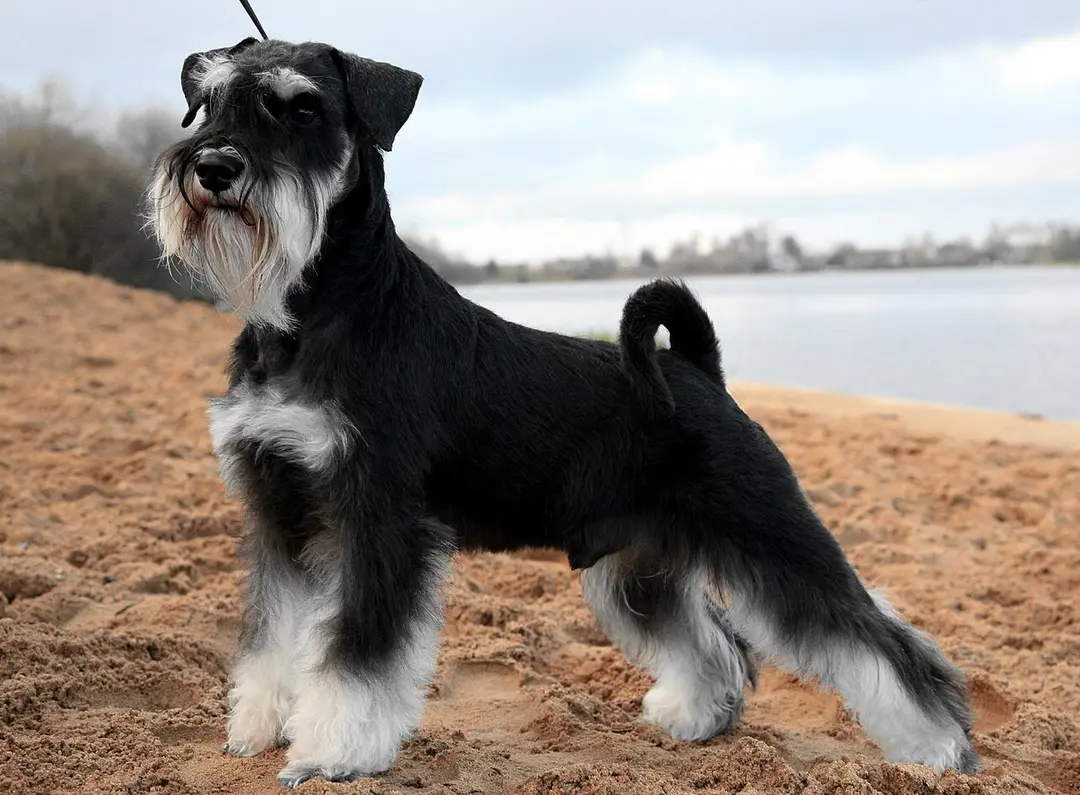
Miniature Schnauzer

Lively and quick to learn, tends to bark at strangers.
Adult weight
4–8 kg
8.8–18 lb
Lifespan
13.3 yrs
Class · Companion
also Family

What it's like

The Miniature Schnauzer is alert, lively and quick to learn, and closely attached to its household. It tends to bark at strangers and unfamiliar sounds, which suits its old role as a watchdog.

Owners who rated their dogs' everyday behaviour found Mini Schnauzers close to the typical dog on independence, calmness, and friendliness with people and with other dogs. Breed is only a small part of any one dog's personality, so meet the dog before you decide.
Day to day
Activity
A good daily walk and play
Intelligence
Learns readily, likes games
Handler demand
Needs steady training
With people
Affection
Affectionate on its own terms
Loyalty
Bonded to its family
Independence
Cooperative, with its own ideas
Around the home
Sensitivity
Average
Voice
Very vocal
Prey drive
Chases; needs managing
Breed explains only about 9% of how individual dogs differ in behaviour1. Meet the dog. A good breeder breeds for temperament as well as health, and matches each puppy's personality to the right home2,3.
Is a Miniature Schnauzer right for you?
Take the breed matcher

Living with one

Most pet owners have a Mini Schnauzer's coat clipped by a groomer every five to eight weeks. If you'd rather hand-strip, a groomer or breeder can show you how. It needs a modest amount of exercise, and owners say it seeks constant activity less often than most.

Size and growth

A Miniature Schnauzer is a small dog, about the weight of a grown Jack Russell. It is one of the lightest small breeds.

It is a sturdy, square-built dog with a long, blunt head, bushy eyebrows and a full beard and moustache. The coat is harsh and wiry over a soft undercoat and comes in salt and pepper, black and silver, or solid black. White is accepted in some countries but not others. In Britain the ears are left natural and fold forward, because cropping is banned.

Puppy growth

Reference curve · community data appears as owners log
By about 3 months, a male Miniature Schnauzer puppy is already as heavy as a grown Chihuahua. They grow fastest between 3 and 4 months old. The chart follows Miniature Schnauzers themselves, not a general size band.
Fully grown
10 mo
Both sexes, at 99% of adult weight8
Male
Female
Shaded: expected range
024682m4m6m9m12m18m
024682m3m4m6m9m12m18m
Age
Male
Female
2 months
1.1–2.3 kg 2.4–5.1 lb
3 months
1.8–3.6 kg 4.0–7.9 lb
4 months
2.5–5.1 kg 5.5–11.2 lb
5 months
3.1–6.3 kg 6.8–13.9 lb
6 months
3.5–7.1 kg 7.7–15.7 lb
7 months
3.8–7.5 kg 8.4–16.5 lb
8 months
3.9–7.8 kg 8.6–17.2 lb
9 months
3.9–7.9 kg 8.6–17.4 lb
10 months
4.0–7.9 kg 8.8–17.4 lb
11 months
4–8 kg 8.8–18 lb
4–8 kg 8.8–18 lb
12 months
4–8 kg 8.8–18 lb
4–8 kg 8.8–18 lb

Health and lifespan

Vets record these more often in Mini Schnauzers than in crossbreeds. An adrenal gland tumour (life-limiting) and dry eye (moderate) are much more likely. Cushing's syndrome (serious), balance disorder and underactive thyroid (both moderate) are more likely. These are figures for the breed as a whole, not a prediction for your dog.
Listed by likelihood level, highest first, then by how serious it is, then by name. These are 5 of 12 measured; lab-confirmed figures only fill places the vet-record studies leave empty.
  • Adrenal gland tumour
    Much more likely
    Impact: life-limiting
  • Dry eye
    Much more likely
    Impact: moderate
  • Cushing's syndrome
    More likely
    Impact: serious
  • Balance disorder
    More likely
    Impact: moderate
  • Underactive thyroid
    More likely
    Impact: moderate

Lifespan

In UK vet records, the typical Miniature Schnauzer lived to about 13 and a half years, about average for a small breed.

Where it comes from

The Miniature Schnauzer is a small form of Germany's Schnauzer, a farm dog also used as a rat catcher, and Affenpinscher blood is thought to have brought its size down. The small variety appears in official records from 1888, though around 1900 one from the Frankfurt am Main area was still being described as a rough-haired Miniature Pinscher6,16,17.

The Miniature Schnauzer was developed as a distinct small dog in Germany in the late nineteenth century. Its name comes from the German word Schnauze, meaning snout, a nod to its bearded muzzle. After the First World War the breed reached the United States, where it later became widely kept, and it became established in Britain between the wars. The American Kennel Club places it among the terriers, although it is not thought to descend from British terrier stock. In Britain it belongs to the Utility Group. It was bred to kill rats and keep watch on farms and in stables.

Breed standard

The Miniature Schnauzer is judged against standard no. 183, in group 2, Pinscher and Schnauzer, Molossoid and Swiss Mountain Dogs6.

Questions people ask

General guidance for dogs rather than a measured Miniature Schnauzer figure: most females have a first season somewhere between six and fifteen months, and cycles then settle to roughly every 180 days. Smaller breeds tend to start earlier and larger ones later, so a small breed is most likely at the early end.
Track your own Miniature Schnauzer
Log a minute a day and watch them sit on these curves. Free.

Sources

Something wrong on this page?
Parts of this page were written by AI ·