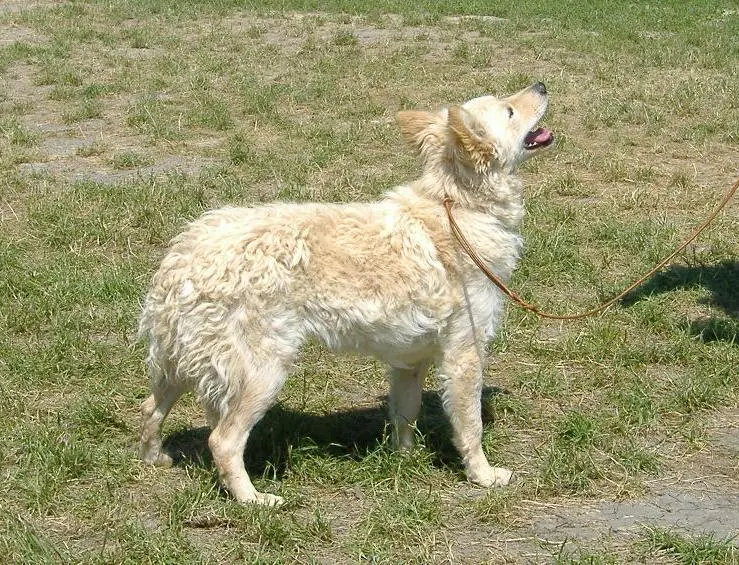
Mudi

Lively and quick to learn, barks readily.
Adult male
11–15 kg
24–33 lb
Adult female
8–12 kg
18–26 lb
Lifespan
12–14 yrs
Class · Working
also Sport, Watchdog

What it's like

The Mudi is a medium, roughly square dog with a wedge-shaped head, upright pointed ears and a keen expression. Its coat is short and smooth on the head and the fronts of the legs, and wavy or curly over the body. It comes in black, white, brown, ash, fawn and blue merle, and some puppies are born with a naturally short tail. In temperament it is lively, alert and quick to learn, close to its own people and reserved with strangers, and it barks readily, which makes it a watchful guard.

Day to day
Activity
Needs lots of exercise
Intelligence
Needs daily brain work
Handler demand
Needs an experienced owner
With people
Affection
Affectionate on its own terms
Loyalty
Sticks close to its people
Independence
Keen to work with you
Around the home
Sensitivity
Needs a calm, predictable home
Voice
Very vocal
Prey drive
Chases; needs managing
Breed explains only about 9% of how individual dogs differ in behaviour1. Meet the dog. A good breeder breeds for temperament as well as health, and matches each puppy's personality to the right home2,3.
Is a Mudi right for you?
Take the breed matcher

Living with one

It has a wavy coat. It sheds through the year rather than in big seasonal moults. Plan on brushing a few times a week. It needs plenty of exercise compared with other breeds.

Size and growth

A Mudi is a medium dog, heavier than a Pug and lighter than a Cocker Spaniel. Males end up clearly heavier than females. It is one of the lightest medium breeds.

Puppy growth

Reference curve · community data appears as owners log
By about 5 months, a male Mudi puppy is already as heavy as a grown Cavalier King Charles Spaniel. They grow fastest between 3 and 4 months old.
Fully grown
10 mo
Both sexes, at 99% of adult weight7
Male
Female
Shaded: expected range
0510152m4m6m9m12m18m
0510152m3m4m6m9m12m18m
Age
Male
Female
2 months
2.8–3.8 kg 6.2–8.4 lb
2.3–3.4 kg 5.1–7.5 lb
3 months
3.8–5.2 kg 8.4–11.5 lb
2.9–4.4 kg 6.4–9.7 lb
4 months
5.3–7.3 kg 11.7–16.1 lb
3.9–5.9 kg 8.6–13.0 lb
5 months
6.6–9.0 kg 14.6–19.8 lb
4.7–7.1 kg 10.4–15.7 lb
6 months
7.6–10.4 kg 16.8–22.9 lb
5.4–8.1 kg 11.9–17.9 lb
7 months
8.4–11.5 kg 18.5–25.4 lb
5.9–8.8 kg 13.0–19.4 lb
8 months
9.0–12.3 kg 19.8–27.1 lb
6.3–9.4 kg 13.9–20.7 lb
9 months
9.4–12.9 kg 20.7–28.4 lb
6.6–9.9 kg 14.6–21.8 lb
10 months
9.8–13.3 kg 21.6–29.3 lb
6.9–10.3 kg 15.2–22.7 lb
11 months
10.0–13.7 kg 22.0–30.2 lb
7.1–10.6 kg 15.7–23.4 lb
12 months
10.2–14.0 kg 22.5–30.9 lb
7.2–10.8 kg 15.9–23.8 lb
15 months
10.6–14.5 kg 23.4–32.0 lb
7.6–11.4 kg 16.8–25.1 lb
18 months
11–15 kg 24–33 lb
7.9–11.9 kg 17.4–26.2 lb

Lifespan

No vet study has measured how long Mudis live yet. The 12–14 years shown is a general figure without a published source.

Where it comes from

The Mudi is a Hungarian herding breed that formed over the 18th and 19th centuries, most probably when prick-eared German herding dogs were crossed into the local stock. Around 1930 Dr Dezső Fényes was among the first to breed it apart from the Puli and Pumi, and he gave it its name. The Second World War cost it heavily, and the 1966 standard was drawn from a handful of dogs4,8.

The Mudi came close to dying out after the Second World War and, though it survived, stayed scarce, even in Hungary, where many still work on farms. Interest abroad grew slowly from the late twentieth century, especially in Finland, and the American Kennel Club gave it full recognition only recently. It was bred as an all-round farm dog: it gathered and drove sheep and cattle, guarded the yard and caught rats and other vermin. That range of skills remains. In Finland the breed has been trained for search and rescue, and it also competes in agility, obedience and herding trials.

Breed standard

The Mudi is judged against standard no. 238, in group 1, Sheepdogs and Cattledogs4.

Questions people ask

General guidance for dogs rather than a measured Mudi figure: most females have a first season somewhere between six and fifteen months, and cycles then settle to roughly every 180 days. Smaller breeds tend to start earlier and larger ones later, so a medium-sized breed is most likely somewhere in the middle.
Track your own Mudi
Log a minute a day and watch them sit on these curves. Free.

Sources

Uncited on this page: Lifespan — no reviewed source yet, so it is a general reference figure rather than a published one.
Something wrong on this page?
Parts of this page were written by AI ·