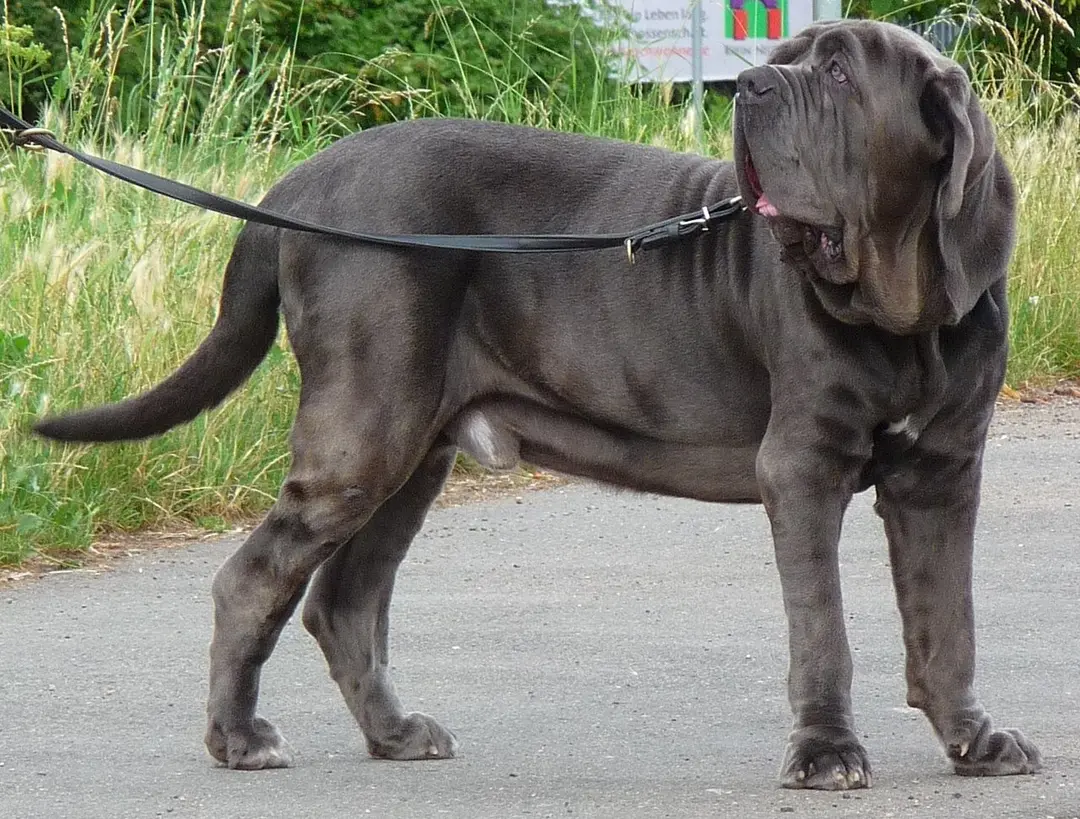
Neapolitan Mastiff

Calm with family, quiet unless provoked.
Adult male
60–70 kg
132–154 lb
Adult female
50–60 kg
110–132 lb
Lifespan
9.3 yrs
Class · Watchdog

What it's like

In temperament the breed is calm and steady with its own family, loyal and dignified, and watchful and reserved with strangers. It is protective by nature and tends to stay quiet unless provoked. Neapolitan Mastiffs played Fang, Hagrid's boarhound, in the Harry Potter films.

Day to day
Activity
Happy with modest walks
Intelligence
Easy-going, simple routines
Handler demand
Needs an experienced owner
With people
Affection
Affectionate on its own terms
Loyalty
Sticks close to its people
Independence
Decides for itself
Around the home
Sensitivity
Average
Voice
Quiet
Prey drive
Chases; needs managing
Breed explains only about 9% of how individual dogs differ in behaviour1. Meet the dog. A good breeder breeds for temperament as well as health, and matches each puppy's personality to the right home2,3.
Is a Neapolitan Mastiff right for you?
Take the breed matcher

Living with one

It has a short coat. It sheds through the year rather than in big seasonal moults. Plan on a brush once a week. It needs a moderate amount of exercise compared with other breeds.

Size and growth

A Neapolitan Mastiff is a giant dog, about the weight of a grown Great Dane. Males end up clearly heavier than females.

The dog is massive and heavy-boned, with a body longer than it is tall and a broad head covered in deep folds and wrinkles. A heavy dewlap hangs beneath the jaw. The coat is short, dense and smooth, usually grey, black, mahogany or tawny, sometimes with brindling. Its gait is slow and rolling, often compared to the walk of a bear.

Puppy growth

Reference curve · community data appears as owners log
By about 5 months, a male Neapolitan Mastiff puppy is already as heavy as a grown Labrador. They grow fastest between 4 and 5 months old. They keep growing past their first birthday, longer than a Beagle does. Most males grow into the size large-breed puppy foods are made for.
Fully grown
13 mo
Both sexes, at 99% of adult weight5
Male
Female
Shaded: expected range
0204060802m4m6m9m12m18m
0204060802m3m4m6m9m12m18m
Age
Male
Female
2 months
10.5–12.2 kg 23.1–26.9 lb
8.7–10.5 kg 19.2–23.1 lb
3 months
16.8–19.6 kg 37.0–43.2 lb
14.0–16.8 kg 30.9–37.0 lb
4 months
24.9–29.0 kg 54.9–63.9 lb
20.8–24.9 kg 45.9–54.9 lb
5 months
33.8–39.4 kg 74.5–86.9 lb
28.1–33.8 kg 61.9–74.5 lb
6 months
41.9–48.9 kg 92.4–107.8 lb
34.9–41.9 kg 76.9–92.4 lb
7 months
48.2–56.3 kg 106.3–124.1 lb
40.2–48.2 kg 88.6–106.3 lb
8 months
52.7–61.5 kg 116.2–135.6 lb
43.9–52.7 kg 96.8–116.2 lb
9 months
55.6–64.8 kg 122.6–142.9 lb
46.3–55.6 kg 102.1–122.6 lb
10 months
57.4–66.9 kg 126.5–147.5 lb
47.8–57.4 kg 105.4–126.5 lb
11 months
58.4–68.2 kg 128.7–150.4 lb
48.7–58.4 kg 107.4–128.7 lb
12 months
59.1–69.0 kg 130.3–152.1 lb
49.3–59.1 kg 108.7–130.3 lb
15 months
59.8–69.8 kg 131.8–153.9 lb
49.8–59.8 kg 109.8–131.8 lb
18 months
59.9–69.9 kg 132.1–154.1 lb
50.0–59.9 kg 110.2–132.1 lb

Health and lifespan

In UK vet records, the conditions below turn up more often in Neapolitan Mastiffs than in crossbreeds. All of them are far more likely. None of them is rated serious. These are figures for the breed as a whole, not a prediction for your dog.
Listed by likelihood level, highest first, then by how serious it is, then by name.
  • Cherry eye
    Far more likely
    Impact: moderate
  • Inward-rolling eyelid
    Far more likely
    Impact: moderate
  • Outward-drooping eyelid
    Far more likely
    Impact: minor

Flat face and breathing

The Neapolitan Mastiff is one of the flat-faced breeds. In UK vet records, flat-faced dogs were more likely to have breathing and airway problems than dogs with a medium-length muzzle, and lived shorter lives on average. Noisy breathing at rest is worth raising with a vet.

Lifespan

In UK vet records, the typical Neapolitan Mastiff lived to about 9 and a half years, shorter than the typical giant breed.

Where it comes from

The Neapolitan Mastiff is thought to descend from the Roman mastiff that Columella described in the first century AD, and it survived for centuries in the countryside around Naples and Vesuvius. Revived after the Second World War, it was first shown in Naples in 1946; Piero Scanziani's kennel and breeding plan set out to stabilise it, and breeders now aim to temper its loose skin4,11.

The Neapolitan Mastiff, known in Italy as the Mastino Napoletano, was for generations a working dog of Campanian farms and country estates rather than a show animal. After its post-war revival the breed received a written standard and was recognised by the Fédération Cynologique Internationale in the mid-twentieth century, later spreading to Britain and North America. Stories of its forebears fighting in Roman arenas and on battlefields are often told, but they belong to tradition rather than firm record. It was bred as a guard of property, livestock and households, deterring intruders largely through its size and appearance.

Breed standard

The Neapolitan Mastiff is judged against standard no. 197, in group 2, Pinscher and Schnauzer, Molossoid and Swiss Mountain Dogs4.

Questions people ask

General guidance for dogs rather than a measured Neapolitan Mastiff figure: most females have a first season somewhere between six and fifteen months, and cycles then settle to roughly every 180 days. Smaller breeds tend to start earlier and larger ones later, so a giant breed is most likely at the late end.
Track your own Neapolitan Mastiff
Log a minute a day and watch them sit on these curves. Free.

Sources

Something wrong on this page?
Parts of this page were written by AI ·