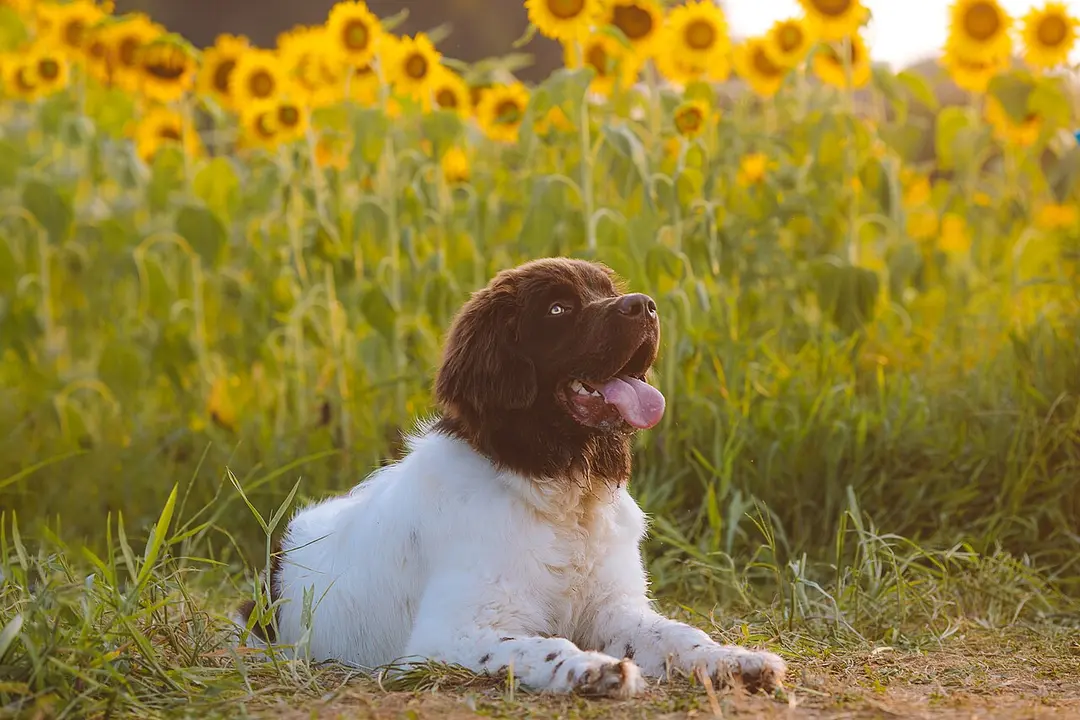
Newfoundland

Sweet, patient, and known for kindness to children.
Adult male
59–68 kg
130–150 lb
Adult female
45–54 kg
100–120 lb
Lifespan
11 yrs
Class · Family
also Companion, Working

What it's like

In temperament the Newfoundland is sweet, patient and devoted, with a calm, gentle manner and a long-standing reputation for kindness to children. A Newfoundland named Seaman travelled with the Lewis and Clark expedition to the Pacific coast and back in the early nineteenth century, and Nana, the nursemaid dog in J. M. Barrie's Peter Pan, is a Newfoundland.

Day to day
Activity
Happy with modest walks
Intelligence
Learns readily, likes games
Handler demand
Needs steady training
With people
Affection
A lap or leaning dog
Loyalty
Friendly with everyone
Independence
Cooperative, with its own ideas
Around the home
Sensitivity
Average
Voice
Quiet
Prey drive
Usually fine with small pets
Breed explains only about 9% of how individual dogs differ in behaviour1. Meet the dog. A good breeder breeds for temperament as well as health, and matches each puppy's personality to the right home2,3.
Is a Newfoundland right for you?
Take the breed matcher

Living with one

It has a long coat. Most of the shedding comes when the seasons change. Plan on daily brushing. It needs a moderate amount of exercise compared with other breeds.

Size and growth

A Newfoundland is a giant dog, heavier than a Rottweiler and lighter than a Great Dane. Males end up clearly heavier than females.

It is a massive, heavy-boned dog with a broad head, small deep-set eyes and a soft expression. Its flat double coat is dense and oily enough to shed water, and its feet are webbed, both suited to swimming in cold seas. The colours accepted in Britain are black, brown, and white with black markings.

Puppy growth

Reference curve · community data appears as owners log
By about 5 months, a male Newfoundland puppy is already as heavy as a grown German Shepherd. They grow fastest between 4 and 5 months old. The chart follows Newfoundlands themselves, not a general size band. Most males grow into the size large-breed puppy foods are made for.
Fully grown
11 mo
Both sexes, at 99% of adult weight6
Male
Female
Shaded: expected range
0204060802m4m6m9m12m18m
0204060802m3m4m6m9m12m18m
Age
Male
Female
2 months
9.6–11.1 kg 21.2–24.5 lb
7.4–8.9 kg 16.3–19.6 lb
3 months
16.9–19.5 kg 37.3–43.0 lb
13.0–15.6 kg 28.7–34.4 lb
4 months
26.8–30.9 kg 59.1–68.1 lb
20.6–24.7 kg 45.4–54.5 lb
5 months
37.3–43.0 kg 82.2–94.8 lb
28.7–34.4 kg 63.3–75.8 lb
6 months
46.0–53.1 kg 101.4–117.1 lb
35.4–42.4 kg 78.0–93.5 lb
7 months
51.9–59.8 kg 114.4–131.8 lb
40.0–47.9 kg 88.2–105.6 lb
8 months
55.4–63.8 kg 122.1–140.7 lb
42.6–51.0 kg 93.9–112.4 lb
9 months
57.2–65.9 kg 126.1–145.3 lb
44.0–52.7 kg 97.0–116.2 lb
10 months
58.1–67.0 kg 128.1–147.7 lb
44.7–53.6 kg 98.5–118.2 lb
11 months
58.6–67.5 kg 129.2–148.8 lb
45.1–54.0 kg 99.4–119.0 lb
12 months
58.8–67.8 kg 129.6–149.5 lb
45.2–54.2 kg 99.6–119.5 lb

Health and lifespan

In UK vet and lab records, the conditions below turn up more often in Newfoundlands than in crossbreeds. Inward-rolling eyelid and outward-drooping eyelid stand out as far more likely. The most serious, mouth melanoma, can shorten a life and is much more likely. These are figures for the breed as a whole, not a prediction for your dog.
Listed by likelihood level, highest first, then by how serious it is, then by name.
  • Inward-rolling eyelid
    Far more likely
    Impact: moderate
  • Outward-drooping eyelid
    Far more likely
    Impact: minor
  • Mouth melanoma
    Lab-confirmed cases
    Much more likely
    Impact: life-limiting
  • Cherry eye
    Much more likely
    Impact: moderate
Lab-confirmed: compares dogs whose tumour samples went to a lab with dogs seen in general practice, so the figures run higher than vet-record ones.

Lifespan

In UK vet records, the typical Newfoundland lived to about 11 years, longer than the typical giant breed.

Where it comes from

The Newfoundland comes from the island it is named for, where it worked as a ships' dog, carrying ropes ashore and pulling people out of the water. The breed as it is known today grew from dogs taken to England in the early 1800s, and the painter Edwin Landseer gave his name to its white-and-black variety, which some countries treat as a separate breed13.

The Newfoundland's deeper ancestry is uncertain. It is generally thought to descend from dogs brought to the island by European fishermen and settlers, though which types contributed, and in what measure, is debated. On the island, besides working at sea, the dogs are said to have hauled nets for fishermen, and they hauled firewood on carts and sledges. By the early nineteenth century they were already fashionable in England: Lord Byron's Newfoundland, Boatswain, lies beneath a verse epitaph at Newstead Abbey. English breeders went on to standardise the type over the following decades.

Breed standard

The Newfoundland is judged against standard no. 50, in group 2, Pinscher and Schnauzer, Molossoid and Swiss Mountain Dogs4.

Questions people ask

General guidance for dogs rather than a measured Newfoundland figure: most females have a first season somewhere between six and fifteen months, and cycles then settle to roughly every 180 days. Smaller breeds tend to start earlier and larger ones later, so a giant breed is most likely at the late end.
Track your own Newfoundland
Log a minute a day and watch them sit on these curves. Free.

Sources

Something wrong on this page?
Parts of this page were written by AI ·