Norwegian Elkhound
What it's like
Friendly, bold and dependable, the Elkhound is confident with people and independent at work, where it was expected to make its own decisions out of the hunter's sight. It is a vocal breed and quick to bark, and it keeps the stamina of a dog bred for long days in rough northern forest.
Living with one
Size and growth
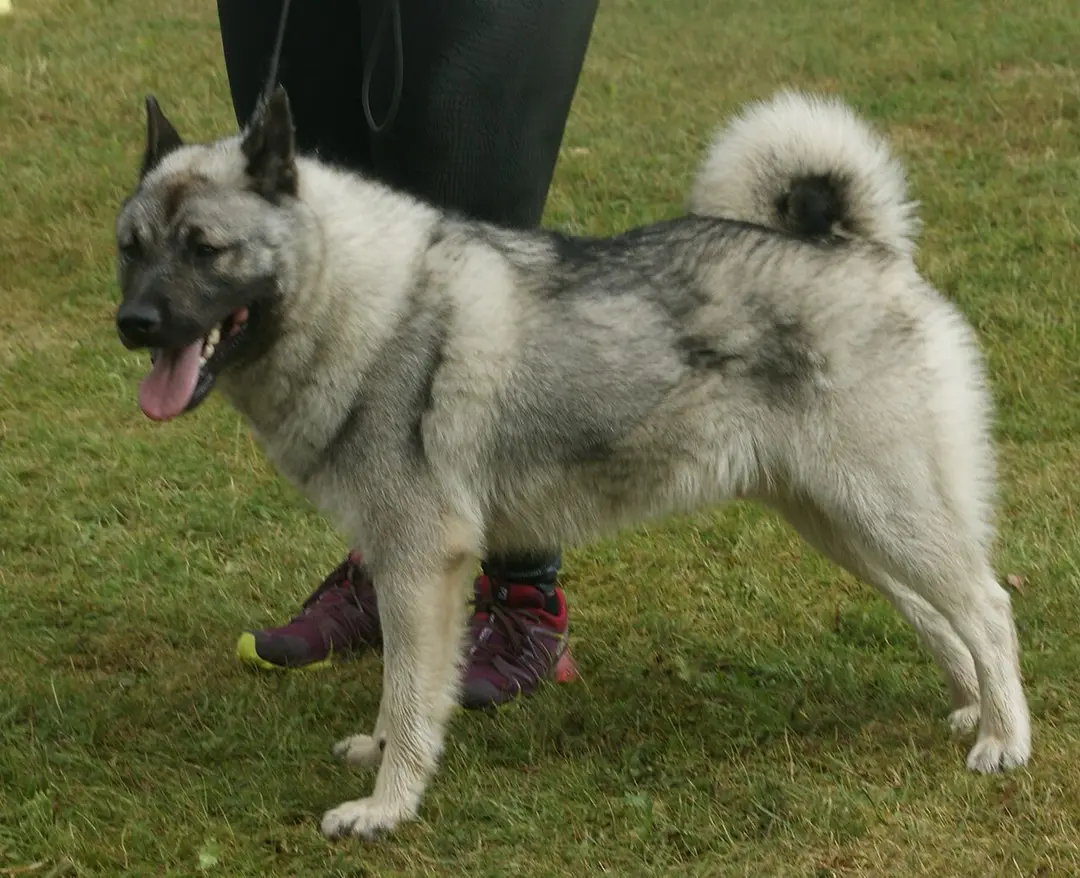
It is a compact, square-built spitz with a broad, wedge-shaped head, small pointed ears held upright and a thick tail curled tightly over the back. The dense double coat is grey, with black tips to the longer outer hairs, a paler undercoat and legs, and a darker muzzle and ears.
Puppy growth
Lifespan
Where it comes from
The Norwegian Elkhound took its modern shape in the late nineteenth century, when Norwegian hunters began recording pedigrees and showing their dogs, and a written standard soon followed. In Norway it is called the Norsk elghund grå, the grey elk dog, which distinguishes it from the smaller black elkhound, a separate breed. In the field it usually works off the lead, ranging well ahead of the hunter and barking steadily once it has an elk standing, while keeping clear of hooves and antlers. On farms it also served as a watchdog and general-purpose dog.
Breed standard
Questions people ask
Compare with related
Sources
- 1Morrill et al., 2022. Ancestry-inclusive dog genomics challenges popular breed stereotypes. Science 376: eabk0639 (Darwin's Ark). ↑
- 2Dogs Trust. Finding a good, responsible breeder. ↑
- 3American Kennel Club. Screening puppy buyers: how top breeders find the best homes. ↑
- 4
- 5
- 6Hawthorne et al., 2004. Body-weight changes during growth in puppies of different breeds. Journal of Nutrition 134(8 Suppl): 2027S–2030S (WALTHAM). ↑
- 7
- 8The Kennel Club. Norwegian Elkhound. ↑
- 9American Kennel Club. Norwegian Elkhound breed history. ↑