Norwegian Lundehund
What it's like
In temperament the Lundehund is alert, lively and attached to its household, but often reserved with strangers and independent in outlook. It is a quick, agile climber and remains a rare breed outside Norway.
Living with one
Size and growth
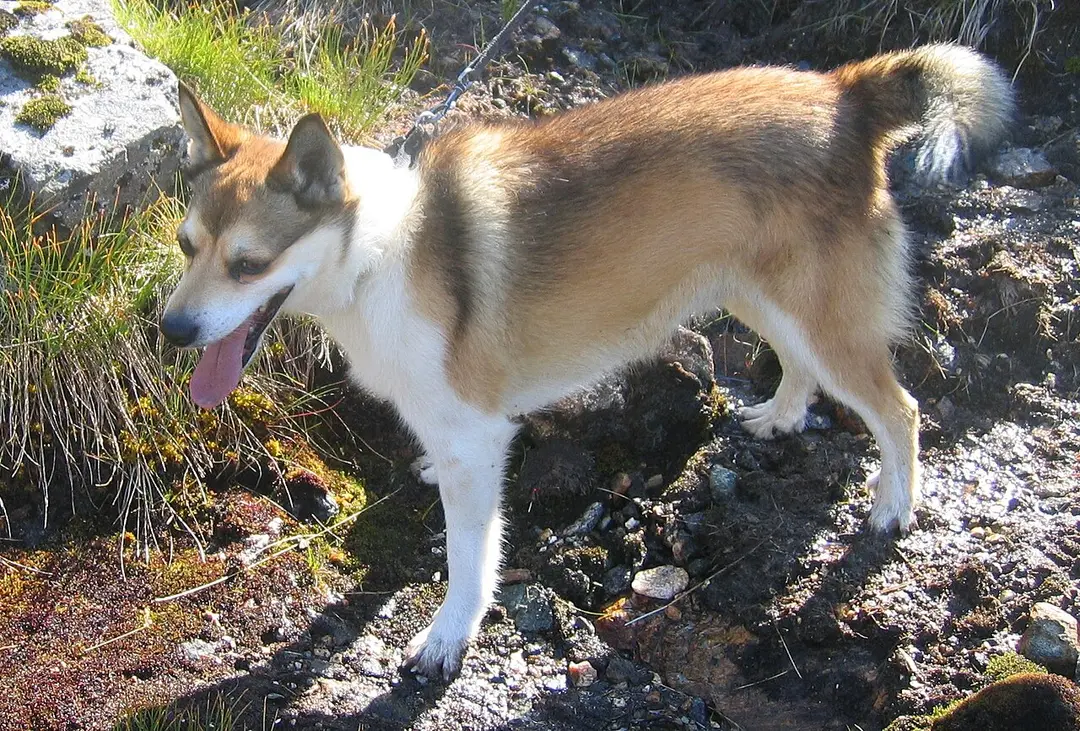
It is a small, rectangular spitz with a wedge-shaped head, upright triangular ears and a tail carried in a loose curl over the back or hanging low. The coat is dense and rough over a soft undercoat. It is usually fallow to reddish-brown with black-tipped hairs and white markings. Its joints allow unusual movements: it can tip its head back until the crown nearly touches its spine and stretch its forelegs out flat to the sides. Its ears can fold shut, which is often said to keep out water and dirt.
Puppy growth
Lifespan
Where it comes from
The Norwegian Lundehund lost its purpose when islanders began catching puffins with nets, and later when puffin hunting was restricted. With no work left for it, the dog dwindled until it survived mainly around the small settlement of Måstad on Værøy. Norwegian enthusiasts began an organised breeding effort in the twentieth century, and today's dogs descend from the few that remained after distemper outbreaks.
Breed standard
Questions people ask
Compare with related
Sources
- 1Morrill et al., 2022. Ancestry-inclusive dog genomics challenges popular breed stereotypes. Science 376: eabk0639 (Darwin's Ark). ↑
- 2Dogs Trust. Finding a good, responsible breeder. ↑
- 3American Kennel Club. Screening puppy buyers: how top breeders find the best homes. ↑
- 4
- 5American Kennel Club. Norwegian Lundehund breed page. ↑
- 6
- 7Hawthorne et al., 2004. Body-weight changes during growth in puppies of different breeds. Journal of Nutrition 134(8 Suppl): 2027S–2030S (WALTHAM). ↑
- 8Stronen et al. 2017. PLOS One. ↑
- 9American Kennel Club. Norwegian Lundehund breed history. ↑