Nova Scotia Duck Tolling Retriever
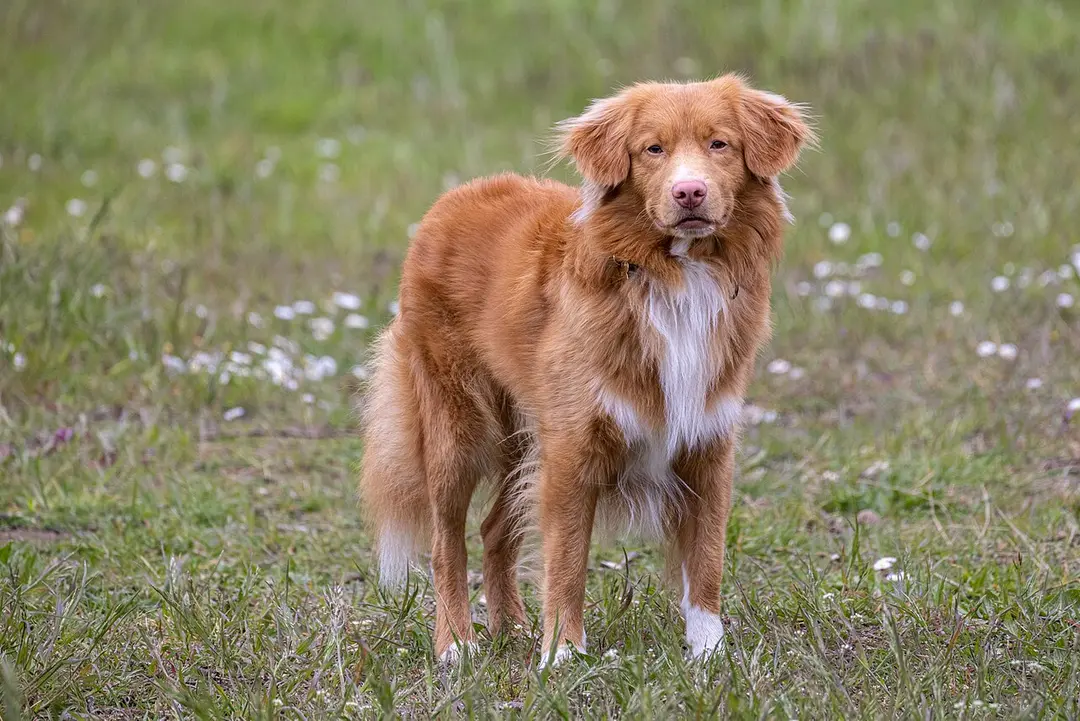
Can seem subdued at rest, but comes alive for play.
Adult male
20–23 kg
44–51 lb
Adult female
17–20 kg
37–44 lb
Lifespan
13.2 yrs
Class · Sport
also Field, Family

What it's like

Tollers are alert, energetic and quick to learn, affectionate with their own people and sometimes reserved with strangers. They may seem subdued at rest but come alive quickly when work or play begins. Many make a distinctive high-pitched cry, known as the Toller scream, when excited.

Day to day
Activity
Needs lots of exercise
Intelligence
Needs daily brain work
Handler demand
Needs steady training
With people
Affection
Affectionate on its own terms
Loyalty
Bonded to its family
Independence
Keen to work with you
Around the home
Sensitivity
Average
Voice
Very vocal
Prey drive
Chases; needs managing
Breed explains only about 9% of how individual dogs differ in behaviour1. Meet the dog. A good breeder breeds for temperament as well as health, and matches each puppy's personality to the right home2,3.
Is a Nova Scotia Duck Tolling Retriever right for you?
Take the breed matcher

Living with one

It has a coat of medium length. Most of the shedding comes when the seasons change. Plan on brushing a few times a week, plus daily brushing through the seasonal moult. It needs plenty of exercise compared with other breeds.

Size and growth

A Nova Scotia Duck Tolling Retriever is a medium dog, heavier than a Border Collie and lighter than a Golden Retriever. Males end up clearly heavier than females.

Small for a retriever, it is compact, muscular and powerful, with a slightly wedge-shaped head. The double coat is water-repellent and of medium length, in shades of red or orange, usually with white on the chest, feet, tail tip or face, and the tail is well feathered.

Puppy growth

Reference curve · community data appears as owners log
By about 3 months, a male Nova Scotia Duck Tolling Retriever puppy is already as heavy as a grown Cavalier King Charles Spaniel. They grow fastest between 3 and 4 months old.
Fully grown
11 mo
Both sexes, at 99% of adult weight6
Male
Female
Shaded: expected range
01020302m4m6m9m12m18m
01020302m3m4m6m9m12m18m
Age
Male
Female
2 months
4.4–5.0 kg 9.7–11.0 lb
4.1–4.8 kg 9.0–10.6 lb
3 months
6.4–7.4 kg 14.1–16.3 lb
5.8–6.8 kg 12.8–15.0 lb
4 months
9.3–10.7 kg 20.5–23.6 lb
8.3–9.7 kg 18.3–21.4 lb
5 months
12.0–13.8 kg 26.5–30.4 lb
10.5–12.3 kg 23.1–27.1 lb
6 months
14.3–16.4 kg 31.5–36.2 lb
12.3–14.4 kg 27.1–31.7 lb
7 months
16.0–18.4 kg 35.3–40.6 lb
13.6–16.0 kg 30.0–35.3 lb
8 months
17.3–19.8 kg 38.1–43.7 lb
14.5–17.1 kg 32.0–37.7 lb
9 months
18.1–20.8 kg 39.9–45.9 lb
15.2–17.9 kg 33.5–39.5 lb
10 months
18.7–21.5 kg 41.2–47.4 lb
15.7–18.5 kg 34.6–40.8 lb
11 months
19.1–22.0 kg 42.1–48.5 lb
16.0–18.9 kg 35.3–41.7 lb
12 months
19.4–22.3 kg 42.8–49.2 lb
16.3–19.1 kg 35.9–42.1 lb
15 months
19.9–22.9 kg 43.9–50.5 lb
16.8–19.7 kg 37.0–43.4 lb

Lifespan

In UK vet records, the typical Nova Scotia Duck Tolling Retriever lived to about 13 years, about average for a medium breed. Too few had died yet to pin the figure down, so it may turn out higher.

Where it comes from

The Nova Scotia Duck Tolling Retriever comes from Little River Harbour in Yarmouth County, Nova Scotia, where it was bred in the early 1800s to lure ducks within range and retrieve them. Like a fox, it plays on the shore as a hidden hunter throws sticks, drawing curious ducks closer. First called the Little River duck dog, it was renamed when the Canadian Kennel Club recognised it in 19454,8.

The Nova Scotia Duck Tolling Retriever's ancestry is not fully known. It is usually said to combine retrievers, spaniels and setters, perhaps with some farm collie, and a link to decoy dogs brought over by European settlers is sometimes suggested rather than proven. For much of the twentieth century it remained a local working dog, little seen outside the Maritimes. Wider attention came later, and in the nineteen-nineties it was named the provincial dog of Nova Scotia. Its work is unusual among retrievers: it lures ducks within gunshot range and then retrieves the shot birds, and its brisk, bouncing play and waving plumed tail are central to tolling.

Breed standard

The Nova Scotia Duck Tolling Retriever is judged against standard no. 312, in group 8, Retrievers, Flushing Dogs and Water Dogs4.

Questions people ask

General guidance for dogs rather than a measured Nova Scotia Duck Tolling Retriever figure: most females have a first season somewhere between six and fifteen months, and cycles then settle to roughly every 180 days. Smaller breeds tend to start earlier and larger ones later, so a medium-sized breed is most likely somewhere in the middle.
Track your own Nova Scotia Duck Tolling Retriever
Log a minute a day and watch them sit on these curves. Free.

Sources

Something wrong on this page?
Parts of this page were written by AI ·