Old English Sheepdog
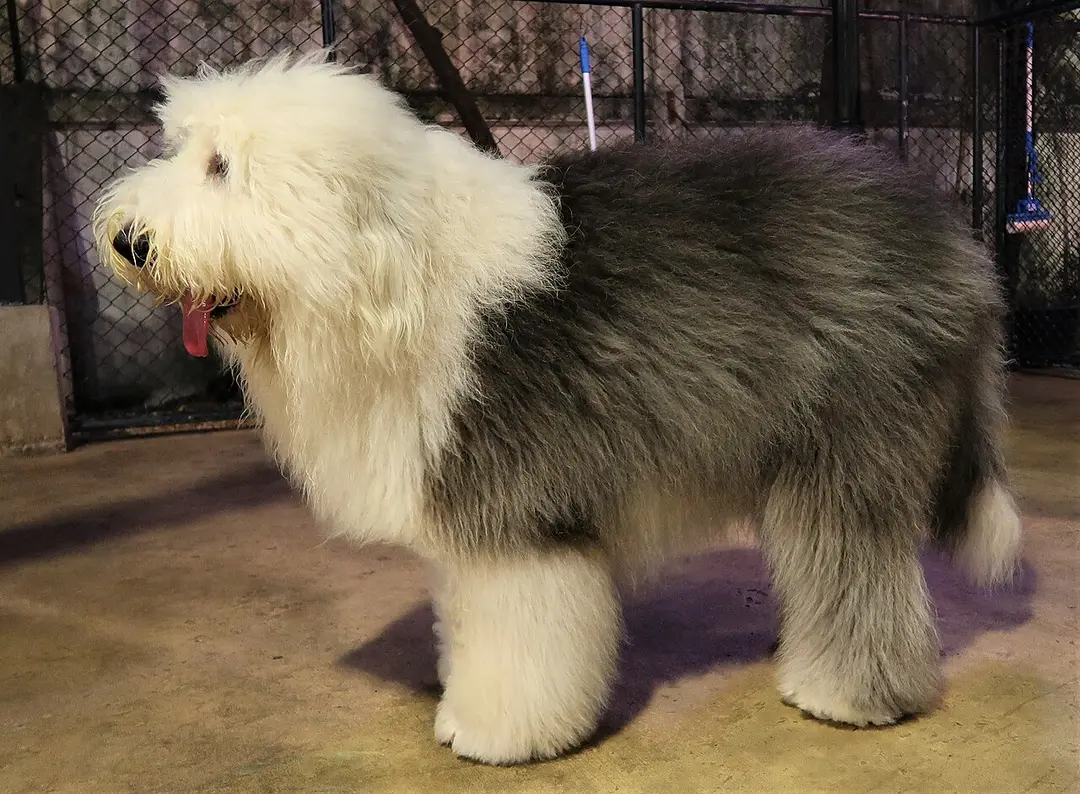
Steady and playful, with a clownish streak.
Adult weight
27–45 kg
60–100 lb
Lifespan
12.1 yrs
Class · Family
also Companion

What it's like

The breed is steady, good-natured and playful, with a clownish streak, and some try to herd the people around them. In Britain it became widely familiar through decades of paint advertising. Paul McCartney's Old English Sheepdog, Martha, gave her name to a Beatles song.

Day to day
Activity
A good daily walk and play
Intelligence
Learns readily, likes games
Handler demand
Needs steady training
With people
Affection
A lap or leaning dog
Loyalty
Bonded to its family
Independence
Cooperative, with its own ideas
Around the home
Sensitivity
Hardy, takes a busy home in its stride
Voice
Very vocal
Prey drive
Usually fine with small pets
Breed explains only about 9% of how individual dogs differ in behaviour1. Meet the dog. A good breeder breeds for temperament as well as health, and matches each puppy's personality to the right home2,3.
Is an Old English Sheepdog right for you?
Take the breed matcher

Living with one

It has a double coat, an outer coat over an undercoat. Most of the shedding comes when the seasons change. Plan on a brush once a week, plus daily brushing through the seasonal moult. It needs plenty of exercise compared with other breeds.

Size and growth

An Old English Sheepdog is a large dog, about the weight of a grown German Shepherd.

It is a thickset, square-built dog whose topline rises from shoulder to loin, so the rump stands higher than the withers. The profuse, shaggy coat is hard-textured over a dense undercoat. It is usually grey, grizzle or blue with white on the head, chest and forelegs, and hair often falls over the eyes. Puppies are born black and white, and the dark areas lighten as they grow. At a walk it moves with a rolling, bear-like amble, and the British standard describes a loud bark with a distinctive cracked ring.

Puppy growth

Reference curve · community data appears as owners log
By about 5 months, a male Old English Sheepdog puppy is already as heavy as a grown Border Collie. They grow fastest between 3 and 4 months old. Most males grow into the size large-breed puppy foods are made for.
Fully grown
12 mo
Both sexes, at 99% of adult weight8
Male
Female
Shaded: expected range
02040602m4m6m9m12m18m
02040602m3m4m6m9m12m18m
Age
Male
Female
2 months
5.7–9.5 kg 12.6–20.9 lb
6.3–10.4 kg 13.9–22.9 lb
3 months
8.6–14.3 kg 19.0–31.5 lb
9.0–15.1 kg 19.8–33.3 lb
4 months
12.7–21.2 kg 28.0–46.7 lb
13.1–21.9 kg 28.9–48.3 lb
5 months
16.3–27.2 kg 35.9–60.0 lb
16.7–27.8 kg 36.8–61.3 lb
6 months
19.4–32.5 kg 42.8–71.7 lb
19.6–32.7 kg 43.2–72.1 lb
7 months
22.0–36.6 kg 48.5–80.7 lb
21.7–36.3 kg 47.8–80.0 lb
8 months
23.8–39.7 kg 52.5–87.5 lb
23.2–38.8 kg 51.1–85.5 lb
9 months
25.0–41.7 kg 55.1–91.9 lb
24.3–40.6 kg 53.6–89.5 lb
10 months
25.8–43.0 kg 56.9–94.8 lb
25.1–41.9 kg 55.3–92.4 lb
11 months
26.2–43.7 kg 57.8–96.3 lb
25.6–42.8 kg 56.4–94.4 lb
12 months
26.5–44.2 kg 58.4–97.4 lb
26.1–43.5 kg 57.5–95.9 lb
15 months
26.9–44.9 kg 59.3–99.0 lb
26.8–44.7 kg 59.1–98.5 lb

Health and lifespan

In vet and lab records from the UK and North America, the conditions below turn up more often in Old English Sheepdogs than in crossbreeds. Bone cancer stands out as much more likely. The most serious are bone cancer (much more likely) and lymph node cancer (more likely), and both can shorten a life. These are figures for the breed as a whole, not a prediction for your dog.
Listed by likelihood level, highest first, then by how serious it is, then by name.
  • Bone cancer
    Lab-confirmed cases
    Much more likely
    Impact: life-limiting
  • Lymph node cancer
    More likely
    Impact: life-limiting
  • Joint wear-and-tear arthritis in the limbs
    More likely
    Impact: serious
Lab-confirmed: compares dogs whose tumour samples went to a lab with dogs seen in general practice, so the figures run higher than vet-record ones.

Lifespan

In UK vet records, the typical Old English Sheepdog lived to about 12 years, about average for a large breed.

Where it comes from

The Old English Sheepdog is thought to have begun as a drover's dog of England's south-west in the early 1800s, moving sheep and cattle to market, with Owtcharka- and Bergamasco-type sheepdogs from Europe possibly among its ancestors. Its American club passes on the theory that drovers docked their dogs' tails to prove they were tax-exempt workers, the likely source of the nickname Bobtail4,13.

The Old English Sheepdog, often linked to the West Country though its origins are obscure, moved into the show ring in the later nineteenth century, when dogs of the type were first exhibited and a breed club was formed in England. Fanciers in Britain worked to fix a more uniform appearance, and the breed's working role with drovers gradually gave way to life as a show dog and companion.

Breed standard

The Old English Sheepdog is judged against standard no. 16, in group 1, Sheepdogs and Cattledogs4.

Questions people ask

General guidance for dogs rather than a measured Old English Sheepdog figure: most females have a first season somewhere between six and fifteen months, and cycles then settle to roughly every 180 days. Smaller breeds tend to start earlier and larger ones later, so a large breed is most likely at the later end.
Track your own Old English Sheepdog
Log a minute a day and watch them sit on these curves. Free.

Sources

Something wrong on this page?
Parts of this page were written by AI ·