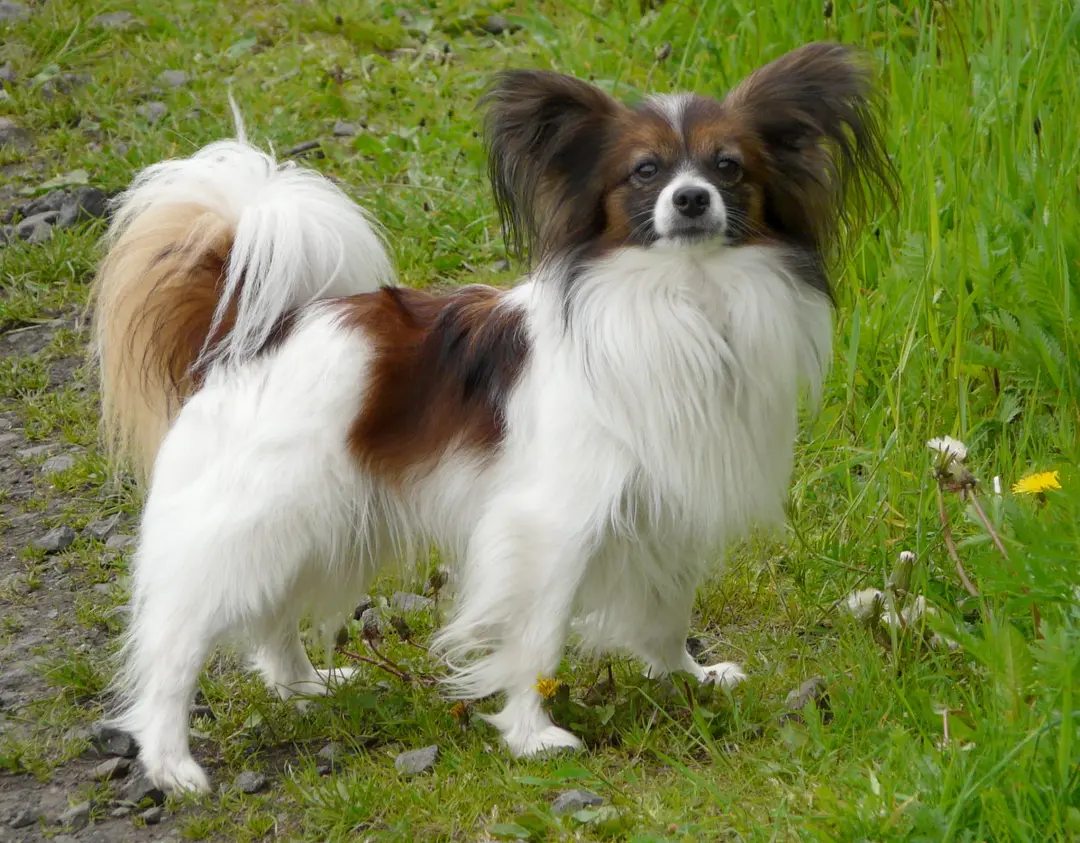
Papillon

Lively and friendly, sturdier and busier than it looks.
Adult male
1.5–4.5 kg
3.3–9.9 lb
Adult female
1.5–5 kg
3.3–11 lb
Lifespan
14.5 yrs
Handler demand
Suits a first-time owner
Class · Lap dog
also Sport, Companion

What it's like

In temperament it is lively, alert and friendly, and sturdier and more energetic than its delicate look suggests. It learns quickly, and it has done well in obedience and agility competitions.

Day to day
Activity
A good daily walk and play
Intelligence
Needs daily brain work
Handler demand
Suits a first-time owner
With people
Affection
A lap or leaning dog
Loyalty
Sticks close to its people
Independence
Keen to work with you
Around the home
Sensitivity
Average
Voice
Barks to alert, then settles
Prey drive
Chases; needs managing
Breed explains only about 9% of how individual dogs differ in behaviour1. Meet the dog. A good breeder breeds for temperament as well as health, and matches each puppy's personality to the right home2,3.
Is a Papillon right for you?
Take the breed matcher

Living with one

It has a coat of medium length. It sheds through the year rather than in big seasonal moults. Plan on brushing a few times a week. It needs a modest amount of exercise compared with other breeds.

Size and growth

A Papillon is a toy dog, heavier than a Chihuahua and lighter than a Yorkshire Terrier. Females run heavier than males.

Bred as a companion, the Papillon is a small, fine-boned dog, slightly longer than tall, with a dainty muzzle and large, heavily fringed ears. Its single coat, without an undercoat, is long, straight and silky, forming a frill at the chest and a plumed tail carried arched over the back; that tail is said to have earned it the old name squirrel spaniel. The coat is white with patches of colour, ideally with a white blaze dividing the face.

Varieties

FCI 77 divides this breed by weight. Pick the variety your dog is for a band that fits.
Variety
Weight
Height
Small
1.5–2.5 kg4
Standard
M 2.5–4.5 kg · F 2.5–5 kg4

Puppy growth

Reference curve · community data appears as owners log
Papillons grow fastest between 2 and 3 months old. The chart follows Papillons themselves, not a general size band.
Fully grown
10 mo
Both sexes, at 99% of adult weight6
Male
Female
Shaded: expected range
02462m4m6m9m12m18m
02462m3m4m6m9m12m18m
Age
Male
Female
2 months
0.6–1.8 kg 1.3–4.0 lb
0.6–2.1 kg 1.3–4.6 lb
3 months
0.9–2.6 kg 2.0–5.7 lb
0.9–2.9 kg 2.0–6.4 lb
4 months
1.1–3.2 kg 2.4–7.1 lb
1.1–3.6 kg 2.4–7.9 lb
5 months
1.2–3.7 kg 2.6–8.2 lb
1.2–4.2 kg 2.6–9.3 lb
6 months
1.4–4.1 kg 3.1–9.0 lb
1.4–4.5 kg 3.1–9.9 lb
7 months
1.4–4.3 kg 3.1–9.5 lb
1.4–4.7 kg 3.1–10.4 lb
8 months
1.5–4.4 kg 3.3–9.7 lb
1.5–4.9 kg 3.3–10.8 lb
9 months
1.5–4.4 kg 3.3–9.7 lb
1.5–4.9 kg 3.3–10.8 lb
10 months
1.5–4.5 kg 3.3–9.9 lb
1.5–5 kg 3.3–11 lb
11 months
1.5–4.5 kg 3.3–9.9 lb
1.5–5 kg 3.3–11 lb
12 months
1.5–4.5 kg 3.3–9.9 lb
1.5–5 kg 3.3–11 lb

Lifespan

In UK vet records, the typical Papillon lived to about 14 and a half years, longer than the typical toy breed.

Where it comes from

The Papillon and the drop-eared Phalène are two varieties of one French and Belgian toy spaniel, known on the Continent as the dwarf spaniel. It was a lapdog of Europe's royal courts, kept by Madame de Pompadour and Marie Antoinette. Its name, French for butterfly, comes from the fringed, open ears; the Phalène's hanging ears recall a moth's folded wings4,8.

The Papillon's long history as a court companion is recorded largely in art. Dwarf spaniels resembling it appear in paintings by Titian, Rubens and later Fragonard, and for centuries the drop-eared form was the usual one. During the nineteenth century the erect-eared type became more fashionable, and breeders in France and Belgium settled it into the dog known today. Both ear types can still turn up in the same litter, and in Britain they are shown as one breed.

Breed standard

One registry divides it into two varieties by weight, each with its own weight range.

Questions people ask

General guidance for dogs rather than a measured Papillon figure: most females have a first season somewhere between six and fifteen months, and cycles then settle to roughly every 180 days. Smaller breeds tend to start earlier and larger ones later, so a toy breed is most likely at the early end.
Track your own Papillon
Log a minute a day and watch them sit on these curves. Free.

Sources

Something wrong on this page?
Parts of this page were written by AI ·