Parson Russell Terrier
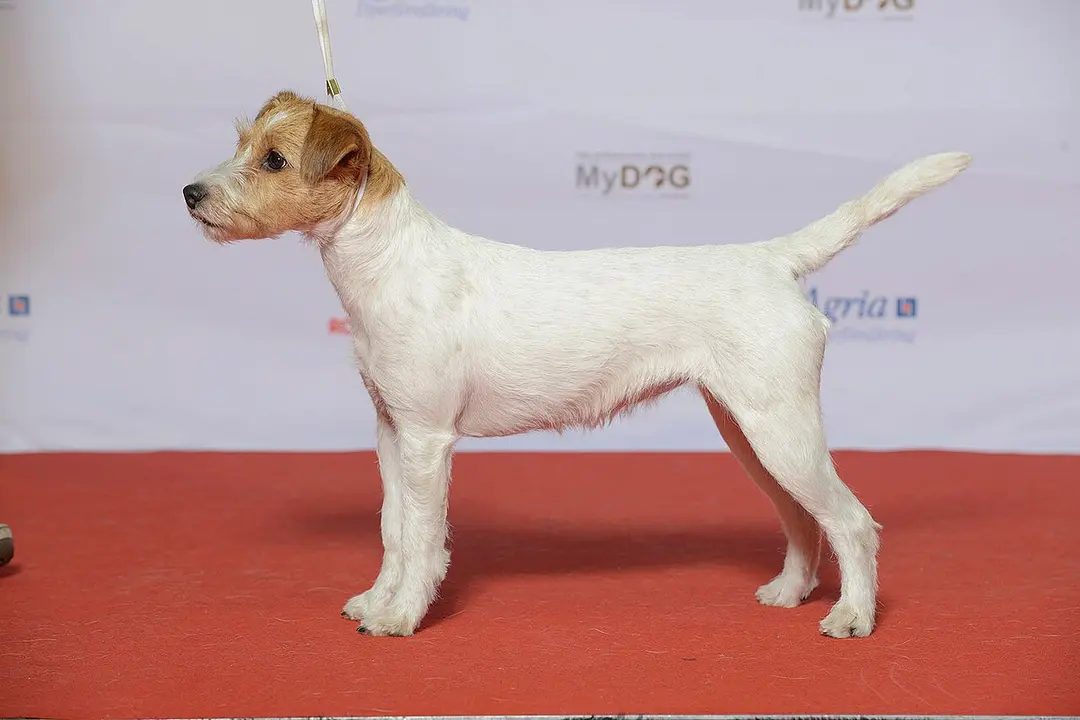
Bold and friendly, quick to learn but independent.
Adult weight
5.9–7.7 kg
13–17 lb
Lifespan
13.8 yrs
Class · Sport
also Field

What it's like

The Parson is bold, lively and friendly, quick to learn but independent-minded. It has considerable stamina and keeps at a task once it has found something to chase or dig for.

Day to day
Activity
Needs lots of exercise
Intelligence
Needs daily brain work
Handler demand
Needs an experienced owner
With people
Affection
Likes its own space
Loyalty
Bonded to its family
Independence
Decides for itself
Around the home
Sensitivity
Average
Voice
Very vocal
Prey drive
Likely to chase small pets
Breed explains only about 9% of how individual dogs differ in behaviour1. Meet the dog. A good breeder breeds for temperament as well as health, and matches each puppy's personality to the right home2,3.
Is a Parson Russell Terrier right for you?
Take the breed matcher

Living with one

A broken-coated Parson needs plucking or clipping so the longer hairs don't mat, while a smooth coat is brushed with a hound glove or thick brush. Either way, a lead on outings is recommended because of the breed's strong prey drive.

Size and growth

A Parson Russell Terrier is a small dog, about the weight of a grown Cavalier King Charles Spaniel.

It is balanced and roughly square, with fairly long legs, a narrow, flexible chest that can be spanned by hand behind the shoulders, and a strong, moderately high-set tail. The coat is smooth or broken, dense and weatherproof, and entirely or mainly white, often with tan, lemon or black markings, preferably on the head and tail root. White is said to have helped hunters tell the terrier from the fox.

Puppy growth

Reference curve · community data appears as owners log
By about 3 months, a male Parson Russell Terrier puppy is already as heavy as a grown Chihuahua. They grow fastest between 3 and 4 months old.
Fully grown
10 mo
Both sexes, at 99% of adult weight8
Male
Female
Shaded: expected range
024682m4m6m9m12m18m
024682m3m4m6m9m12m18m
Age
Male
Female
2 months
1.8–2.3 kg 4.0–5.1 lb
1.9–2.5 kg 4.2–5.5 lb
3 months
2.4–3.1 kg 5.3–6.8 lb
2.4–3.2 kg 5.3–7.1 lb
4 months
3.2–4.2 kg 7.1–9.3 lb
5 months
3.9–5.1 kg 8.6–11.2 lb
3.8–5.0 kg 8.4–11.0 lb
6 months
4.4–5.7 kg 9.7–12.6 lb
4.3–5.6 kg 9.5–12.3 lb
7 months
4.7–6.2 kg 10.4–13.7 lb
4.6–6.1 kg 10.1–13.4 lb
8 months
5.0–6.5 kg 11.0–14.3 lb
4.9–6.4 kg 10.8–14.1 lb
9 months
5.2–6.8 kg 11.5–15.0 lb
5.1–6.7 kg 11.2–14.8 lb
10 months
5.4–7.0 kg 11.9–15.4 lb
5.3–6.9 kg 11.7–15.2 lb
11 months
5.5–7.2 kg 12.1–15.9 lb
5.4–7.0 kg 11.9–15.4 lb
12 months
5.6–7.3 kg 12.3–16.1 lb
5.5–7.1 kg 12.1–15.7 lb
15 months
5.8–7.5 kg 12.8–16.5 lb
5.7–7.4 kg 12.6–16.3 lb

Lifespan

In UK vet records, the typical Parson Russell Terrier lived to about 14 years, about average for a small breed.

Where it comes from

The Parson Russell Terrier is regarded as descending from Trump, a terrier the Victorian hunting parson John Russell bought in 1819. It worked below ground on fox and badger, and tradition holds that it had to be small enough to follow them in yet fit enough to run with the pack. First recognised by The Kennel Club in 1990 with 'Jack' in its name, it took its present name in 19995,10.

The Parson Russell Terrier took shape in the West Country, where John Russell bred working terriers for much of the nineteenth century. Although he was a founder member of The Kennel Club and judged fox terriers at early shows, he kept his own dogs to a hunting type while the show fox terrier drifted away from it. After his death, local enthusiasts such as Arthur Heinemann kept the working strain going. Today most kennel clubs distinguish the breed from the shorter-legged Jack Russell Terrier. It was bred to bolt foxes from their earths for the hunt rather than to kill below ground.

Breed standard

The Parson Russell Terrier is judged against standard no. 339, in group 3, Terriers5.

Questions people ask

General guidance for dogs rather than a measured Parson Russell Terrier figure: most females have a first season somewhere between six and fifteen months, and cycles then settle to roughly every 180 days. Smaller breeds tend to start earlier and larger ones later, so a small breed is most likely at the early end.
Track your own Parson Russell Terrier
Log a minute a day and watch them sit on these curves. Free.

Sources

Something wrong on this page?
Parts of this page were written by AI ·