Pekingese
What it's like
The Pekingese is affectionate and loyal with its own people but dignified and aloof with strangers. It is independent and can be stubborn, yet shows real courage for its size. A Pekingese named Sun Yat Sen was one of the few dogs to survive the sinking of the Titanic.
Living with one
Size and growth
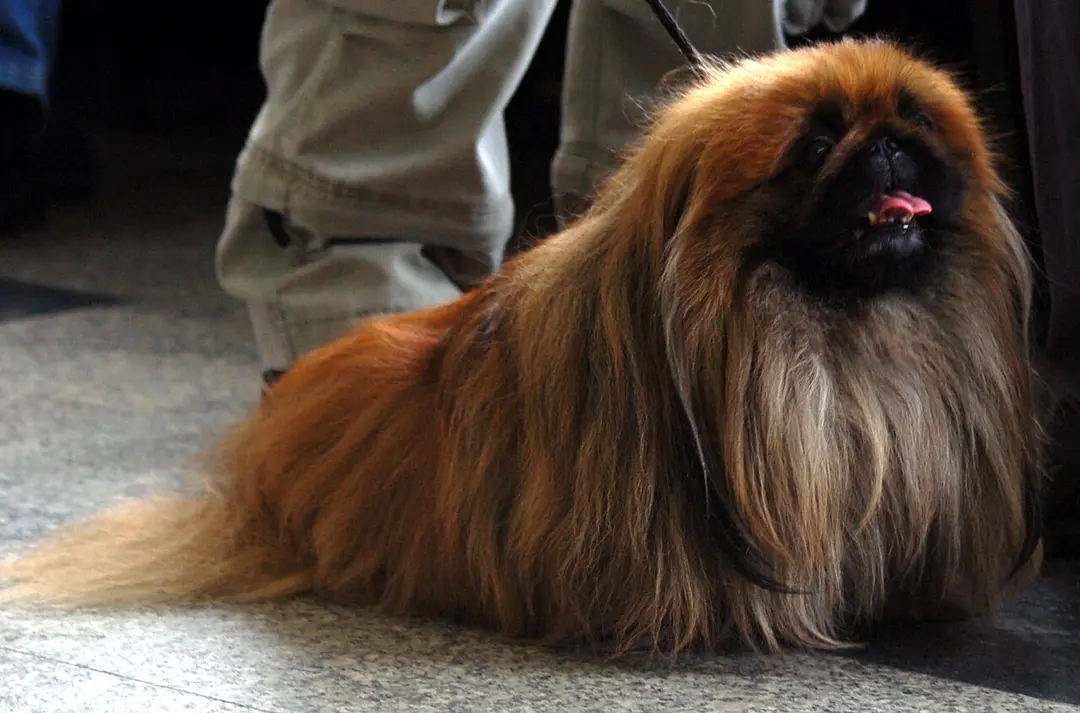
The breed is compact and pear-shaped, with a heavy front, lighter hindquarters and a broad, flat face framed by a lion-like mane. Short, slightly bowed forelegs give it a distinctive rolling gait. The long, straight coat has a dense undercoat, heavy feathering on the ears, legs and toes, and a plumed tail carried over the back. Many colours are seen, often with a black mask.
Puppy growth
Health and lifespan
- Mouth melanomaLab-confirmed casesMuch more likelyImpact: life-limiting
Flat face and breathing
Lifespan
Where it comes from
The Pekingese reached the West in greater numbers in the late nineteenth and early twentieth centuries, as dogs left China with Western diplomats and visitors, some of them gifts from the Empress Dowager Cixi, who was devoted to the breed. British breeders took it up keenly, and specialist clubs formed in the early twentieth century shaped the show dog seen today. It was bred chiefly as a palace companion. The smallest court dogs were called sleeve dogs, reputedly carried in the wide sleeves of a courtier's robe.
Breed standard
Questions people ask
Compare with related
Sources
- 1Morrill et al., 2022. Ancestry-inclusive dog genomics challenges popular breed stereotypes. Science 376: eabk0639 (Darwin's Ark). ↑
- 2Dogs Trust. Finding a good, responsible breeder. ↑
- 3American Kennel Club. Screening puppy buyers: how top breeders find the best homes. ↑
- 4
- 5
- 6Hawthorne et al., 2004. Body-weight changes during growth in puppies of different breeds. Journal of Nutrition 134(8 Suppl): 2027S–2030S (WALTHAM). ↑
- 7
- 8
- 9
- 10Pekingese Club of America. Pekingese history. ↑
- 11Royal Collection Trust. Looty the Pekingese. ↑