Peruvian Inca Orchid
What it's like
The breed is lively, alert and affectionate with its own household, staying close to the people it knows. It is often reserved and watchful with strangers and makes an effective watchdog.
Living with one
Size and growth
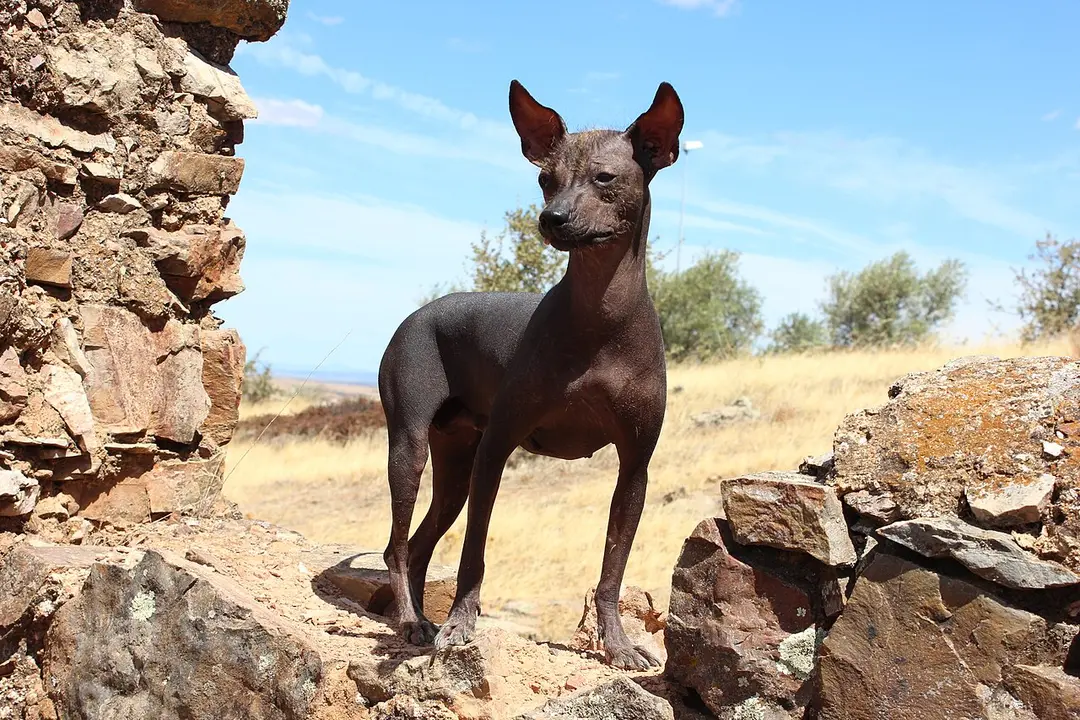
It is a lean, graceful dog shaped like a sighthound, with a long neck, almond-shaped eyes and erect ears that it often folds back when relaxed. It is bred in several sizes. The hairless variety has smooth skin in black, elephant grey, slate or copper, often with pink patches, and may have short tufts of hair on the head, feet or tail tip. Coated puppies regularly appear in litters from hairless parents because hairless dogs carry only one copy of the dominant gene.
Varieties
Puppy growth
Lifespan
Where it comes from
The Peruvian Inca Orchid declined after the Spanish conquest and survived mainly in rural communities along Peru's northern coast. There it was kept as a household companion and a source of warmth, not as a specialised working dog. Its English name dates from the twentieth century, when dogs were taken to the United States. One story says the Spanish first saw these dogs among orchids in Inca homes, but nothing documents it. In Peru and in international registries the breed is also called the Perro sin pelo del Perú.
Breed standard
Questions people ask
Compare with related
Sources
- 1Morrill et al., 2022. Ancestry-inclusive dog genomics challenges popular breed stereotypes. Science 376: eabk0639 (Darwin's Ark). ↑
- 2Dogs Trust. Finding a good, responsible breeder. ↑
- 3American Kennel Club. Screening puppy buyers: how top breeders find the best homes. ↑
- 4
- 5
- 6Hawthorne et al., 2004. Body-weight changes during growth in puppies of different breeds. Journal of Nutrition 134(8 Suppl): 2027S–2030S (WALTHAM). ↑
- 7American Kennel Club. Peruvian Inca Orchid. ↑
- 8Peru Ministry of Culture. Notes on the Peruvian dog. ↑