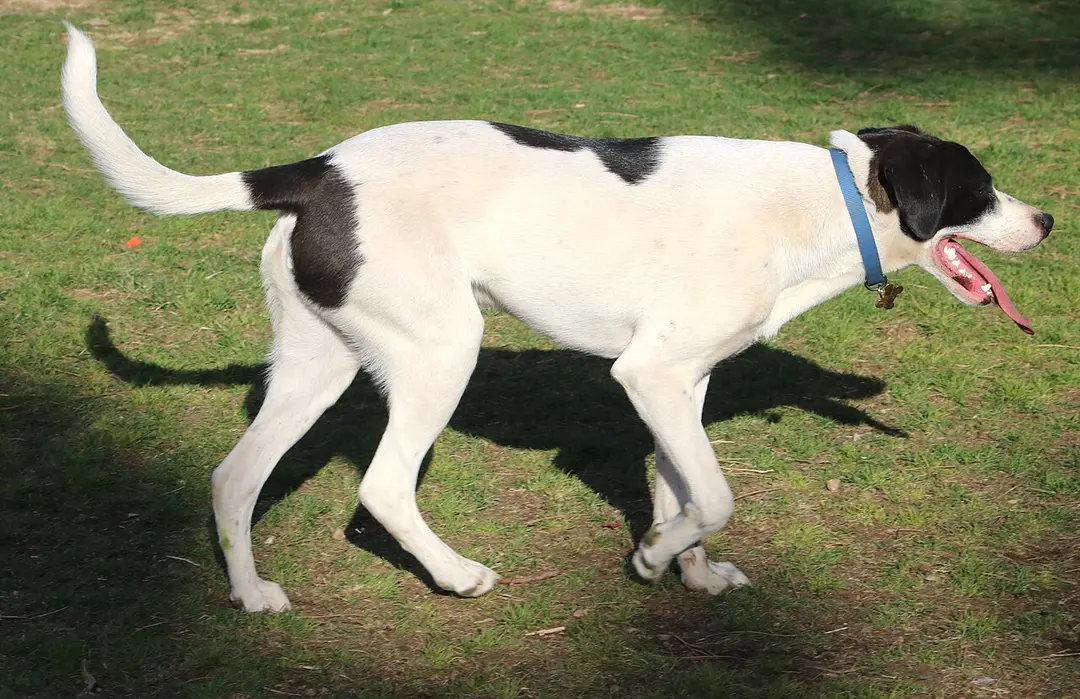
Pointer

Gentle and affectionate, with great stamina and drive.
Adult male
25–34 kg
55–75 lb
Adult female
20–29 kg
45–65 lb
Lifespan
12–17 yrs
Class · Field
also Sport, Family

What it's like

Pointers are generally even-tempered, gentle and affectionate, and they bring great stamina and drive to fieldwork. A Pointer named Sensation appears on the Westminster Kennel Club's emblem.

Day to day
Activity
Needs lots of exercise
Intelligence
Learns readily, likes games
Handler demand
Needs steady training
With people
Affection
Affectionate on its own terms
Loyalty
Bonded to its family
Independence
Cooperative, with its own ideas
Around the home
Sensitivity
Average
Voice
Quiet
Prey drive
Likely to chase small pets
Breed explains only about 9% of how individual dogs differ in behaviour1. Meet the dog. A good breeder breeds for temperament as well as health, and matches each puppy's personality to the right home2,3.
Is a Pointer right for you?
Take the breed matcher

Living with one

It has a short coat. It sheds through the year rather than in big seasonal moults. Plan on a brush once a week. It needs plenty of exercise compared with other breeds.

Size and growth

A Pointer is a large dog, about the weight of a grown Golden Retriever. Males end up clearly heavier than females. It is one of the lightest large breeds.

The breed is lean and athletic, with a long neck, a deep chest and a tail that is thick at the root and tapers to a point, lashing from side to side as it moves. Its head is distinctive: the muzzle is slightly concave, which gives it a dish-faced profile. The short, fine, glossy coat is usually white with lemon, orange, liver or black markings, though solid colours also occur.

Puppy growth

Reference curve · community data appears as owners log
By about 5 months, a male Pointer puppy is already as heavy as a grown Border Collie. They grow fastest between 3 and 4 months old. The biggest males grow into the size large-breed puppy foods are made for.
Fully grown
11 mo
Both sexes, at 99% of adult weight8
Male
Female
Shaded: expected range
0102030402m4m6m9m12m18m
0102030402m3m4m6m9m12m18m
Age
Male
Female
2 months
5.4–7.4 kg 11.9–16.3 lb
4.9–7.1 kg 10.8–15.7 lb
3 months
8.0–10.9 kg 17.6–24.0 lb
7.0–10.1 kg 15.4–22.3 lb
4 months
11.6–15.8 kg 25.6–34.8 lb
9.9–14.4 kg 21.8–31.7 lb
5 months
14.9–20.3 kg 32.8–44.8 lb
12.6–18.2 kg 27.8–40.1 lb
6 months
17.8–24.3 kg 39.2–53.6 lb
14.7–21.3 kg 32.4–47.0 lb
7 months
19.9–27.2 kg 43.9–60.0 lb
16.3–23.6 kg 35.9–52.0 lb
8 months
21.5–29.3 kg 47.4–64.6 lb
17.4–25.2 kg 38.4–55.6 lb
9 months
22.6–30.8 kg 49.8–67.9 lb
18.3–26.4 kg 40.3–58.2 lb
10 months
23.3–31.8 kg 51.4–70.1 lb
18.8–27.2 kg 41.4–60.0 lb
11 months
23.8–32.5 kg 52.5–71.7 lb
19.2–27.8 kg 42.3–61.3 lb
12 months
24.1–32.9 kg 53.1–72.5 lb
19.5–28.2 kg 43.0–62.2 lb
15 months
24.7–33.8 kg 54.5–74.5 lb
20.1–29.1 kg 44.3–64.2 lb

Health and lifespan

In UK lab records, the conditions below turn up more often in Pointers than in crossbreeds. Toe melanoma stands out as much more likely. The most serious, mouth melanoma, can shorten a life and is more likely. These are figures for the breed as a whole, not a prediction for your dog.
Listed by likelihood level, highest first, then by how serious it is, then by name.
  • Toe melanoma
    Lab-confirmed cases
    Much more likely
    Impact: serious
  • Mouth melanoma
    Lab-confirmed cases
    More likely
    Impact: life-limiting
  • Blood-vessel cancer of the skin
    Lab-confirmed cases
    More likely
    Impact: serious
Lab-confirmed: compares dogs whose tumour samples went to a lab with dogs seen in general practice, so the figures run higher than vet-record ones.

Lifespan

No vet study has measured how long Pointers live yet. The 12–17 years shown is a general figure without a published source.

Where it comes from

The Pointer took shape in Britain over the 18th century from Spanish Pointers that army officers brought home in 1713, with French Pointer blood added to make the coarse, slow Spanish type finer and faster. British sportsmen shot game birds over it, and in America, the club says, the Westminster Kennel Club began in 1877 chiefly as a way to get and breed better Pointers11.

The Pointer, known as the English Pointer in some countries, was refined by British breeders through the eighteenth and nineteenth centuries. Foxhound and greyhound blood are often said to have added stamina and speed, though nobody recorded the exact mix. Early pointers are thought to have found hares for coursing greyhounds. Once shooting birds on the wing became common, the breed settled into its work as a bird dog: it ranges fast and wide over open ground, picks up the scent of game and freezes on point until the guns arrive. Pointers ran in England's first organised field trials in the mid-nineteenth century.

Breed standard

The Pointer is judged against standard no. 1, in group 7, Pointing Dogs4.

Questions people ask

General guidance for dogs rather than a measured Pointer figure: most females have a first season somewhere between six and fifteen months, and cycles then settle to roughly every 180 days. Smaller breeds tend to start earlier and larger ones later, so a large breed is most likely at the later end.
Track your own Pointer
Log a minute a day and watch them sit on these curves. Free.

Sources

Uncited on this page: Lifespan — no reviewed source yet, so it is a general reference figure rather than a published one.
Something wrong on this page?
Parts of this page were written by AI ·