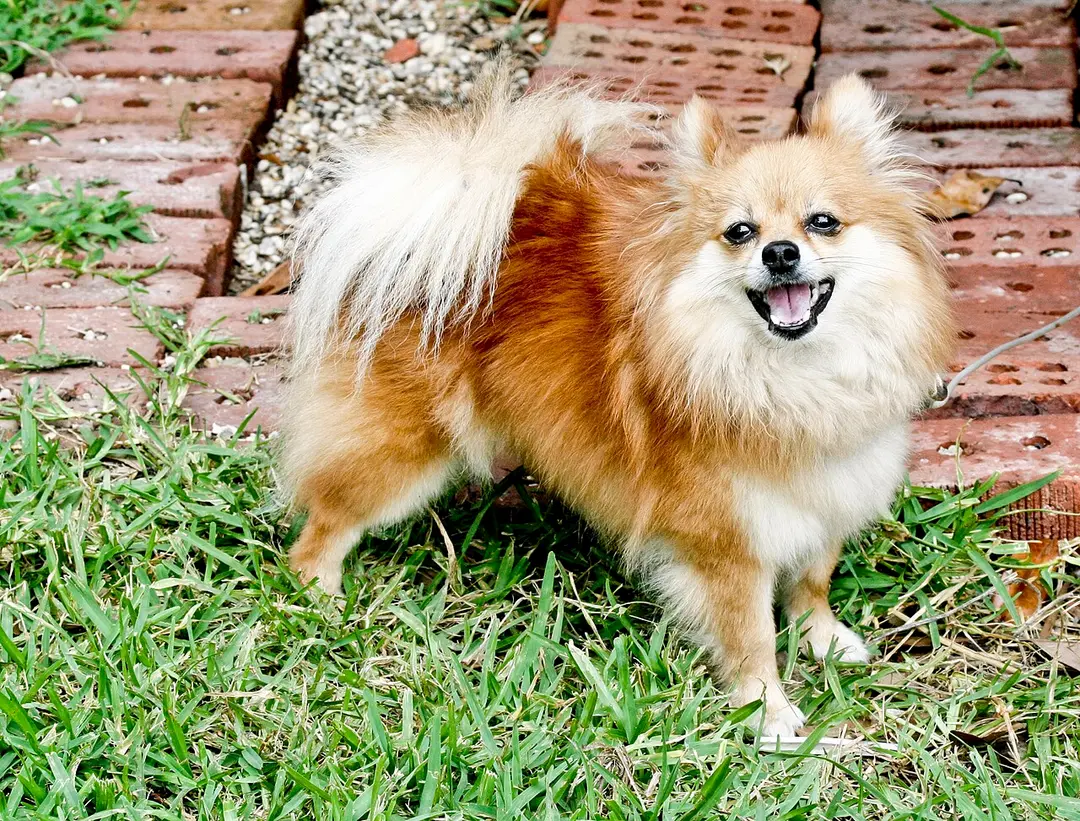
Pomeranian

Bold and busy, quick to announce visitors, often loudly.
Adult weight
1.4–3.2 kg
3–7 lb
Lifespan
12.2 yrs
Handler demand
Suits a first-time owner
Class · Lap dog
also Companion

What it's like

In temperament the Pomeranian is inquisitive, bold and lively, with a confidence well beyond its size. It is alert and quick to announce visitors, often loudly, and tends to carry itself with a busy, self-assured air.

Owners who rated their dogs' everyday behaviour found Pomeranians more independent-minded than most, and much less often among the friendliest with other dogs. Breed is only a small part of any one dog's personality, so meet the dog before you decide.
Day to day
Activity
Happy with modest walks
Intelligence
Learns readily, likes games
Handler demand
Suits a first-time owner
With people
Affection
A lap or leaning dog
Loyalty
Sticks close to its people
Independence
Cooperative, with its own ideas
Around the home
Sensitivity
Average
Voice
Very vocal
Prey drive
Usually fine with small pets
Breed explains only about 9% of how individual dogs differ in behaviour1. Meet the dog. A good breeder breeds for temperament as well as health, and matches each puppy's personality to the right home2,3.
Is a Pomeranian right for you?
Take the breed matcher

Living with one

Poms can slip through small gaps in fencing or climb low fences, and large birds of prey can mistake them for small game, so stay close outdoors. Discourage jumping on and off sofas and beds, which can hurt their joints or even break a bone.

Size and growth

A Pomeranian is a toy dog, heavier than a Chihuahua and lighter than a Yorkshire Terrier. It is one of the lightest toy breeds.

It is a compact, short-backed dog with a fox-like face, small upright ears and dark, bright eyes. A soft, dense undercoat holds out a long, harsh outer coat, which forms a thick frill around the neck and chest. The heavily plumed tail lies flat over the back. Orange and sable are the familiar colours, though black, white, cream, chocolate and others are also seen.

Puppy growth

Reference curve · community data appears as owners log
Pomeranians reach half their adult weight at about 4 months. They grow fastest between 3 and 4 months old.
Fully grown
10 mo
Both sexes, at 99% of adult weight9
Male
Female
Shaded: expected range
012342m4m6m9m12m18m
012342m3m4m6m9m12m18m
Age
Male
Female
2 months
0.5–1.0 kg 1.1–2.2 lb
0.5–1.1 kg 1.1–2.4 lb
3 months
0.6–1.3 kg 1.3–2.9 lb
0.6–1.4 kg 1.3–3.1 lb
4 months
0.7–1.7 kg 1.5–3.7 lb
0.8–1.8 kg 1.8–4.0 lb
5 months
0.9–2.0 kg 2.0–4.4 lb
6 months
1.0–2.3 kg 2.2–5.1 lb
7 months
1.1–2.5 kg 2.4–5.5 lb
1.1–2.4 kg 2.4–5.3 lb
8 months
1.1–2.6 kg 2.4–5.7 lb
1.1–2.5 kg 2.4–5.5 lb
9 months
1.2–2.7 kg 2.6–6.0 lb
1.2–2.6 kg 2.6–5.7 lb
10 months
1.2–2.8 kg 2.6–6.2 lb
1.2–2.7 kg 2.6–6.0 lb
11 months
1.2–2.9 kg 2.6–6.4 lb
1.2–2.8 kg 2.6–6.2 lb
12 months
1.3–2.9 kg 2.9–6.4 lb
1.2–2.9 kg 2.6–6.4 lb
15 months
1.3–3.0 kg 2.9–6.6 lb
18 months
1.4–3.2 kg 3–7 lb
1.4–3.1 kg 3.1–6.8 lb

Health and lifespan

Vets record these more often in Pomeranians than in crossbreeds, and neither is rated serious. A kneecap slipping out of place is much more likely and underactive thyroid more likely; both are moderate. These are figures for the breed as a whole, not a prediction for your dog.
Listed by likelihood level, highest first, then by how serious it is, then by name.
  • Kneecap slipping out of place
    Much more likely
    Impact: moderate
  • Underactive thyroid
    More likely
    Impact: moderate

Lifespan

In UK vet records, the typical Pomeranian lived to about 12 years, shorter than the typical toy breed.

Where it comes from

The Pomeranian is named for Pomerania, a Baltic region now split between Poland and Germany, and comes from the German Spitz family, whose larger spitz ancestors herded, guarded and pulled sleds. Queen Charlotte brought two to England in 1767, and Queen Victoria, whose Marco came from Florence in 1888, gets the credit for the shift to smaller Pomeranians. The FCI treats it as the toy size of the German Spitz7,13.

The Pomeranian took its present form in Victorian Britain, where breeders steadily reduced the size of the larger, often white spitz dogs then kept in England. Queen Victoria kept a sizeable kennel and showed her dogs. With royal interest behind it, the smaller type, in a widening range of colours, came to dominate the show ring. Two Pomeranians are recorded among the few dogs that survived the sinking of the Titanic. Unlike its working ancestors, the breed was kept mainly as a companion.

Breed standard

Kennel clubs do not all register this breed the same way.

Questions people ask

General guidance for dogs rather than a measured Pomeranian figure: most females have a first season somewhere between six and fifteen months, and cycles then settle to roughly every 180 days. Smaller breeds tend to start earlier and larger ones later, so a toy breed is most likely at the early end.
Track your own Pomeranian
Log a minute a day and watch them sit on these curves. Free.

Sources

Something wrong on this page?
Parts of this page were written by AI ·