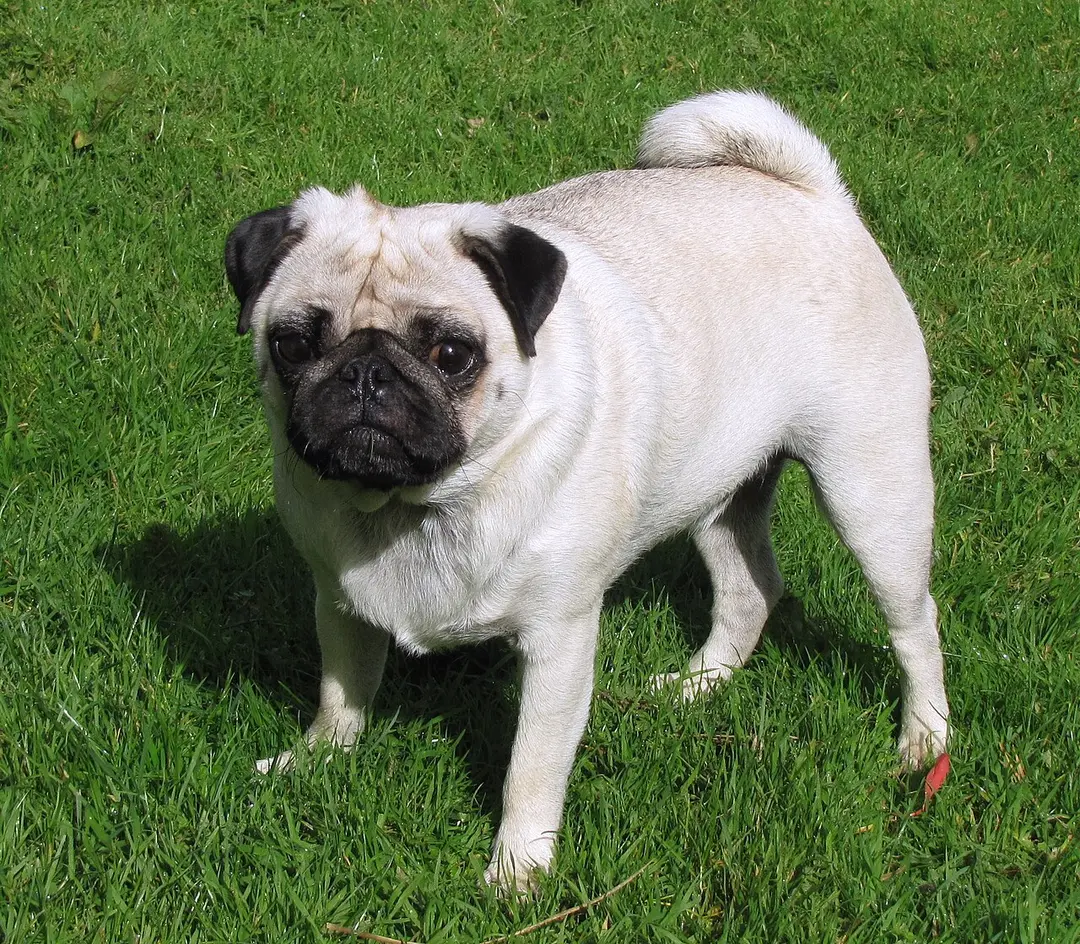
Pug

Playful and sociable; often follows you about the house.
Adult male
8.8–11.1 kg
19–24 lb
Adult female
7.3–9.3 kg
16–21 lb
Lifespan
11.6 yrs
Handler demand
Suits a first-time owner
Class · Lap dog
also Companion

What it's like

By temperament the Pug is good-natured, sociable and playful. It likes to stay close to its people and often follows them about the house. It can be stubborn, but it is generally even-tempered and comical company.

Owners who rated their dogs' everyday behaviour found Pugs friendlier with people and more independent-minded than most. On calmness and with other dogs, they were about average. Breed is only a small part of any one dog's personality, so meet the dog before you decide.
Day to day
Activity
Happy with modest walks
Intelligence
Easy-going, simple routines
Handler demand
Suits a first-time owner
With people
Affection
A lap or leaning dog
Loyalty
Bonded to its family
Independence
Cooperative, with its own ideas
Around the home
Sensitivity
Average
Voice
Quiet
Prey drive
Usually fine with small pets
Breed explains only about 9% of how individual dogs differ in behaviour1. Meet the dog. A good breeder breeds for temperament as well as health, and matches each puppy's personality to the right home2,3.
Is a Pug right for you?
Take the breed matcher

Living with one

Heat is a real risk for a Pug, so on hot days keep its exercise to the cool of the morning or evening. Bred for company, it needs a modest amount of exercise compared with other breeds. The short coat sheds through the year and needs a weekly brush.

Size and growth

A Pug is a small dog, heavier than a Cavalier King Charles Spaniel and lighter than a Cocker Spaniel. Males end up clearly heavier than females.

It is a square, thickset little dog, often summed up by the Latin motto multum in parvo, meaning much in little. The round head has deep wrinkles on the forehead, a short blunt muzzle, large dark eyes and small, thin ears. The tail curls tightly over the hip, ideally in a double curl. The short, glossy coat is fawn or black, and some kennel clubs also accept apricot and silver. Lighter-coloured dogs have a black mask and ears, and often a dark line running along the back.

Puppy growth

Reference curve · community data appears as owners log
By about 5 months, a male Pug puppy is already as heavy as a grown Jack Russell. They grow fastest between 3 and 4 months old.
Fully grown
10 mo
Both sexes, at 99% of adult weight8
Male
Female
Shaded: expected range
0510152m4m6m9m12m18m
0510152m3m4m6m9m12m18m
Age
Male
Female
2 months
2.2–2.8 kg 4.9–6.2 lb
2.4–3.0 kg 5.3–6.6 lb
3 months
3.0–3.8 kg 6.6–8.4 lb
3.0–3.9 kg 6.6–8.6 lb
4 months
4.3–5.4 kg 9.5–11.9 lb
4.0–5.1 kg 8.8–11.2 lb
5 months
5.3–6.7 kg 11.7–14.8 lb
4.7–6.0 kg 10.4–13.2 lb
6 months
6.1–7.7 kg 13.4–17.0 lb
5.3–6.8 kg 11.7–15.0 lb
7 months
6.7–8.5 kg 14.8–18.7 lb
5.8–7.3 kg 12.8–16.1 lb
8 months
7.2–9.1 kg 15.9–20.1 lb
6.1–7.7 kg 13.4–17.0 lb
9 months
7.6–9.5 kg 16.8–20.9 lb
6.3–8.0 kg 13.9–17.6 lb
10 months
7.8–9.9 kg 17.2–21.8 lb
6.5–8.3 kg 14.3–18.3 lb
11 months
8.0–10.1 kg 17.6–22.3 lb
6.6–8.5 kg 14.6–18.7 lb
12 months
8.2–10.3 kg 18.1–22.7 lb
6.8–8.6 kg 15.0–19.0 lb
15 months
8.5–10.7 kg 18.7–23.6 lb
7.0–9.0 kg 15.4–19.8 lb

Health and lifespan

Vets record these more often in Pugs than in crossbreeds or other dogs, and all five are far more likely. Breathing obstruction from a short muzzle is life-limiting; corneal ulcers, dry eye, narrowed nostrils and skin fold inflammation are moderate. These are figures for the breed as a whole, not a prediction for your dog.
Listed by likelihood level, highest first, then by how serious it is, then by name. These are the first 5 of 35 measured.
  • Breathing obstruction from a short muzzle
    Far more likely
    Impact: life-limiting
  • Corneal ulcers
    Far more likely
    Impact: moderate
  • Dry eye
    Far more likely
    Impact: moderate
  • Narrowed nostrils
    Far more likely
    Impact: moderate
  • Skin fold inflammation
    Far more likely
    Impact: moderate

Flat face and breathing

The Pug is one of the flat-faced breeds. In UK vet records, flat-faced dogs were more likely to have breathing and airway problems than dogs with a medium-length muzzle, and lived shorter lives on average. Noisy breathing at rest is worth raising with a vet.

Lifespan

In UK vet records, the typical Pug lived to about 11 and a half years, shorter than the typical small breed. Flat-faced breeds as a group live shorter lives than breeds with a longer muzzle.

Where it comes from

The Pug's origin is debated; it seems to have come from the East, and China, where emperors prized flat-faced toy dogs, is listed as its home. Dutch traders carried it to Holland, where it was admired by the 1500s and became a badge of the royal patriots. It reached England with William III, and English Pugs stayed fawn until a black pair came from the East in 18774,14.

The Pug has long been kept chiefly as a companion. Through the eighteenth century it was a fashionable lapdog across Europe. William Hogarth painted himself beside his Pug, Trump, and a story is told that Josephine's Pug, Fortuné, bit Napoleon on their wedding night. Queen Victoria kept and bred Pugs, and Victorian fanciers took up the breed. Older paintings show dogs with longer legs and longer muzzles than the Pug of today.

Breed standard

The Pug is judged against standard no. 253, in group 9, Companion and Toy Dogs4.

Questions people ask

General guidance for dogs rather than a measured Pug figure: most females have a first season somewhere between six and fifteen months, and cycles then settle to roughly every 180 days. Smaller breeds tend to start earlier and larger ones later, so a small breed is most likely at the early end.
Track your own Pug
Log a minute a day and watch them sit on these curves. Free.

Sources

Something wrong on this page?
Parts of this page were written by AI ·