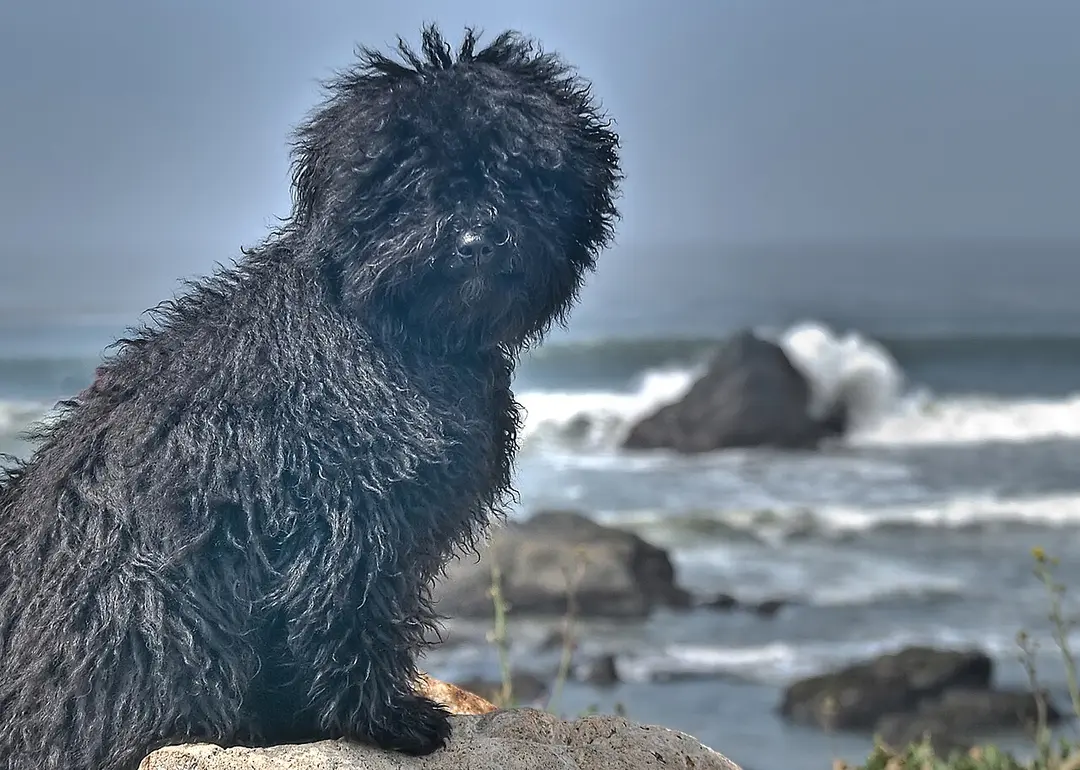
Puli

Attentive with its people, quick to bark at the unusual.
Adult male
13–15 kg
29–33 lb
Adult female
10–13 kg
22–29 lb
Lifespan
13.3 yrs
Class · Working
also Watchdog, Companion

What it's like

In temperament the Puli is lively, alert and attentive, closely attached to its own people and wary of strangers. It is quick to bark at anything unusual, which has made it a capable watchdog as well as a herder.

Day to day
Activity
Needs lots of exercise
Intelligence
Needs daily brain work
Handler demand
Needs an experienced owner
With people
Affection
Affectionate on its own terms
Loyalty
Sticks close to its people
Independence
Decides for itself
Around the home
Sensitivity
Average
Voice
Very vocal
Prey drive
Chases; needs managing
Breed explains only about 9% of how individual dogs differ in behaviour1. Meet the dog. A good breeder breeds for temperament as well as health, and matches each puppy's personality to the right home2,3.
Is a Puli right for you?
Take the breed matcher

Living with one

It has a corded coat. Loose hair stays caught in the coat until it is brushed, stripped or clipped out. Plan on cords separated by hand as they form. It needs plenty of exercise compared with other breeds.

Size and growth

A Puli is a medium dog, about the weight of a grown Cocker Spaniel. Males end up clearly heavier than females. It is one of the lightest medium breeds.

The Puli is a compact, squarely built dog with fine bones beneath a coat that makes it look far heavier than it is. The cords hang over the whole body and usually hide the eyes, and the tail curls tightly over the back so that it merges into the coat. Solid black is the usual colour, but grey, fawn with a dark mask and white also occur. It moves with a short, quick, springing step.

Puppy growth

Reference curve · community data appears as owners log
Pulis reach half their adult weight at about 5 months. They grow fastest between 3 and 4 months old.
Fully grown
10 mo
Both sexes, at 99% of adult weight6
Male
Female
Shaded: expected range
0510152m4m6m9m12m18m
0510152m3m4m6m9m12m18m
Age
Male
Female
2 months
3.3–3.8 kg 7.3–8.4 lb
2.8–3.7 kg 6.2–8.2 lb
3 months
4.5–5.2 kg 9.9–11.5 lb
3.6–4.7 kg 7.9–10.4 lb
4 months
6.3–7.3 kg 13.9–16.1 lb
4.9–6.4 kg 10.8–14.1 lb
5 months
7.8–9.0 kg 17.2–19.8 lb
5.9–7.7 kg 13.0–17.0 lb
6 months
9.0–10.4 kg 19.8–22.9 lb
6.7–8.8 kg 14.8–19.4 lb
7 months
9.9–11.5 kg 21.8–25.4 lb
7.4–9.6 kg 16.3–21.2 lb
8 months
10.6–12.3 kg 23.4–27.1 lb
7.9–10.2 kg 17.4–22.5 lb
9 months
11.2–12.9 kg 24.7–28.4 lb
8.3–10.7 kg 18.3–23.6 lb
10 months
11.5–13.3 kg 25.4–29.3 lb
8.6–11.1 kg 19.0–24.5 lb
11 months
11.9–13.7 kg 26.2–30.2 lb
8.8–11.5 kg 19.4–25.4 lb
12 months
12.1–14.0 kg 26.7–30.9 lb
9.0–11.8 kg 19.8–26.0 lb
15 months
12.6–14.5 kg 27.8–32.0 lb
9.5–12.4 kg 20.9–27.3 lb
18 months
13–15 kg 29–33 lb
9.9–12.9 kg 21.8–28.4 lb

Lifespan

In UK vet records, the typical Puli lived to about 13 and a half years, about average for a medium breed. The group was small, so treat the figure as rough.

Where it comes from

The Puli herded sheep on the Hungarian plains. A Hungarian breed of Asiatic origin, its forebears most probably came with the Magyars, a nomadic herding people, perhaps about a thousand years ago. Its coat starts as soft tufts and forms cords as the dog matures, and a working Puli will often cross a tightly bunched herd by running over the animals' backs4,8,9.

The Puli remained a working dog of Hungarian shepherds for centuries, valued for speed and stamina rather than size. On the plains it often worked beside the much larger Komondor and Kuvasz: the big dogs guarded the flock against wolves and thieves, while the nimble Puli gathered and drove the sheep. In the early twentieth century, Hungarian breeders began recording and standardising the breed, and it later spread abroad with emigrants and enthusiasts. In the nineteen-thirties, the United States Department of Agriculture imported Pulik to test them as herding dogs.

Breed standard

The Puli is judged against standard no. 55, in group 1, Sheepdogs and Cattledogs4.

Questions people ask

General guidance for dogs rather than a measured Puli figure: most females have a first season somewhere between six and fifteen months, and cycles then settle to roughly every 180 days. Smaller breeds tend to start earlier and larger ones later, so a medium-sized breed is most likely somewhere in the middle.
Track your own Puli
Log a minute a day and watch them sit on these curves. Free.

Sources

Something wrong on this page?
Parts of this page were written by AI ·