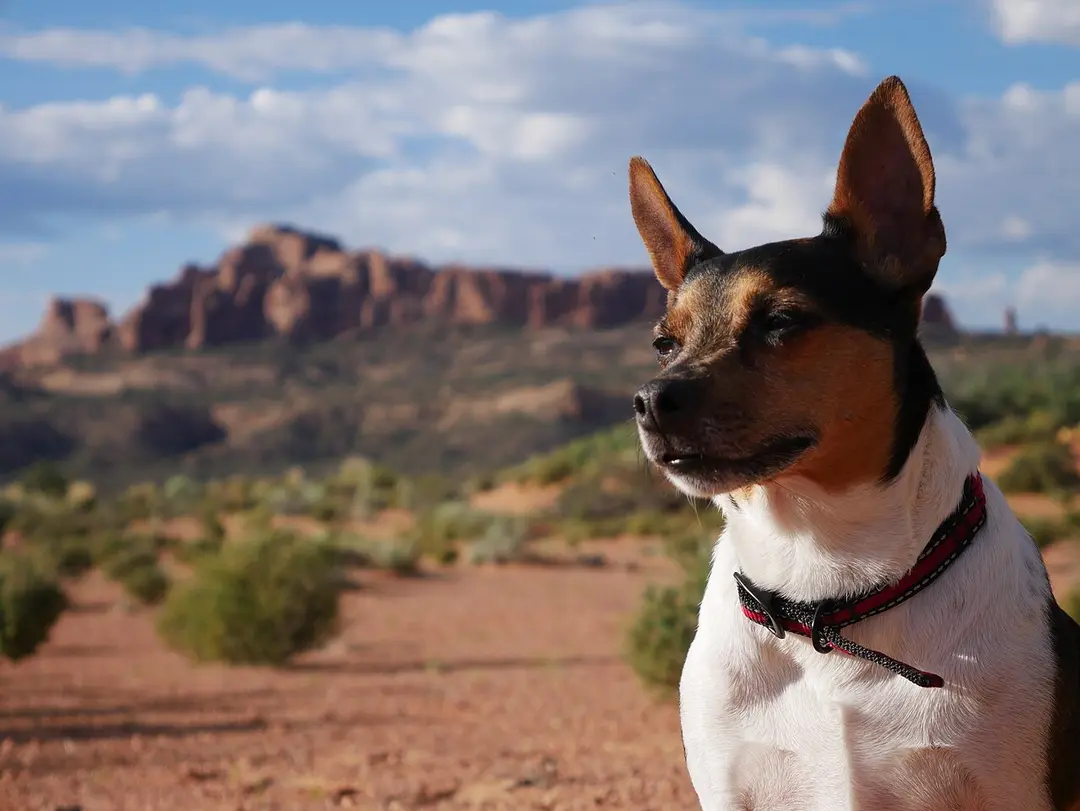
Rat Terrier

Lively and affectionate, with a terrier's urge to dig.
Adult weight
4.5–11 kg
10–25 lb
Lifespan
12–18 yrs
Class · Companion
also Sport, Field

What it's like

In temperament it is lively, alert and quick to learn, affectionate with its household and reserved with strangers. It keeps a terrier's urge to chase and dig, but is usually described as less quarrelsome with other dogs than many terriers.

Day to day
Activity
Needs lots of exercise
Intelligence
Needs daily brain work
Handler demand
Needs steady training
With people
Affection
A lap or leaning dog
Loyalty
Bonded to its family
Independence
Cooperative, with its own ideas
Around the home
Sensitivity
Average
Voice
Barks to alert, then settles
Prey drive
Likely to chase small pets
Breed explains only about 9% of how individual dogs differ in behaviour1. Meet the dog. A good breeder breeds for temperament as well as health, and matches each puppy's personality to the right home2,3.
Is a Rat Terrier right for you?
Take the breed matcher

Size and growth

A Rat Terrier is a small dog, heavier than a Cavalier King Charles Spaniel and lighter than a Pug.

It is a compact, muscular dog, slightly longer than tall, with a short, smooth, close-lying coat. The coat is pied, white combined with patches of colours such as black, tan, chocolate, red or lemon, and the ears may stand erect or tip over. Some are born with a natural bobtail.

Varieties

AKC divides this breed by height at the withers. Pick the variety your dog is for a band that fits.
Variety
Weight
Height
Miniature
25.4–33 cm (breed club figure)5
Standard
33–45.7 cm (breed club figure)6

Puppy growth

Reference curve · community data appears as owners log
By about 5 months, a male Rat Terrier puppy is already as heavy as a grown Yorkshire Terrier. They grow fastest between 3 and 4 months old.
Fully grown
10 mo
Both sexes, at 99% of adult weight8
Male
Female
Shaded: expected range
0510152m4m6m9m12m18m
0510152m3m4m6m9m12m18m
Age
Male
Female
2 months
1.3–3.4 kg 2.9–7.5 lb
1.5–3.7 kg 3.3–8.2 lb
3 months
1.8–4.5 kg 4.0–9.9 lb
1.9–4.7 kg 4.2–10.4 lb
4 months
2.4–6.1 kg 5.3–13.4 lb
2.5–6.2 kg 5.5–13.7 lb
5 months
3.0–7.4 kg 6.6–16.3 lb
2.9–7.3 kg 6.4–16.1 lb
6 months
3.3–8.4 kg 7.3–18.5 lb
3.3–8.2 kg 7.3–18.1 lb
7 months
3.6–9.1 kg 7.9–20.1 lb
3.5–8.9 kg 7.7–19.6 lb
8 months
3.8–9.6 kg 8.4–21.2 lb
3.7–9.4 kg 8.2–20.7 lb
9 months
4.0–10.0 kg 8.8–22.0 lb
3.9–9.8 kg 8.6–21.6 lb
10 months
4.1–10.3 kg 9.0–22.7 lb
4.0–10.1 kg 8.8–22.3 lb
11 months
4.2–10.5 kg 9.3–23.1 lb
4.1–10.3 kg 9.0–22.7 lb
12 months
4.2–10.7 kg 9.3–23.6 lb
4.2–10.5 kg 9.3–23.1 lb
15 months
4.4–11.0 kg 9.7–24.3 lb
4.3–10.9 kg 9.5–24.0 lb
18 months
4.5–11 kg 10–25 lb
4.5–11.2 kg 9.9–24.7 lb

Lifespan

No vet study has measured how long Rat Terriers live yet. The 12–18 years shown is a general figure without a published source.

Where it comes from

The Rat Terrier is an American farm dog. Its breed club credits early 19th-century immigrants with crossing Smooth Fox, Old English White, Bull and Manchester Terriers to make it, and says most farms had one in the 1910s and 1920s, to clear barns of vermin rather than go to ground. Midwestern farmers added Whippet and Italian Greyhound against crop-raiding rabbits, and Beagle crosses farther south sharpened its nose9.

The Rat Terrier's numbers fell in the mid-twentieth century, when farm poisons reduced the need for a ratting dog. Enthusiasts kept the type going until kennel clubs took it up, the American Kennel Club only in the early twenty-first century. A hairless puppy born in the nineteen-seventies founded a separate breed, the American Hairless Terrier, and the shorter-legged Teddy Roosevelt Terrier has since been split off too. That President Theodore Roosevelt named the breed is a story told rather than known. Its work was catching rats and mice in barns and grain stores and flushing small game.

Breed standard

One registry divides it into two varieties by height, each with its own weight range.

Questions people ask

General guidance for dogs rather than a measured Rat Terrier figure: most females have a first season somewhere between six and fifteen months, and cycles then settle to roughly every 180 days. Smaller breeds tend to start earlier and larger ones later, so a small breed is most likely at the early end.
Track your own Rat Terrier
Log a minute a day and watch them sit on these curves. Free.

Sources

Uncited on this page: Lifespan — no reviewed source yet, so it is a general reference figure rather than a published one.
Something wrong on this page?
Parts of this page were written by AI ·