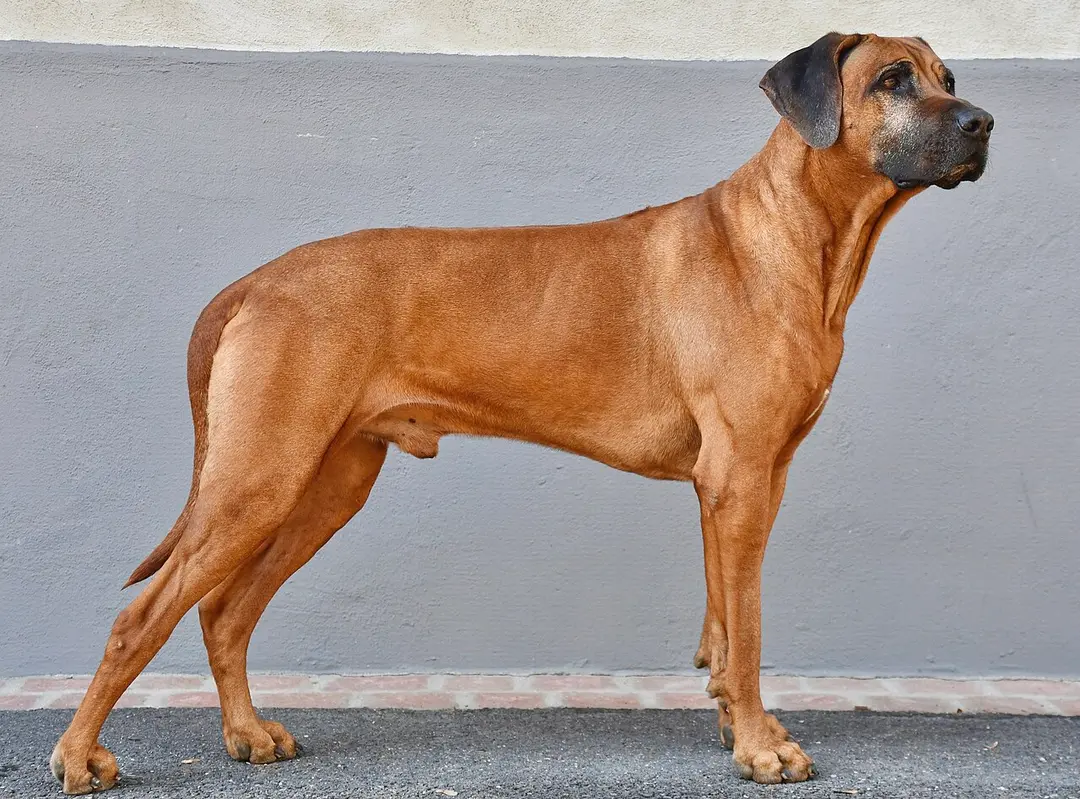
Rhodesian Ridgeback

Gentle with its own, generally quiet, and strong-willed.
Adult male
36–41 kg
79–90 lb
Adult female
29–34 kg
64–75 lb
Lifespan
12 yrs
Class · Watchdog
also Companion, Sport

What it's like

The Ridgeback is affectionate and gentle with its own people but reserved with strangers, and is generally quiet. It is strong-willed and independent, as suits a dog once expected to act on its own judgement, and it keeps a keen instinct to chase.

Day to day
Activity
Needs lots of exercise
Intelligence
Learns readily, likes games
Handler demand
Needs an experienced owner
With people
Affection
Affectionate on its own terms
Loyalty
Sticks close to its people
Independence
Decides for itself
Around the home
Sensitivity
Average
Voice
Quiet
Prey drive
Likely to chase small pets
Breed explains only about 9% of how individual dogs differ in behaviour1. Meet the dog. A good breeder breeds for temperament as well as health, and matches each puppy's personality to the right home2,3.
Is a Rhodesian Ridgeback right for you?
Take the breed matcher

Living with one

It has a short coat. It sheds through the year rather than in big seasonal moults. Plan on a brush once a week. It needs plenty of exercise compared with other breeds.

Size and growth

A Rhodesian Ridgeback is a large dog, about the weight of a grown German Shepherd. Males end up clearly heavier than females.

It is muscular and clean-limbed, built for speed and stamina, with a short, dense coat in shades from light wheaten to red wheaten and a black or brown nose. Its hallmark is the ridge, a strip of hair along the spine that grows against the rest of the coat. The ridge begins with matching whorls behind the shoulders and tapers towards the hips. Some puppies are born without it.

Puppy growth

Reference curve · community data appears as owners log
By about 3 months, a male Rhodesian Ridgeback puppy is already as heavy as a grown Pug. They grow fastest between 3 and 4 months old. Most males grow into the size large-breed puppy foods are made for.
Fully grown
12 mo
Both sexes, at 99% of adult weight8
Male
Female
Shaded: expected range
02040602m4m6m9m12m18m
02040602m3m4m6m9m12m18m
Age
Male
Female
2 months
7.6–8.6 kg 16.8–19.0 lb
6.7–7.8 kg 14.8–17.2 lb
3 months
11.4–13.0 kg 25.1–28.7 lb
9.6–11.3 kg 21.2–24.9 lb
4 months
16.8–19.2 kg 37.0–42.3 lb
14.0–16.4 kg 30.9–36.2 lb
5 months
21.6–24.6 kg 47.6–54.2 lb
17.8–20.8 kg 39.2–45.9 lb
6 months
25.7–29.3 kg 56.7–64.6 lb
20.9–24.5 kg 46.1–54.0 lb
7 months
29.1–33.1 kg 64.2–73.0 lb
23.2–27.2 kg 51.1–60.0 lb
8 months
31.5–35.8 kg 69.4–78.9 lb
24.8–29.0 kg 54.7–63.9 lb
9 months
33.1–37.7 kg 73.0–83.1 lb
26.0–30.4 kg 57.3–67.0 lb
10 months
34.1–38.8 kg 75.2–85.5 lb
26.8–31.4 kg 59.1–69.2 lb
11 months
34.7–39.5 kg 76.5–87.1 lb
27.3–32.1 kg 60.2–70.8 lb
12 months
35.1–39.9 kg 77.4–88.0 lb
27.8–32.6 kg 61.3–71.9 lb
15 months
35.6–40.5 kg 78.5–89.3 lb
28.6–33.5 kg 63.1–73.9 lb

Health and lifespan

In UK vet and lab records, the conditions below turn up more often in Rhodesian Ridgebacks than in crossbreeds. Bone cancer, melanoma of the eye or eyelid, skin melanoma and underactive thyroid stand out as much more likely. Bone cancer is also the most serious on the list, and can shorten a life. These are figures for the breed as a whole, not a prediction for your dog.
Listed by likelihood level, highest first, then by how serious it is, then by name.
  • Bone cancer
    Lab-confirmed cases
    Much more likely
    Impact: life-limiting
  • Melanoma of the eye or eyelid
    Lab-confirmed cases
    Much more likely
    Impact: serious
  • Skin melanoma
    Lab-confirmed cases
    Much more likely
    Impact: moderate
  • Underactive thyroid
    Much more likely
    Impact: moderate
  • Mast cell tumour
    Lab-confirmed cases
    Slightly more likely
    Impact: serious
Lab-confirmed: compares dogs whose tumour samples went to a lab with dogs seen in general practice, so the figures run higher than vet-record ones.

Lifespan

In UK vet records, the typical Rhodesian Ridgeback lived to about 12 years, about average for a large breed.

Where it comes from

The Rhodesian Ridgeback descends from dogs of the Cape Colony, where settlers' dogs crossed with the ridged, semi-domesticated hunting dogs of the Khoikhoi. Working in small teams, it found lions and held them until a hunter could get there, hence its old name, Lion Dog. F. R. Barnes of Bulawayo wrote its standard in 1922, using the Dalmatian's as a template4.

The Rhodesian Ridgeback took its modern form in the late nineteenth century in what is now Zimbabwe. The hunter Cornelius van Rooyen is usually credited with shaping it by crossing his own dogs with ridged dogs brought from the Cape by the missionary Charles Helm. The South African Kennel Union adopted F. R. Barnes's standard in the nineteen-twenties, and the breed later reached Britain and North America. Besides baying lions, it served settlers as an all-round hunting dog, valued for coping with heat, rough country and little water.

Breed standard

The Rhodesian Ridgeback is judged against standard no. 146, in group 6, Scenthounds and related breeds4.

Questions people ask

General guidance for dogs rather than a measured Rhodesian Ridgeback figure: most females have a first season somewhere between six and fifteen months, and cycles then settle to roughly every 180 days. Smaller breeds tend to start earlier and larger ones later, so a large breed is most likely at the later end.
Track your own Rhodesian Ridgeback
Log a minute a day and watch them sit on these curves. Free.

Sources

Something wrong on this page?
Parts of this page were written by AI ·