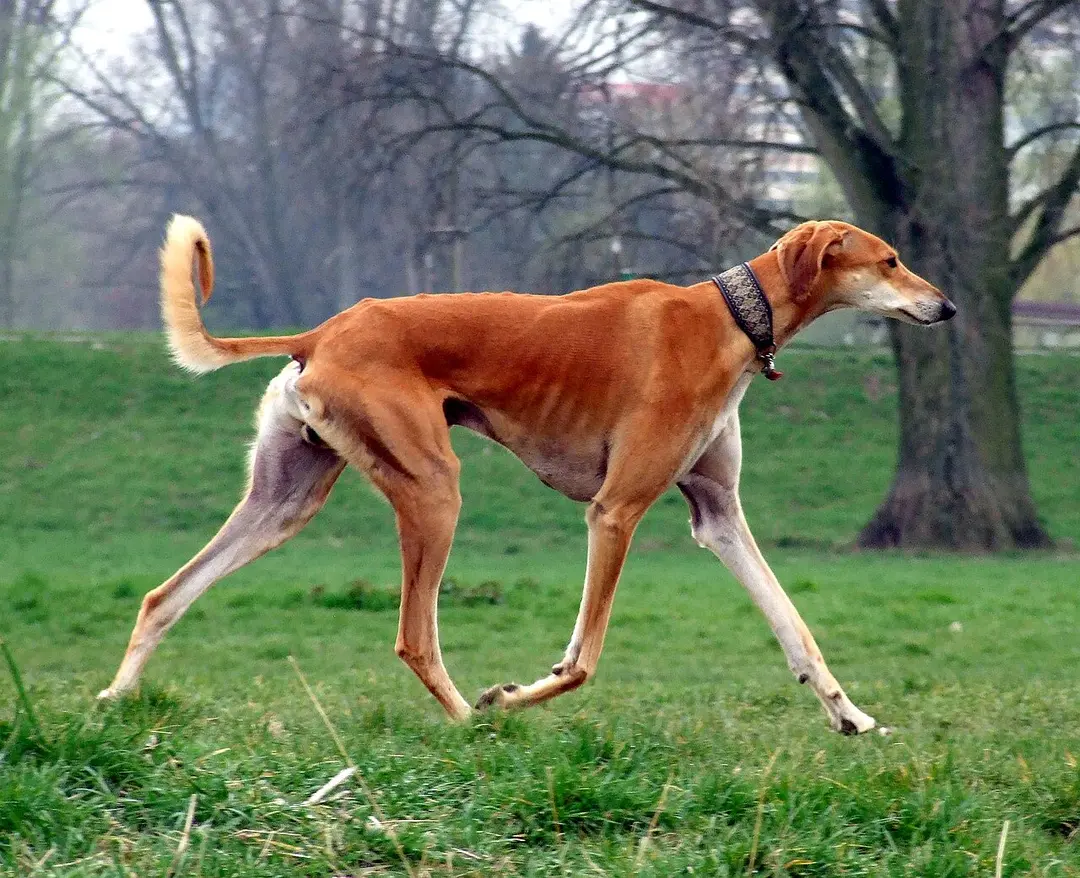
Saluki

Gentle with family, sensitive, and quick to chase.
Adult weight
18–29 kg
40–65 lb
Lifespan
13.3 yrs
Class · Companion
also Field, Sport

What it's like

The Saluki is lean and narrow, with a long head, deep chest, long legs and a long, low-set tail carried in a curve. The feathered variety has silky feathering on the ears, the backs of the legs and the tail; the smooth variety has none. Colours include cream, fawn, golden, red, grizzle, white, and black and tan. With its family the breed is gentle and affectionate. It tends to be reserved with strangers, sensitive to harsh handling and quick to chase anything that runs.

Day to day
Activity
Needs lots of exercise
Intelligence
Learns readily, likes games
Handler demand
Needs steady training
With people
Affection
Affectionate on its own terms
Loyalty
Sticks close to its people
Independence
Decides for itself
Around the home
Sensitivity
Needs a calm, predictable home
Voice
Quiet
Prey drive
Likely to chase small pets
Breed explains only about 9% of how individual dogs differ in behaviour1. Meet the dog. A good breeder breeds for temperament as well as health, and matches each puppy's personality to the right home2,3.
Is a Saluki right for you?
Take the breed matcher

Living with one

It sheds through the year rather than in big seasonal moults. The grooming it needs depends on the coat. It needs a moderate amount of exercise compared with other breeds.

Size and growth

A Saluki is a medium dog, heavier than a Border Collie and lighter than a Golden Retriever.

Puppy growth

Reference curve · community data appears as owners log
By about 5 months, a male Saluki puppy is already as heavy as a grown Staffordshire Bull Terrier. They grow fastest between 3 and 4 months old.
Fully grown
11 mo
Both sexes, at 99% of adult weight7
Male
Female
Shaded: expected range
01020302m4m6m9m12m18m
01020302m3m4m6m9m12m18m
Age
Male
Female
2 months
3.9–6.4 kg 8.6–14.1 lb
4.4–7.1 kg 9.7–15.7 lb
3 months
5.8–9.5 kg 12.8–20.9 lb
6.2–10.1 kg 13.7–22.3 lb
4 months
8.4–13.7 kg 18.5–30.2 lb
8.8–14.4 kg 19.4–31.7 lb
5 months
10.8–17.6 kg 23.8–38.8 lb
11.1–18.2 kg 24.5–40.1 lb
6 months
12.9–21.1 kg 28.4–46.5 lb
13.1–21.3 kg 28.9–47.0 lb
7 months
14.5–23.6 kg 32.0–52.0 lb
8 months
15.6–25.5 kg 34.4–56.2 lb
15.5–25.2 kg 34.2–55.6 lb
9 months
16.4–26.7 kg 36.2–58.9 lb
16.2–26.4 kg 35.7–58.2 lb
10 months
16.9–27.6 kg 37.3–60.8 lb
16.7–27.2 kg 36.8–60.0 lb
11 months
17.3–28.2 kg 38.1–62.2 lb
17.1–27.8 kg 37.7–61.3 lb
12 months
17.5–28.6 kg 38.6–63.1 lb
17.3–28.2 kg 38.1–62.2 lb
15 months
18.0–29.3 kg 39.7–64.6 lb
17.9–29.1 kg 39.5–64.2 lb

Lifespan

In UK vet records, the typical Saluki lived to about 13 and a half years, about average for a medium breed.

Where it comes from

The Saluki is a coursing hound of the Middle East, and its standard treats its range of type as a feature: tribes shaped their hounds to the game of their own country, and gave them as gifts of honour, never selling them. Florence Amherst's came from Egypt's Eastern Desert in 1895 and Brigadier-General Frederick Lance's from Syria, and Britain's 1923 standard, Europe's first, was drawn wide enough to cover both4,9.

The Saluki's standing in the West grew after the First World War. The Saluki or Gazelle Hound Club was founded in Britain in the nineteen-twenties, and the breed was recognised in the United States soon afterwards. In its homelands it stayed a hunter's dog. Arab owners are said to call it el hor, the noble one, and to keep it apart from ordinary dogs, sometimes inside the tent. It was bred to chase game by sight across desert and steppe. Its quarry included gazelle, hare and fox, and in falconry a trained hawk would harry a gazelle until the hounds caught up. Breeders valued stamina over rough, stony ground as much as speed over a short sprint.

Breed standard

The Saluki is judged against standard no. 269, in group 10, Sighthounds4.

Questions people ask

General guidance for dogs rather than a measured Saluki figure: most females have a first season somewhere between six and fifteen months, and cycles then settle to roughly every 180 days. Smaller breeds tend to start earlier and larger ones later, so a medium-sized breed is most likely somewhere in the middle.
Track your own Saluki
Log a minute a day and watch them sit on these curves. Free.

Sources

Something wrong on this page?
Parts of this page were written by AI ·