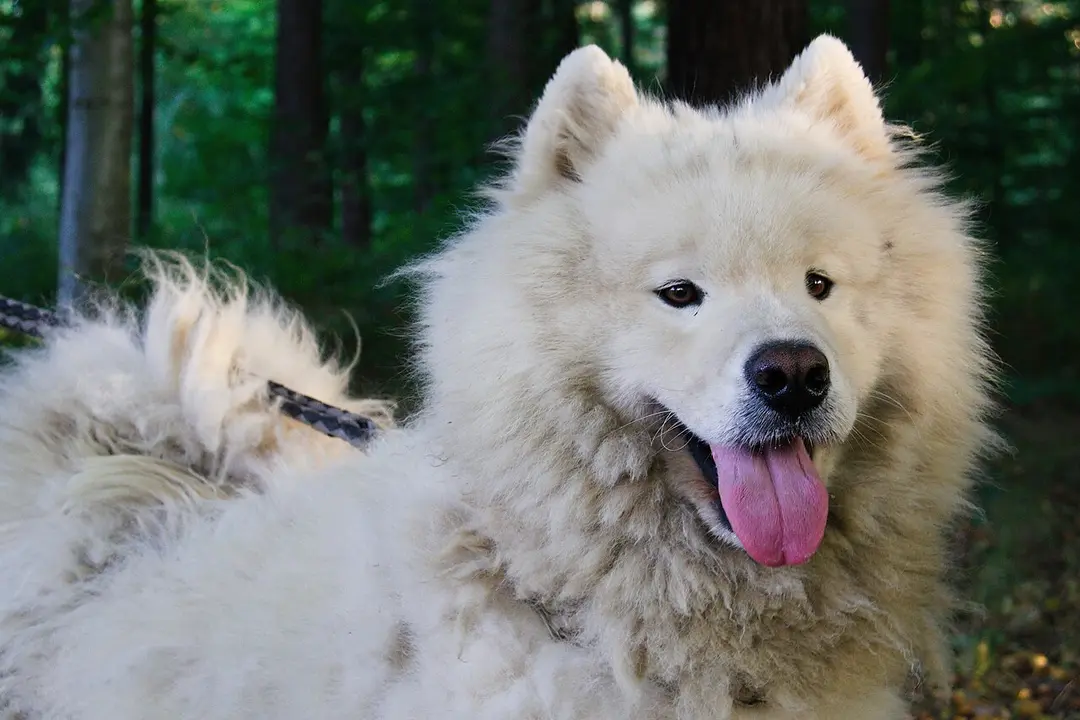
Samoyed

Friendly and sociable, often vocal; a poor guard dog.
Adult male
20–29 kg
45–65 lb
Adult female
16–23 kg
35–50 lb
Lifespan
13.1 yrs
Class · Family
also Working, Sport

What it's like

In temperament the Samoyed is friendly, gentle and sociable. It tends to greet strangers with interest rather than suspicion, so it makes a poor guard dog. It is lively and often vocal, and it keeps an independent streak from its working past. Some owners comb out the shed undercoat and have it spun into a soft, warm yarn.

Day to day
Activity
Needs lots of exercise
Intelligence
Learns readily, likes games
Handler demand
Needs steady training
With people
Affection
A lap or leaning dog
Loyalty
Bonded to its family
Independence
Cooperative, with its own ideas
Around the home
Sensitivity
Average
Voice
Very vocal
Prey drive
Chases; needs managing
Breed explains only about 9% of how individual dogs differ in behaviour1. Meet the dog. A good breeder breeds for temperament as well as health, and matches each puppy's personality to the right home2,3.
Is a Samoyed right for you?
Take the breed matcher

Living with one

It has a double coat, an outer coat over an undercoat. Most of the shedding comes when the seasons change. Plan on a brush once a week, plus daily brushing through the seasonal moult. It needs plenty of exercise compared with other breeds.

Size and growth

A Samoyed is a medium dog, heavier than a Border Collie and lighter than a Golden Retriever. Males end up clearly heavier than females.

The breed is a strong, compact spitz with a wedge-shaped head, erect ears and a plumed tail carried curled over the back. Its thick double coat has a soft, dense undercoat beneath a straight, harsher outer coat that stands away from the body, and it comes in white, cream, or white with biscuit markings. The upturned corners of the mouth give the breed its familiar expression, often called the Samoyed smile.

Puppy growth

Reference curve · community data appears as owners log
By about 5 months, a male Samoyed puppy is already as heavy as a grown Staffordshire Bull Terrier. They grow fastest between 3 and 4 months old.
Fully grown
11 mo
Both sexes, at 99% of adult weight7
Male
Female
Shaded: expected range
01020302m4m6m9m12m18m
01020302m3m4m6m9m12m18m
Age
Male
Female
2 months
4.4–6.4 kg 9.7–14.1 lb
3.8–5.5 kg 8.4–12.1 lb
3 months
6.5–9.5 kg 14.3–20.9 lb
5.4–7.7 kg 11.9–17.0 lb
4 months
9.5–13.7 kg 20.9–30.2 lb
7.7–11.1 kg 17.0–24.5 lb
5 months
12.2–17.6 kg 26.9–38.8 lb
9.8–14.0 kg 21.6–30.9 lb
6 months
14.6–21.1 kg 32.2–46.5 lb
11.5–16.4 kg 25.4–36.2 lb
7 months
16.3–23.6 kg 35.9–52.0 lb
12.7–18.2 kg 28.0–40.1 lb
8 months
17.6–25.5 kg 38.8–56.2 lb
13.6–19.4 kg 30.0–42.8 lb
9 months
18.5–26.7 kg 40.8–58.9 lb
14.2–20.3 kg 31.3–44.8 lb
10 months
19.1–27.6 kg 42.1–60.8 lb
14.7–21.0 kg 32.4–46.3 lb
11 months
19.5–28.2 kg 43.0–62.2 lb
15.0–21.4 kg 33.1–47.2 lb
12 months
19.8–28.6 kg 43.7–63.1 lb
15.2–21.7 kg 33.5–47.8 lb
15 months
20.3–29.3 kg 44.8–64.6 lb
15.7–22.4 kg 34.6–49.4 lb

Lifespan

In UK vet records, the typical Samoyed lived to about 13 years, about average for a medium breed.

Where it comes from

The Samoyed takes its name from the Samoyed peoples of northern Russia and Siberia, whose dogs herded and guarded reindeer, hunted and pulled sledges, and even slept in their owners' shelters. The western breed grew from a few dogs the zoologist Ernest Kilburn Scott brought or imported to England after visiting the tribes in 1889, together with explorers' dogs; an English standard followed in 19094,9.

The Samoyed's history in the West is closely tied to polar exploration. Dogs of the type were taken on several Arctic and Antarctic expeditions around the turn of the twentieth century, and some dogs from those expeditions are reported to have joined the early English breeding stock. Early imports included black, brown and patched dogs, but breeders in Britain soon favoured white, and the range of coat colours narrowed.

Breed standard

The Samoyed is judged against standard no. 212, in group 5, Spitz and primitive types4.

Questions people ask

General guidance for dogs rather than a measured Samoyed figure: most females have a first season somewhere between six and fifteen months, and cycles then settle to roughly every 180 days. Smaller breeds tend to start earlier and larger ones later, so a medium-sized breed is most likely somewhere in the middle.
Track your own Samoyed
Log a minute a day and watch them sit on these curves. Free.

Sources

Something wrong on this page?
Parts of this page were written by AI ·