Schapendoes

Cheerful and quick to learn, watchful but not aggressive.
Adult weight
12–25 kg
26–55 lb
Lifespan
12–15 yrs
Class · Sport
also Family, Working

What it's like

In temperament the Schapendoes is cheerful, alert and attentive, quick to learn and closely attached to its people. It is watchful with strangers without being aggressive, and its playful, independent streak reflects its working past.

Day to day
Activity
Needs lots of exercise
Intelligence
Needs daily brain work
Handler demand
Needs steady training
With people
Affection
Affectionate on its own terms
Loyalty
Bonded to its family
Independence
Cooperative, with its own ideas
Around the home
Sensitivity
Average
Voice
Very vocal
Prey drive
Usually fine with small pets
Breed explains only about 9% of how individual dogs differ in behaviour1. Meet the dog. A good breeder breeds for temperament as well as health, and matches each puppy's personality to the right home2,3.
Is a Schapendoes right for you?
Take the breed matcher

Living with one

It has a long coat. Most of the shedding comes when the seasons change. Plan on daily brushing. It needs plenty of exercise compared with other breeds.

Size and growth

A Schapendoes is a medium dog, about the weight of a grown Border Collie.

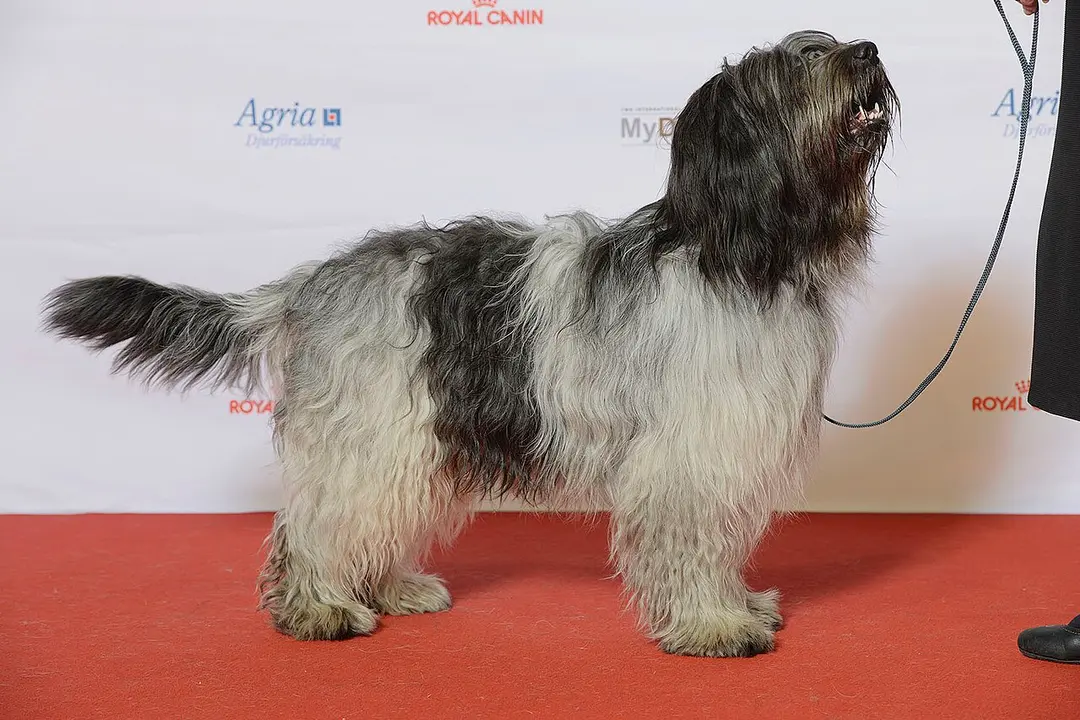
Its gait is light and springy, and it is noted for its agility, its ability to jump and its stamina. It is lightly built and lean beneath a long, dense, slightly wavy coat that can be any colour, though grey to black shades are common. The hair forms a beard and moustache and falls over the eyes, and the long, well-feathered tail is carried gaily when the dog is moving.

Puppy growth

Reference curve · community data appears as owners log
By about 5 months, a male Schapendoes puppy is already as heavy as a grown Pug. They grow fastest between 3 and 4 months old.
Fully grown
11 mo
Both sexes, at 99% of adult weight7
Male
Female
Shaded: expected range
01020302m4m6m9m12m18m
01020302m3m4m6m9m12m18m
Age
Male
Female
2 months
2.6–5.4 kg 5.7–11.9 lb
2.9–6.0 kg 6.4–13.2 lb
3 months
3.9–8.0 kg 8.6–17.6 lb
4.1–8.5 kg 9.0–18.7 lb
4 months
5.6–11.6 kg 12.3–25.6 lb
5.8–12.2 kg 12.8–26.9 lb
5 months
7.2–14.9 kg 15.9–32.8 lb
7.4–15.4 kg 16.3–34.0 lb
6 months
8.6–17.8 kg 19.0–39.2 lb
8.7–18.1 kg 19.2–39.9 lb
7 months
9.6–20.0 kg 21.2–44.1 lb
8 months
10.4–21.6 kg 22.9–47.6 lb
10.3–21.4 kg 22.7–47.2 lb
9 months
10.9–22.7 kg 24.0–50.0 lb
10.7–22.4 kg 23.6–49.4 lb
10 months
11.2–23.4 kg 24.7–51.6 lb
11.1–23.1 kg 24.5–50.9 lb
11 months
11.5–23.9 kg 25.4–52.7 lb
11.3–23.6 kg 24.9–52.0 lb
12 months
11.6–24.2 kg 25.6–53.4 lb
11.5–23.9 kg 25.4–52.7 lb
15 months
11.9–24.8 kg 26.2–54.7 lb
11.8–24.7 kg 26.0–54.5 lb

Lifespan

No vet study has measured how long Schapendoes dogs live yet. The 12–15 years shown is a general figure without a published source.

Where it comes from

The Schapendoes herded sheep wherever the Netherlands had heathland around 1900, one of the long-haired, shaggy-headed herding dogs kin to the Bearded Collie, Puli and Briard. P.M.C. Toepoel, a canine authority and the breed's founder, stirred up interest in it during the Second World War, when the few dogs left were bred from wherever they could be traced, and it was fully recognised in 19714.

The Schapendoes, also called the Dutch Sheepdog, takes part of its name from the Dutch word for sheep. Its decline in the early twentieth century is linked to the shrinking of the heaths, as common grazing land was cultivated and flocks gave way to farming. After the Second World War a Dutch breed club was formed, a written standard followed, and the breed slowly rebuilt from its narrow base into a recognised pedigree dog. It was bred to gather and drive flocks over open country, often working at a distance from the shepherd and using its own judgement.

Breed standard

The Schapendoes is judged against standard no. 313, in group 1, Sheepdogs and Cattledogs4.

Questions people ask

General guidance for dogs rather than a measured Schapendoes figure: most females have a first season somewhere between six and fifteen months, and cycles then settle to roughly every 180 days. Smaller breeds tend to start earlier and larger ones later, so a medium-sized breed is most likely somewhere in the middle.
Track your own Schapendoes
Log a minute a day and watch them sit on these curves. Free.

Sources

Uncited on this page: Lifespan — no reviewed source yet, so it is a general reference figure rather than a published one.
Something wrong on this page?
Parts of this page were written by AI ·