Schipperke
What it's like
In temperament the Schipperke is confident, alert and curious, quick to notice change and ready to bark about it. It tends to be reserved with strangers and closely attached to its household, with an energy suited to its old job of patrolling cramped working spaces.
Living with one
Size and growth
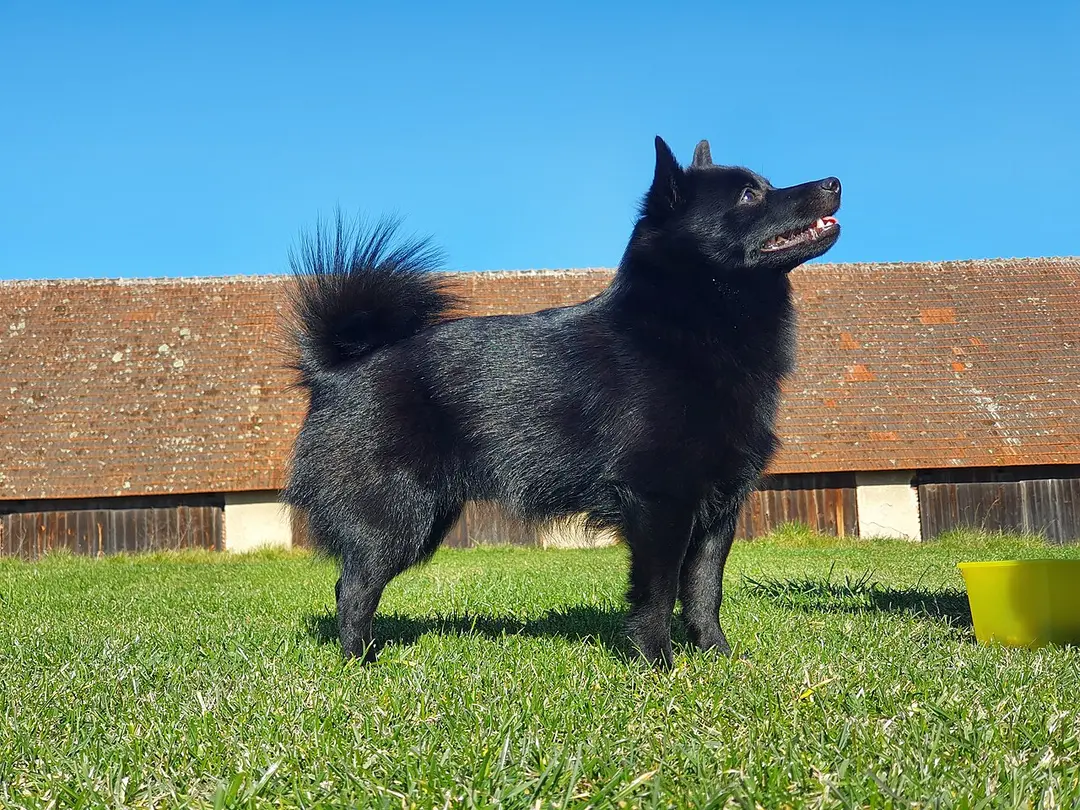
It is a small, compact dog with a fox-like head, sharp upright ears and a short body that appears to slope from the shoulders to the rump. That outline comes from the coat, which is harsh and dense, forming a thick ruff and cape around the neck and shoulders and long culottes on the thighs. Black is the classic colour and the only one the FCI accepts, though the Kennel Club permits other solid colours. Some puppies are born without a tail.
Puppy growth
Lifespan
Where it comes from
The Schipperke grew from a common workshop dog into a recognised show breed in the late nineteenth century, when Belgian fanciers formed a club and set down a written standard. The breed had reached Britain and North America before the century closed. Its working role was modest but demanding: catching rats and mice, and raising the alarm at anything unfamiliar in a yard or shop. Its popular image as a barge dog is disputed.
Breed standard
Questions people ask
Compare with related
Sources
- 1Morrill et al., 2022. Ancestry-inclusive dog genomics challenges popular breed stereotypes. Science 376: eabk0639 (Darwin's Ark). ↑
- 2Dogs Trust. Finding a good, responsible breeder. ↑
- 3American Kennel Club. Screening puppy buyers: how top breeders find the best homes. ↑
- 4
- 5American Kennel Club. Schipperke breed standard. ↑
- 6
- 7Hawthorne et al., 2004. Body-weight changes during growth in puppies of different breeds. Journal of Nutrition 134(8 Suppl): 2027S–2030S (WALTHAM). ↑
- 8The Kennel Club. Schipperke. ↑