Scottish Deerhound
What it's like
In character the deerhound is gentle, dignified and polite. It is quiet and unhurried indoors and friendly towards strangers, which makes it a poor guard dog. Outdoors its instinct to chase anything that runs is strong, and it is sensitive to harsh handling.
Living with one
Size and growth
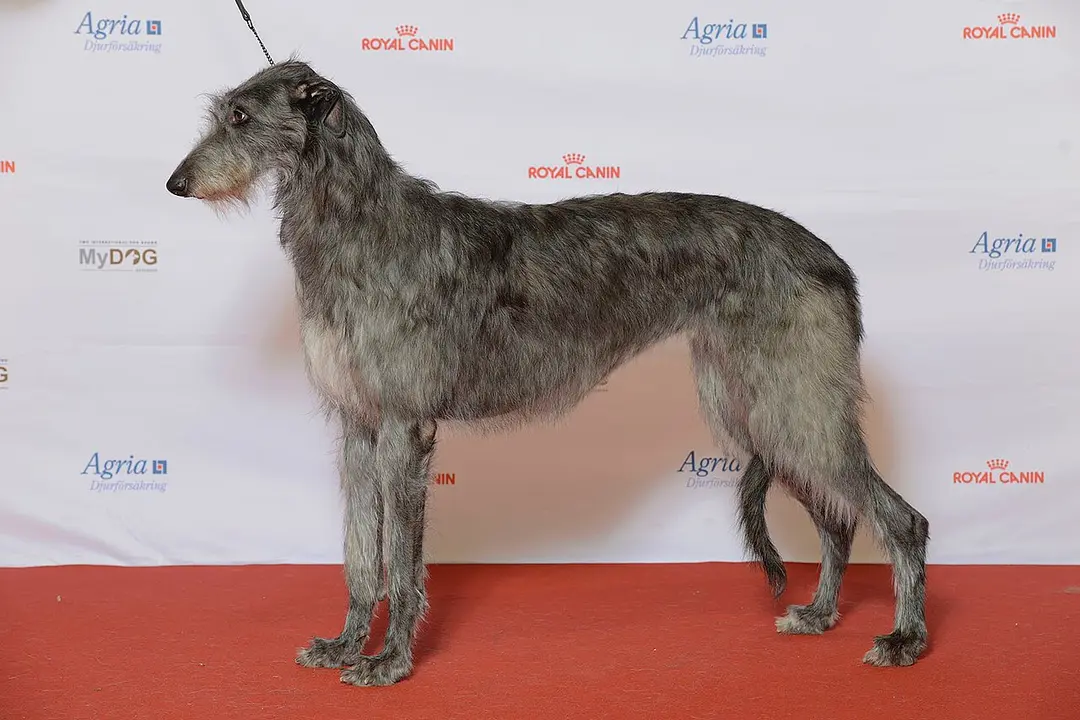
In outline it resembles a larger, rougher Greyhound, with long legs, a deep chest, a gently arched loin and a long, tapering tail. The coat is harsh and wiry on the body and softer on the head, chest and belly, with a slight beard and moustache. Dark blue-grey is the favoured colour, and grey, brindle, sandy red and fawn are also seen. The small ears are folded back, soft and dark.
Puppy growth
Health and lifespan
- Bone cancerFar more likelyImpact: life-limiting
Lifespan
Where it comes from
The Scottish Deerhound's revival in the nineteenth century owed much to Highland sporting estates and Victorian taste. Sir Walter Scott admired deerhounds and wrote of them warmly, and Edwin Landseer painted the breed again and again. A breed club was formed in the eighteen-eighties to protect the type, and Captain George Graham, from the eighteen-sixties, used deerhound blood to rebuild the Irish Wolfhound. The breed was developed to course red deer across open hill country. It hunted by sight and ran alone or in pairs rather than in a pack.
Breed standard
Questions people ask
Compare with related
Sources
- 1Morrill et al., 2022. Ancestry-inclusive dog genomics challenges popular breed stereotypes. Science 376: eabk0639 (Darwin's Ark). ↑
- 2Dogs Trust. Finding a good, responsible breeder. ↑
- 3American Kennel Club. Screening puppy buyers: how top breeders find the best homes. ↑
- 4
- 5American Kennel Club. Scottish Deerhound breed page. ↑
- 6Hawthorne et al., 2004. Body-weight changes during growth in puppies of different breeds. Journal of Nutrition 134(8 Suppl): 2027S–2030S (WALTHAM). ↑
- 7
- 8AAFCO, 2016. AAFCO Dog and Cat Food Nutrient Profiles. Association of American Feed Control Officials. ↑
- 9
- 10
- 11Scottish Deerhound Club of America. History (AKC Complete Dog Book text). ↑