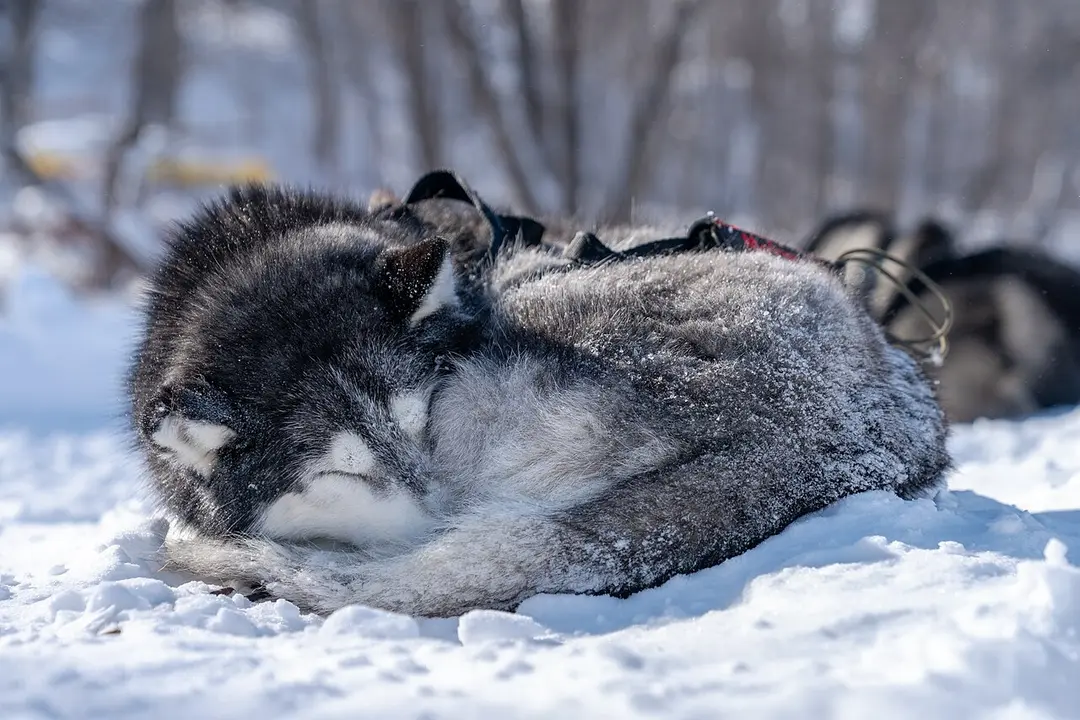
Siberian Husky

Friendly and mischievous; many are escape artists.
Adult male
20–27 kg
45–60 lb
Adult female
16–23 kg
35–50 lb
Lifespan
11.9 yrs
Class · Sport
also Working

What it's like

The Siberian Husky is friendly, gentle and outgoing, with an independent streak and a name for mischief. It greets strangers rather than warning them off, and many are determined escape artists.

Owners rating everyday behaviour found Huskies friendlier with people and dogs, and more independent-minded, than most. Owners far more often said they howl, worth knowing if you share a wall; on calmness they were about average. Breed is only a small part of any one dog's personality, so meet the dog before you decide.
Day to day
Activity
Needs lots of exercise
Intelligence
Learns readily, likes games
Handler demand
Needs an experienced owner
With people
Affection
Affectionate on its own terms
Loyalty
Friendly with everyone
Independence
Decides for itself
Around the home
Sensitivity
Needs a calm, predictable home
Voice
Very vocal
Prey drive
Likely to chase small pets
Breed explains only about 9% of how individual dogs differ in behaviour1. Meet the dog. A good breeder breeds for temperament as well as health, and matches each puppy's personality to the right home2,3.
Is a Siberian Husky right for you?
Take the breed matcher

Living with one

A Husky isn't overly suspicious of strangers, so don't expect a guard dog. The coat is largely self-cleaning, but the undercoat comes out twice a year and needs raking out. Bred to pull over long distances, it needs plenty of exercise.

Size and growth

A Siberian Husky is a medium dog, heavier than a Border Collie and lighter than a Golden Retriever. Males end up clearly heavier than females.

The breed is compact and lighter on its feet than the Alaskan Malamute, with erect triangular ears, a brush tail carried in a sickle curve when alert, and a dense double coat in any colour from black to pure white, often with a contrasting mask. The eyes may be brown or blue, or one of each.

Puppy growth

Reference curve · community data appears as owners log
By about 5 months, a male Siberian Husky puppy is already as heavy as a grown Staffordshire Bull Terrier. They grow fastest between 3 and 4 months old.
Fully grown
11 mo
Both sexes, at 99% of adult weight9
Male
Female
Shaded: expected range
01020302m4m6m9m12m18m
01020302m3m4m6m9m12m18m
Age
Male
Female
2 months
4.4–5.9 kg 9.7–13.0 lb
3.8–5.5 kg 8.4–12.1 lb
3 months
6.5–8.7 kg 14.3–19.2 lb
5.4–7.7 kg 11.9–17.0 lb
4 months
9.5–12.6 kg 20.9–27.8 lb
7.7–11.1 kg 17.0–24.5 lb
5 months
12.2–16.3 kg 26.9–35.9 lb
9.8–14.0 kg 21.6–30.9 lb
6 months
14.6–19.4 kg 32.2–42.8 lb
11.5–16.4 kg 25.4–36.2 lb
7 months
16.3–21.8 kg 35.9–48.1 lb
12.7–18.2 kg 28.0–40.1 lb
8 months
17.6–23.5 kg 38.8–51.8 lb
13.6–19.4 kg 30.0–42.8 lb
9 months
18.5–24.6 kg 40.8–54.2 lb
14.2–20.3 kg 31.3–44.8 lb
10 months
19.1–25.4 kg 42.1–56.0 lb
14.7–21.0 kg 32.4–46.3 lb
11 months
19.5–26.0 kg 43.0–57.3 lb
15.0–21.4 kg 33.1–47.2 lb
12 months
19.8–26.4 kg 43.7–58.2 lb
15.2–21.7 kg 33.5–47.8 lb
15 months
20.3–27.0 kg 44.8–59.5 lb
15.7–22.4 kg 34.6–49.4 lb

Health and lifespan

In UK vet records, underactive thyroid turns up more often in Siberian Huskies than in crossbreeds: it is more likely. It is not rated serious. These are figures for the breed as a whole, not a prediction for your dog.
Listed by likelihood level, highest first, then by how serious it is, then by name.
  • Underactive thyroid
    More likely
    Impact: moderate

Lifespan

In UK vet records, the typical Siberian Husky lived to about 12 years, shorter than the typical medium breed.

Where it comes from

The Siberian Husky descends from the Chukchi sled dog of north-eastern Siberia, bred for long-distance hauling by a people who kept their dogs with the family and castrated every male but the pick of the lead dogs. In 1925 relays of Husky teams carried diphtheria serum to Nome, Alaska. Despite that Siberian ancestry, the FCI gives the United States as its country of origin4,12.

The Siberian Husky as known today took shape in North America. Dogs were brought from Siberia to Alaska early in the twentieth century to race in the All Alaska Sweepstakes, where their speed and stamina surprised drivers used to larger freighting dogs. The musher Leonhard Seppala became closely linked with the breed and helped establish it in New England, where breeders developed the lines behind most modern Huskies. The American Kennel Club recognised it in the early nineteen-thirties. Bred to pull light loads at moderate speed over great distances, Huskies also served with polar expeditions and with American search and rescue units in the Arctic during the Second World War.

Breed standard

The Siberian Husky is judged against standard no. 270, in group 5, Spitz and primitive types4.

Questions people ask

General guidance for dogs rather than a measured Siberian Husky figure: most females have a first season somewhere between six and fifteen months, and cycles then settle to roughly every 180 days. Smaller breeds tend to start earlier and larger ones later, so a medium-sized breed is most likely somewhere in the middle.
Track your own Siberian Husky
Log a minute a day and watch them sit on these curves. Free.

Sources

Something wrong on this page?
Parts of this page were written by AI ·