Skye Terrier

Steady and devoted, often aloof with strangers.
Adult weight
16–20 kg
35–45 lb
Lifespan
10–16 yrs
Class · Companion
also Watchdog

What it's like

In temperament the Skye is courageous and closely attached to its own people, yet reserved and often aloof with strangers. It is a steady, dignified dog rather than an excitable one, though it keeps a terrier's readiness to stand its ground.

Day to day
Activity
A good daily walk and play
Intelligence
Learns readily, likes games
Handler demand
Needs steady training
With people
Affection
Affectionate on its own terms
Loyalty
Sticks close to its people
Independence
Decides for itself
Around the home
Sensitivity
Needs a calm, predictable home
Voice
Barks to alert, then settles
Prey drive
Chases; needs managing
Breed explains only about 9% of how individual dogs differ in behaviour1. Meet the dog. A good breeder breeds for temperament as well as health, and matches each puppy's personality to the right home2,3.
Is a Skye Terrier right for you?
Take the breed matcher

Living with one

It has a double coat, an outer coat over an undercoat. Most of the shedding comes when the seasons change. Plan on a brush once a week, plus daily brushing through the seasonal moult. It needs a moderate amount of exercise compared with other breeds.

Size and growth

A Skye Terrier is a medium dog, about the weight of a grown Border Collie.

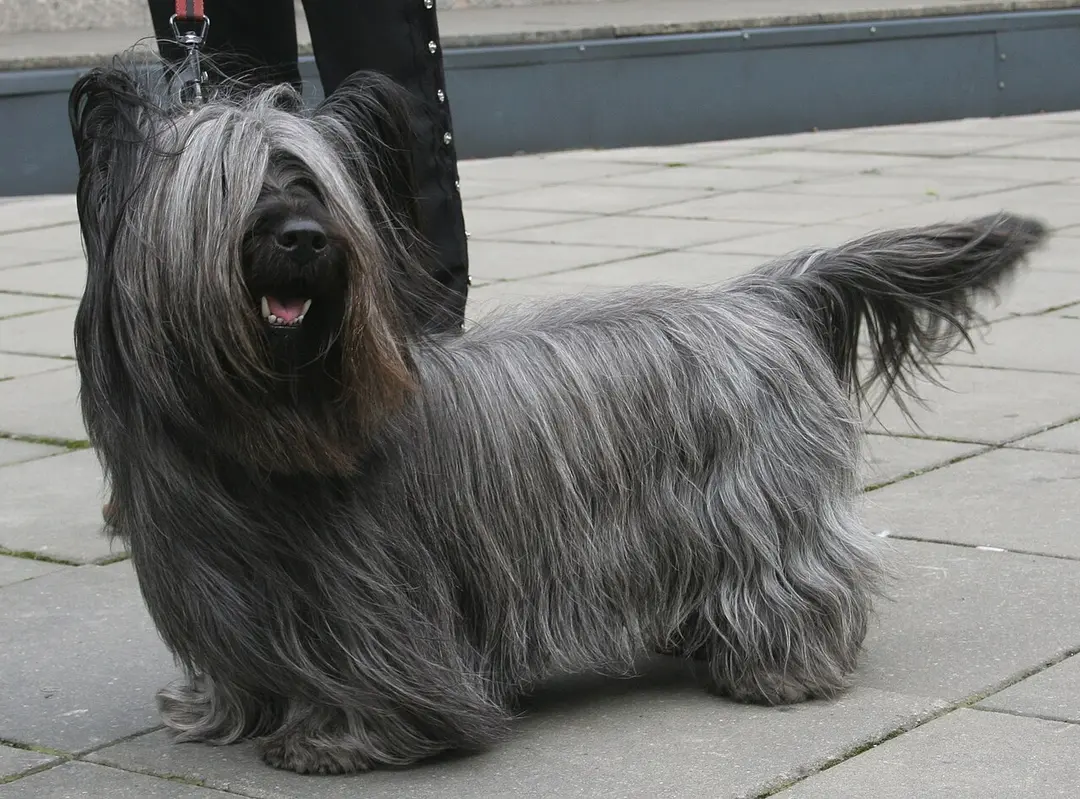
The Skye is long and low, with a hard, straight outer coat over a soft undercoat. The coat parts along the back, falls to either side and veils the forehead and eyes. Ears may be pricked and fringed with feathering, or dropped and lying flat against the head; the prick-eared form is now more common. Colours include black, grey, fawn and cream, with black ears and muzzle.

Puppy growth

Reference curve · community data appears as owners log
By about 5 months, a male Skye Terrier puppy is already as heavy as a grown Pug. They grow fastest between 3 and 4 months old.
Fully grown
11 mo
Both sexes, at 99% of adult weight7
Male
Female
Shaded: expected range
01020302m4m6m9m12m18m
01020302m3m4m6m9m12m18m
Age
Male
Female
2 months
3.5–4.4 kg 7.7–9.7 lb
3.8–4.9 kg 8.4–10.8 lb
3 months
5.1–6.5 kg 11.2–14.3 lb
5.4–7.0 kg 11.9–15.4 lb
4 months
7.4–9.5 kg 16.3–20.9 lb
7.7–9.9 kg 17.0–21.8 lb
5 months
9.5–12.2 kg 20.9–26.9 lb
9.8–12.6 kg 21.6–27.8 lb
6 months
11.4–14.6 kg 25.1–32.2 lb
11.5–14.7 kg 25.4–32.4 lb
7 months
12.7–16.3 kg 28.0–35.9 lb
8 months
13.7–17.6 kg 30.2–38.8 lb
13.6–17.4 kg 30.0–38.4 lb
9 months
14.4–18.5 kg 31.7–40.8 lb
14.2–18.3 kg 31.3–40.3 lb
10 months
14.9–19.1 kg 32.8–42.1 lb
14.7–18.8 kg 32.4–41.4 lb
11 months
15.2–19.5 kg 33.5–43.0 lb
15.0–19.2 kg 33.1–42.3 lb
12 months
15.4–19.8 kg 34.0–43.7 lb
15.2–19.5 kg 33.5–43.0 lb
15 months
15.8–20.3 kg 34.8–44.8 lb
15.7–20.1 kg 34.6–44.3 lb

Lifespan

No vet study has measured how long Skye Terriers live yet. The 10–16 years shown is a reference range, not a measured one.

Where it comes from

The Skye Terrier, once called the terrier of the Western Isles, hunted fox and badger in the Hebrides, and Dr John Caius described it in 1570. Queen Victoria's acquiring one in 1842 helped widen its following, and from around 1858 Greyfriars Bobby kept watch at his master's grave in Edinburgh. Compared with the early dogs, the Skye of today is bigger, with a longer body and a heavier coat4,9.

The Skye Terrier's standing changed considerably after its Victorian heyday. In the nineteenth century the name was applied loosely to several rough-coated Scottish terriers, and the breed's identity settled only once shows and stud books fixed a standard. It later fell from fashion, and the Kennel Club now lists it among its vulnerable native breeds. Its ancestors went to ground after fox, badger and otter among island rocks and cairns, work that favoured a low body and a protective coat.

Breed standard

The Skye Terrier is judged against standard no. 75, in group 3, Terriers4.

Questions people ask

General guidance for dogs rather than a measured Skye Terrier figure: most females have a first season somewhere between six and fifteen months, and cycles then settle to roughly every 180 days. Smaller breeds tend to start earlier and larger ones later, so a medium-sized breed is most likely somewhere in the middle.
Track your own Skye Terrier
Log a minute a day and watch them sit on these curves. Free.

Sources

Something wrong on this page?
Parts of this page were written by AI ·