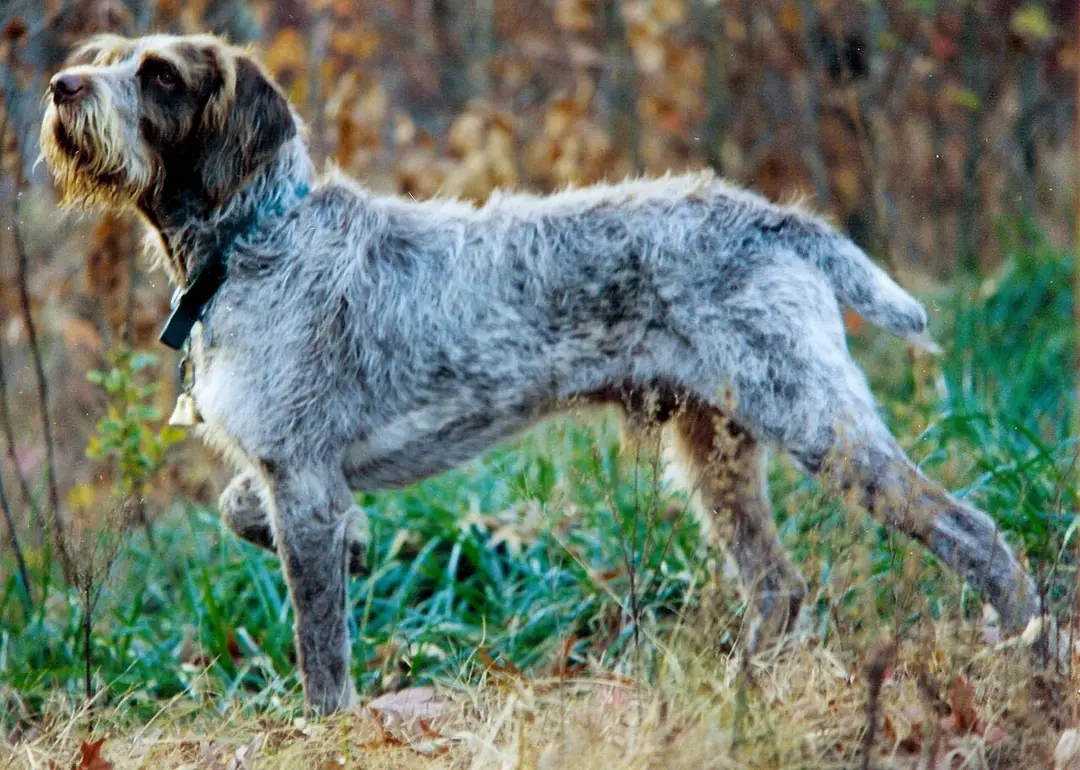
Spinone Italiano

Patient, easy-going and placid around the home.
Adult male
32–37 kg
71–82 lb
Adult female
28–30 kg
62–66 lb
Lifespan
11.9 yrs
Handler demand
Suits a first-time owner
Class · Field
also Family, Companion

What it's like

In temperament the Spinone is sociable, patient and affectionate, and generally easy-going with people and other dogs. In the field it tends to work within range of the hunter in a calm, unhurried style, and that placid manner usually carries over into the home.

Day to day
Activity
A good daily walk and play
Intelligence
Easy-going, simple routines
Handler demand
Suits a first-time owner
With people
Affection
A lap or leaning dog
Loyalty
Bonded to its family
Independence
Cooperative, with its own ideas
Around the home
Sensitivity
Average
Voice
Quiet
Prey drive
Chases; needs managing
Breed explains only about 9% of how individual dogs differ in behaviour1. Meet the dog. A good breeder breeds for temperament as well as health, and matches each puppy's personality to the right home2,3.
Is a Spinone Italiano right for you?
Take the breed matcher

Living with one

It has a wire or harsh coat. Loose hair stays caught in the coat until it is brushed, stripped or clipped out. Plan on a brush once a week, plus hand-stripping two or three times a year. It needs plenty of exercise compared with other breeds.

Size and growth

A Spinone Italiano is a large dog, about the weight of a grown Labrador. Males end up clearly heavier than females.

It is a solidly built, roughly square dog with a long head, a gentle, almost human expression and long, hanging ears. The rough, wiry coat lies fairly close and thickens into eyebrows, a moustache and a beard. Colours are white, white with orange or brown markings, and orange or brown roan.

Puppy growth

Reference curve · community data appears as owners log
By about 5 months, a male Spinone Italiano puppy is already as heavy as a grown Border Collie. They grow fastest between 3 and 4 months old. Most males grow into the size large-breed puppy foods are made for.
Fully grown
12 mo
Both sexes, at 99% of adult weight7
Male
Female
Shaded: expected range
0102030402m4m6m9m12m18m
0102030402m3m4m6m9m12m18m
Age
Male
Female
2 months
6.7–7.8 kg 14.8–17.2 lb
6.7–7.2 kg 14.8–15.9 lb
3 months
10.1–11.7 kg 22.3–25.8 lb
9.5–10.2 kg 20.9–22.5 lb
4 months
15.0–17.3 kg 33.1–38.1 lb
13.6–14.6 kg 30.0–32.2 lb
5 months
19.2–22.2 kg 42.3–48.9 lb
17.2–18.5 kg 37.9–40.8 lb
6 months
22.9–26.5 kg 50.5–58.4 lb
20.2–21.7 kg 44.5–47.8 lb
7 months
25.8–29.9 kg 56.9–65.9 lb
22.4–24.0 kg 49.4–52.9 lb
8 months
28.0–32.3 kg 61.7–71.2 lb
23.9–25.6 kg 52.7–56.4 lb
9 months
29.4–34.0 kg 64.8–75.0 lb
25.1–26.9 kg 55.3–59.3 lb
10 months
30.3–35.0 kg 66.8–77.2 lb
25.8–27.7 kg 56.9–61.1 lb
11 months
30.8–35.6 kg 67.9–78.5 lb
26.4–28.3 kg 58.2–62.4 lb
12 months
31.2–36.0 kg 68.8–79.4 lb
26.8–28.7 kg 59.1–63.3 lb
15 months
31.6–36.6 kg 69.7–80.7 lb
27.6–29.6 kg 60.8–65.3 lb

Health and lifespan

In UK vet and lab records, the conditions below turn up more often in Spinone Italianos than in crossbreeds. Inward-rolling eyelid and outward-drooping eyelid stand out as far more likely. The most serious, blood-vessel cancer of the spleen and bone cancer, can shorten a life and are much more likely. These are figures for the breed as a whole, not a prediction for your dog.
Listed by likelihood level, highest first, then by how serious it is, then by name.
  • Inward-rolling eyelid
    Far more likely
    Impact: moderate
  • Outward-drooping eyelid
    Far more likely
    Impact: minor
  • Blood-vessel cancer of the spleen
    Lab-confirmed cases
    Much more likely
    Impact: life-limiting
  • Bone cancer
    Lab-confirmed cases
    Much more likely
    Impact: life-limiting
  • Blood-vessel cancer of the skin
    Lab-confirmed cases
    Much more likely
    Impact: serious
Lab-confirmed: compares dogs whose tumour samples went to a lab with dogs seen in general practice, so the figures run higher than vet-record ones.

Lifespan

In UK vet records, the typical Spinone Italiano lived to about 12 years, about average for a large breed.

Where it comes from

The Spinone Italiano is a rough-coated Italian pointer, and Andrea Mantegna's 15th-century fresco in the ducal palace at Mantua is among the early pictures of its type. In 1683 Sélincourt's Le parfait chasseur described a "griffon" from Italy and Piedmont, one of several old accounts of a rough-haired Italian dog taken to be its ancestor4.

The Spinone Italiano took shape over centuries in northern Italy as a general-purpose gundog for hunters on foot; Piedmont is most often named as its heartland. Its name is usually linked to the pruno spinoso, the blackthorn, whose thorny thickets the dog would push through to reach game, though this derivation is told rather than proven. The breed declined sharply around the Second World War and was rebuilt by Italian breeders in the decades after; it reached Britain in the nineteen-eighties. Bred to hunt, point and retrieve, it works methodically at a steady extended trot rather than a gallop, and it will readily retrieve from water.

Breed standard

The Spinone Italiano is judged against standard no. 165, in group 7, Pointing Dogs4.

Questions people ask

General guidance for dogs rather than a measured Spinone Italiano figure: most females have a first season somewhere between six and fifteen months, and cycles then settle to roughly every 180 days. Smaller breeds tend to start earlier and larger ones later, so a large breed is most likely at the later end.
Track your own Spinone Italiano
Log a minute a day and watch them sit on these curves. Free.

Sources

Something wrong on this page?
Parts of this page were written by AI ·