Staffordshire Bull Terrier
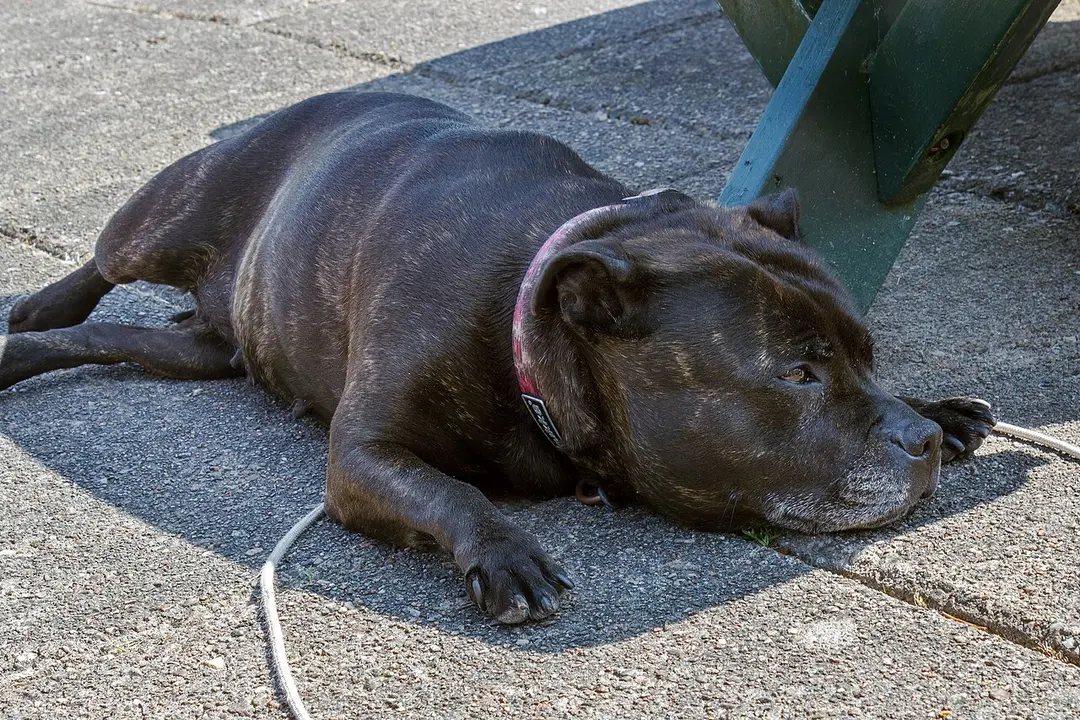
Bold and people-loving; can be intolerant of other dogs.
Adult male
13–17 kg
29–37 lb
Adult female
11–15 kg
24–34 lb
Lifespan
12 yrs
Class · Family
also Companion, Sport

What it's like

Temperamentally the Staffie is bold, tenacious and very attached to people. The Kennel Club standard notes its fondness for children, though its fighting past can show as intolerance of other dogs.

Day to day
Activity
A good daily walk and play
Intelligence
Learns readily, likes games
Handler demand
Needs steady training
With people
Affection
A lap or leaning dog
Loyalty
Bonded to its family
Independence
Cooperative, with its own ideas
Around the home
Sensitivity
Average
Voice
Quiet
Prey drive
Likely to chase small pets
Breed explains only about 9% of how individual dogs differ in behaviour1. Meet the dog. A good breeder breeds for temperament as well as health, and matches each puppy's personality to the right home2,3.
Is a Staffordshire Bull Terrier right for you?
Take the breed matcher

Living with one

A Staffie's short coat sheds through the year rather than in seasonal moults, and a brush once a week is the rule of thumb. Bred to go after vermin in bursts, it needs a moderate amount of exercise compared with other breeds. In UK vet records, its risk of heat-related illness was not measurably different from a Labrador's.

Size and growth

A Staffordshire Bull Terrier is a medium dog, about the weight of a grown Cocker Spaniel. Males end up a little heavier than females. It is one of the lightest medium breeds.

It is a compact, muscular dog, wide through the chest. The head is short and broad, with prominent cheek muscles, a distinct stop, round eyes, preferably dark, and rose or half-pricked ears. The tail is carried low and has been compared to an old-fashioned pump handle. The short, smooth coat lies close and comes in red, fawn, white, black or blue, any of these with white, or brindle, with or without white.

Puppy growth

Reference curve · community data appears as owners log
Staffordshire Bull Terriers reach half their adult weight at about 5 months. They grow fastest between 3 and 4 months old.
Fully grown
11 mo
Both sexes, at 99% of adult weight8
Male
Female
Shaded: expected range
051015202m4m6m9m12m18m
051015202m3m4m6m9m12m18m
Age
Male
Female
2 months
2.8–3.7 kg 6.2–8.2 lb
3.1–4.3 kg 6.8–9.5 lb
3 months
4.2–5.5 kg 9.3–12.1 lb
4.0–5.6 kg 8.8–12.3 lb
4 months
6.0–7.9 kg 13.2–17.4 lb
5.4–7.6 kg 11.9–16.8 lb
5 months
7.8–10.2 kg 17.2–22.5 lb
6.5–9.1 kg 14.3–20.1 lb
6 months
9.3–12.1 kg 20.5–26.7 lb
7.4–10.4 kg 16.3–22.9 lb
7 months
10.4–13.6 kg 22.9–30.0 lb
8.1–11.3 kg 17.9–24.9 lb
8 months
11.2–14.7 kg 24.7–32.4 lb
8.6–12.1 kg 19.0–26.7 lb
9 months
11.8–15.4 kg 26.0–34.0 lb
9.1–12.7 kg 20.1–28.0 lb
10 months
12.1–15.9 kg 26.7–35.1 lb
9.4–13.2 kg 20.7–29.1 lb
11 months
12.4–16.2 kg 27.3–35.7 lb
9.7–13.6 kg 21.4–30.0 lb
12 months
12.6–16.5 kg 27.8–36.4 lb
9.9–13.9 kg 21.8–30.6 lb
15 months
12.9–16.9 kg 28.4–37.3 lb
10.5–14.7 kg 23.1–32.4 lb
18 months
13–17 kg 29–37 lb
10.9–15.2 kg 24.0–33.5 lb

Health and lifespan

Vets record these more often in Staffies than in crossbreeds or other dogs. Mast cell tumour (serious) and demodectic mange in dogs under two (minor) are much more likely. Seizures (serious), a blood blister in the ear flap and corneal ulcers (both moderate) are more likely. These are figures for the breed as a whole, not a prediction for your dog.
Listed by likelihood level, highest first, then by how serious it is, then by name. These are 5 of 16 measured; lab-confirmed figures only fill places the vet-record studies leave empty.
  • Mast cell tumour
    Much more likely
    Impact: serious
  • Demodectic mange starting young, dogs under 2
    Much more likely
    Impact: minor
  • Seizures
    More likely
    Impact: serious
  • Blood blister in the ear flap
    More likely
    Impact: moderate
  • Corneal ulcers
    More likely
    Impact: moderate

Lifespan

In UK vet records, the typical Staffordshire Bull Terrier lived to about 12 years, shorter than the typical medium breed.

Where it comes from

The Staffordshire Bull Terrier's home is the Black Country, in Staffordshire and the northern fringe of Birmingham, where Bulldogs crossed with terriers served for ratting and blood sports. Once baiting was outlawed its followers turned to dog fighting, wanting the Bulldog's courage with a terrier's agility. While Hinks's white Bull Terrier won recognition by 1900, this working man's dog waited until fanciers formed a club and wrote a standard in 193516,17.

The Staffordshire Bull Terrier, once a dog of the ratting and fighting pit, changed course after recognition in the twentieth century. Breeders, many still from the Black Country, worked to settle a consistent type and to favour a steady, sociable dog over a fighting one. The breed spread overseas, and the American Kennel Club recognised it in the nineteen-seventies. Its ties to its home county remain strong: the Staffordshire Regiment kept a Staffie as its mascot, a line of dogs each named Watchman.

Breed standard

The Staffordshire Bull Terrier is judged against standard no. 76, in group 3, Terriers4.

Questions people ask

General guidance for dogs rather than a measured Staffordshire Bull Terrier figure: most females have a first season somewhere between six and fifteen months, and cycles then settle to roughly every 180 days. Smaller breeds tend to start earlier and larger ones later, so a medium-sized breed is most likely somewhere in the middle.
Track your own Staffordshire Bull Terrier
Log a minute a day and watch them sit on these curves. Free.

Sources

Something wrong on this page?
Parts of this page were written by AI ·