Standard Schnauzer
What it's like
The breed is alert, intelligent and energetic, with a strong instinct to guard home and family. It tends to be reserved with strangers but devoted to its own people. It learns quickly, though it can be headstrong and likes to test boundaries.
Living with one
Size and growth
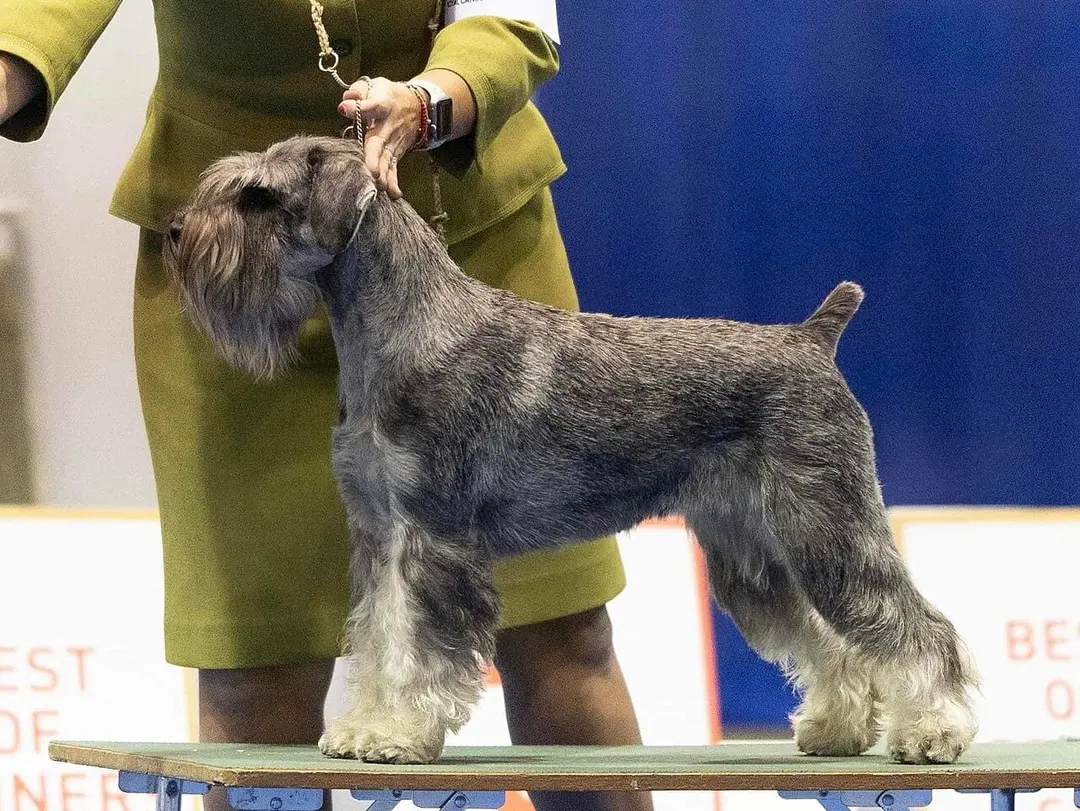
It is a robust, squarely built dog with a strong rectangular head, an arched neck and a short back. Its coat is harsh and wiry over a dense undercoat. The face carries the breed's trademark features: bushy eyebrows, a bristling moustache and a full beard. Coat colours are pepper and salt, in shades from dark iron-grey to silver, or pure black. In Britain, where cropping is illegal and docking largely banned, ears and tails are normally left natural.
Puppy growth
Lifespan
Where it comes from
The Standard Schnauzer became a formal breed in the late nineteenth century, when German breeders wrote a standard for it. In the eighteen-nineties they founded a club covering both the wire-coated Schnauzer and the smooth-coated Pinscher. Similar dogs are said to appear much earlier in German art, including works by Albrecht Dürer. During the First World War it reportedly served the German army as a dispatch carrier and guard. With other breeds, it also helped create the Miniature and Giant Schnauzers.
Breed standard
Questions people ask
Compare with related
Sources
- 1Morrill et al., 2022. Ancestry-inclusive dog genomics challenges popular breed stereotypes. Science 376: eabk0639 (Darwin's Ark). ↑
- 2Dogs Trust. Finding a good, responsible breeder. ↑
- 3American Kennel Club. Screening puppy buyers: how top breeders find the best homes. ↑
- 4
- 5
- 6Hawthorne et al., 2004. Body-weight changes during growth in puppies of different breeds. Journal of Nutrition 134(8 Suppl): 2027S–2030S (WALTHAM). ↑
- 7
- 8The Kennel Club. Schnauzer. ↑