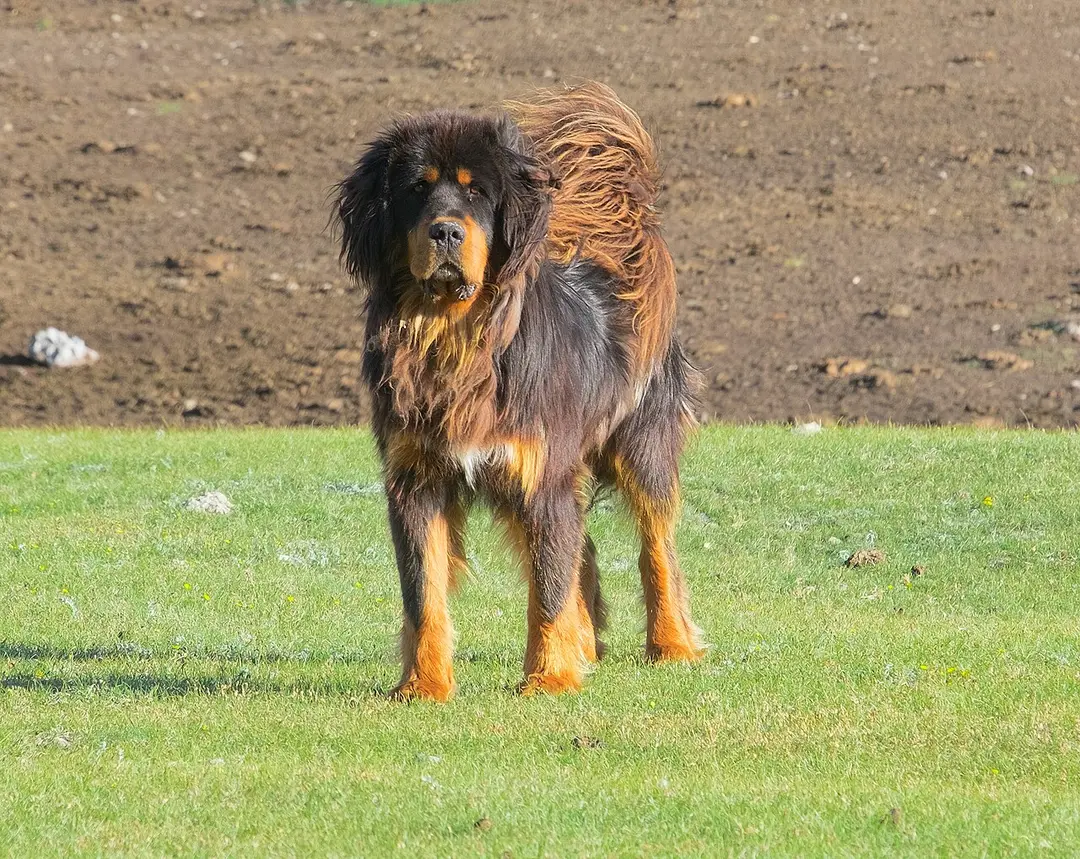
Tibetan Mastiff

Calm with family, territorial, most vocal after dark.
Adult male
41–68 kg
90–150 lb
Adult female
32–54 kg
71–119 lb
Lifespan
13.3 yrs
Class · Watchdog

What it's like

The Tibetan Mastiff has a guard's temperament. It is independent, reserved with strangers and strongly territorial, and is often at its most alert and vocal after dark, when such dogs were traditionally let loose to patrol. With its own household it is usually calm and steady.

Day to day
Activity
Happy with modest walks
Intelligence
Learns readily, likes games
Handler demand
Needs an experienced owner
With people
Affection
Likes its own space
Loyalty
Sticks close to its people
Independence
Decides for itself
Around the home
Sensitivity
Average
Voice
Very vocal
Prey drive
Chases; needs managing
Breed explains only about 9% of how individual dogs differ in behaviour1. Meet the dog. A good breeder breeds for temperament as well as health, and matches each puppy's personality to the right home2,3.
Is a Tibetan Mastiff right for you?
Take the breed matcher

Living with one

It has a double coat, an outer coat over an undercoat. Most of the shedding comes when the seasons change. Plan on a brush once a week, plus daily brushing through the seasonal moult. It needs a moderate amount of exercise compared with other breeds.

Size and growth

A Tibetan Mastiff is a giant dog, about the weight of a grown Rottweiler. Males end up clearly heavier than females. It is one of the lightest giant breeds.

It is a massive, heavy-boned dog with a broad head and deep-set eyes. Its dense double coat forms a thick mane around the neck and shoulders, which is heavier in males, and the well-feathered tail curls over the back. Colours include black, black and tan, brown, gold and slate blue-grey.

Puppy growth

Reference curve · community data appears as owners log
By about 5 months, a male Tibetan Mastiff puppy is already as heavy as a grown Labrador. They grow fastest between 4 and 5 months old. They keep growing past their first birthday, longer than a Beagle does. Most males grow into the size large-breed puppy foods are made for.
Fully grown
13 mo
Both sexes, at 99% of adult weight7
Male
Female
Shaded: expected range
0204060802m4m6m9m12m18m
0204060802m3m4m6m9m12m18m
Age
Male
Female
2 months
7.1–11.9 kg 15.7–26.2 lb
5.6–9.4 kg 12.3–20.7 lb
3 months
11.5–19.0 kg 25.4–41.9 lb
9.0–15.1 kg 19.8–33.3 lb
4 months
17.0–28.2 kg 37.5–62.2 lb
13.3–22.4 kg 29.3–49.4 lb
5 months
23.1–38.3 kg 50.9–84.4 lb
18.0–30.4 kg 39.7–67.0 lb
6 months
28.6–47.5 kg 63.1–104.7 lb
22.3–37.7 kg 49.2–83.1 lb
7 months
33.0–54.7 kg 72.8–120.6 lb
25.7–43.4 kg 56.7–95.7 lb
8 months
36.0–59.7 kg 79.4–131.6 lb
28.1–47.4 kg 61.9–104.5 lb
9 months
38.0–63.0 kg 83.8–138.9 lb
29.6–50.0 kg 65.3–110.2 lb
10 months
39.2–65.0 kg 86.4–143.3 lb
30.6–51.6 kg 67.5–113.8 lb
11 months
39.9–66.2 kg 88.0–145.9 lb
31.2–52.6 kg 68.8–116.0 lb
12 months
40.4–67.0 kg 89.1–147.7 lb
31.5–53.2 kg 69.4–117.3 lb
15 months
40.9–67.8 kg 90.2–149.5 lb
31.9–53.8 kg 70.3–118.6 lb
18 months
41.0–67.9 kg 90.4–149.7 lb
32.0–53.9 kg 70.5–118.8 lb

Lifespan

In UK vet records, the typical Tibetan Mastiff lived to about 13 and a half years, longer than the typical giant breed. Too few had died yet to pin the figure down, so it may turn out higher.

Where it comes from

The Tibetan Mastiff, or Do Khyi, has long worked for the nomadic herders of the Himalaya and guarded Tibet's monasteries; guarding homes and livestock, it was often chained by the gate. Stories about it go back to antiquity, and Marco Polo was among the writers who described it. Among the first known to reach the West was a male Lord Hardinge sent Queen Victoria in 18474,10.

The Tibetan Mastiff stayed rare in Britain through the nineteenth century, despite a pair acquired by the Prince of Wales, later King Edward the Seventh. Upheaval in Tibet in the mid twentieth century disrupted the herding life that had sustained it. Much Western stock descends from dogs later exported from Nepal and India. In China it became a fashionable status symbol in the early twenty-first century, and the prices reported for it drew international attention before demand collapsed. It was bred as a guard rather than a herder, and kept to drive wolves, leopards and intruders away from flocks, tents and courtyards.

Breed standard

The Tibetan Mastiff is judged against standard no. 230, in group 2, Pinscher and Schnauzer, Molossoid and Swiss Mountain Dogs4.

Questions people ask

General guidance for dogs rather than a measured Tibetan Mastiff figure: most females have a first season somewhere between six and fifteen months, and cycles then settle to roughly every 180 days. Smaller breeds tend to start earlier and larger ones later, so a giant breed is most likely at the late end.
Track your own Tibetan Mastiff
Log a minute a day and watch them sit on these curves. Free.

Sources

Something wrong on this page?
Parts of this page were written by AI ·