Toy Fox Terrier
What it's like
In temperament it is alert, bright and lively, bolder than its size suggests and closely attached to its household. It learns quickly and is often watchful and quick to bark at anything unfamiliar.
Size and growth
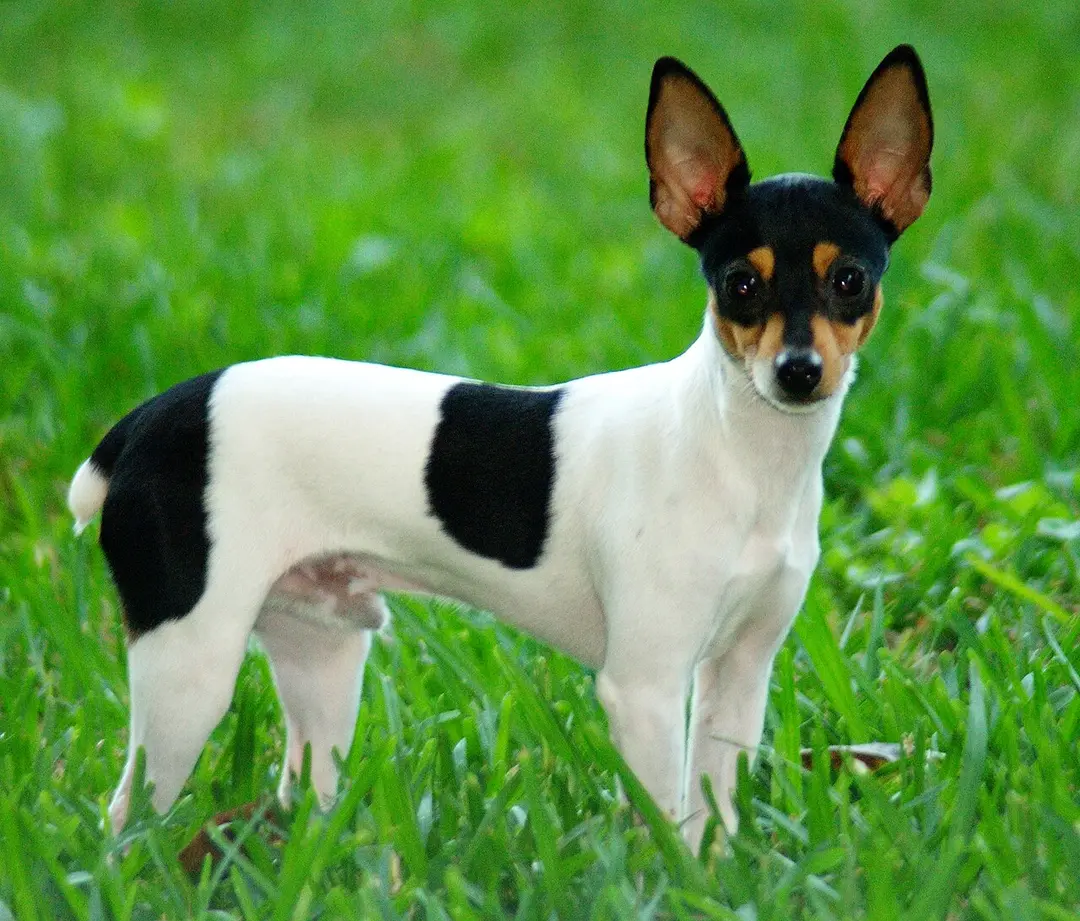
The body is compact and squarely built, with a fairly narrow head, large erect V-shaped ears and a high-set tail. The coat is short, fine and glossy. The body is mostly white, while the head is largely black, tan or chocolate, and the accepted patterns include black tricolour, chocolate tricolour, tan and white, and black and white.
Puppy growth
Lifespan
Where it comes from
The Toy Fox Terrier spent most of the twentieth century as an American farm and household dog, known mainly through the United Kennel Club, which kept its records after it gained its own name. Breeders gradually fixed a consistent type that kept the drive of its terrier ancestors in a much smaller frame. Wider recognition came in the early twenty-first century, when the American Kennel Club admitted it to its Toy Group. It is also known as the American Toy Terrier, sometimes shortened to Amertoy. Long kept as a ratter, it still has the quick reactions and persistence that made it useful around barns and outbuildings.
Breed standard
Questions people ask
Compare with related
Sources
- 1Morrill et al., 2022. Ancestry-inclusive dog genomics challenges popular breed stereotypes. Science 376: eabk0639 (Darwin's Ark). ↑
- 2Dogs Trust. Finding a good, responsible breeder. ↑
- 3American Kennel Club. Screening puppy buyers: how top breeders find the best homes. ↑
- 4American Kennel Club. Toy Fox Terrier breed page. ↑
- 5American Kennel Club. Toy Fox Terrier breed standard. ↑
- 6
- 7Hawthorne et al., 2004. Body-weight changes during growth in puppies of different breeds. Journal of Nutrition 134(8 Suppl): 2027S–2030S (WALTHAM). ↑
- 8
- 9United Kennel Club. Toy Fox Terrier standard. ↑
- 10American Kennel Club. Toy Fox Terrier. ↑