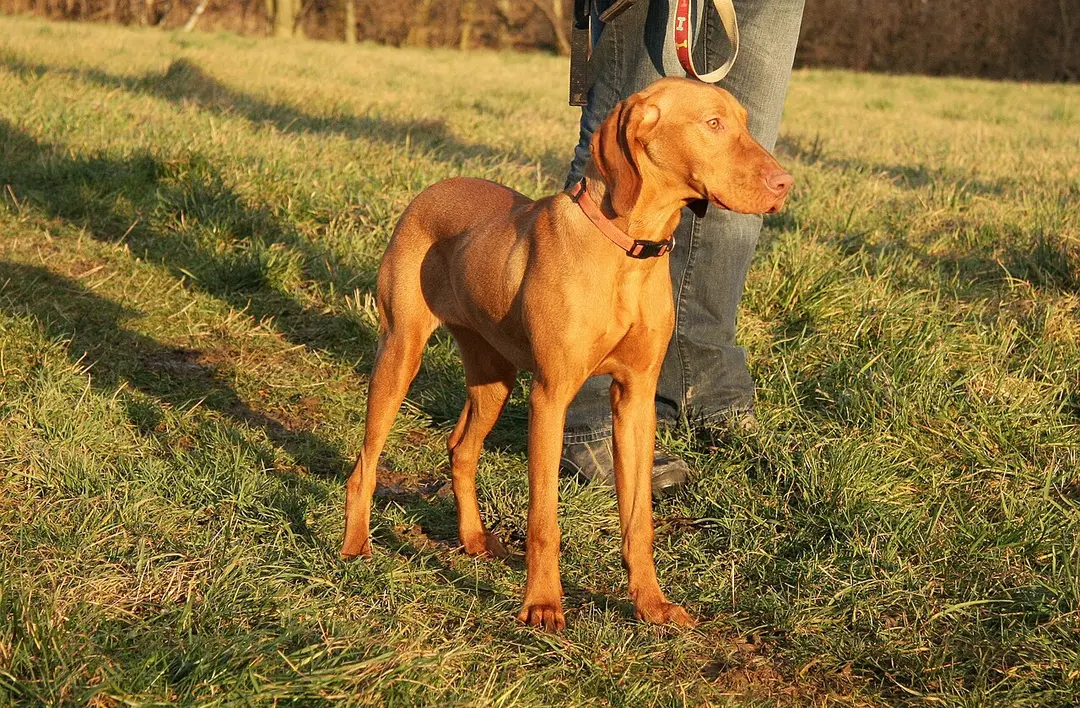
Vizsla

Gentle and affectionate; stays at your side room to room.
Adult male
25–27 kg
55–60 lb
Adult female
20–25 kg
44–55 lb
Lifespan
13.5 yrs
Class · Sport
also Field, Family

What it's like

In temperament the Vizsla is lively, gentle and affectionate. It is sensitive to tone of voice and strongly attached to its people, and its habit of staying at its owner's side from room to room has earned it the nickname 'Velcro dog'.

Day to day
Activity
Needs lots of exercise
Intelligence
Needs daily brain work
Handler demand
Needs steady training
With people
Affection
A lap or leaning dog
Loyalty
Sticks close to its people
Independence
Keen to work with you
Around the home
Sensitivity
Needs a calm, predictable home
Voice
Barks to alert, then settles
Prey drive
Chases; needs managing
Breed explains only about 9% of how individual dogs differ in behaviour1. Meet the dog. A good breeder breeds for temperament as well as health, and matches each puppy's personality to the right home2,3.
Is a Vizsla right for you?
Take the breed matcher

Living with one

A Vizsla cannot bear rough treatment, so consistent, positive training from puppyhood suits it, with ongoing socialisation to build its confidence. Bred to quarter ground all day, it needs plenty of exercise, and owners say it seeks constant activity more often than most.

Size and growth

A Vizsla is a medium dog, heavier than a Border Collie and lighter than a Golden Retriever. Males end up clearly heavier than females.

It is a lean, muscular dog of light, balanced build, with a short, smooth, close-lying coat of solid golden rust, which may vary in shade. Its nose, eyes and nails tone with the coat instead of contrasting with it, and a small white mark on the chest is allowed.

Puppy growth

Reference curve · community data appears as owners log
By about 5 months, a male Vizsla puppy is already as heavy as a grown Staffordshire Bull Terrier. They grow fastest between 3 and 4 months old.
Fully grown
11 mo
Both sexes, at 99% of adult weight8
Male
Female
Shaded: expected range
01020302m4m6m9m12m18m
01020302m3m4m6m9m12m18m
Age
Male
Female
2 months
5.4–5.9 kg 11.9–13.0 lb
4.8–6.0 kg 10.6–13.2 lb
3 months
8.0–8.7 kg 17.6–19.2 lb
6.8–8.5 kg 15.0–18.7 lb
4 months
11.6–12.6 kg 25.6–27.8 lb
9.7–12.1 kg 21.4–26.7 lb
5 months
14.9–16.3 kg 32.8–35.9 lb
12.3–15.3 kg 27.1–33.7 lb
6 months
17.8–19.4 kg 39.2–42.8 lb
14.4–18.0 kg 31.7–39.7 lb
7 months
19.9–21.8 kg 43.9–48.1 lb
16.0–19.9 kg 35.3–43.9 lb
8 months
21.5–23.5 kg 47.4–51.8 lb
17.1–21.3 kg 37.7–47.0 lb
9 months
22.6–24.6 kg 49.8–54.2 lb
17.9–22.3 kg 39.5–49.2 lb
10 months
23.3–25.4 kg 51.4–56.0 lb
18.5–23.0 kg 40.8–50.7 lb
11 months
23.8–26.0 kg 52.5–57.3 lb
18.9–23.5 kg 41.7–51.8 lb
12 months
24.1–26.4 kg 53.1–58.2 lb
19.1–23.8 kg 42.1–52.5 lb
15 months
24.7–27.0 kg 54.5–59.5 lb
19.7–24.6 kg 43.4–54.2 lb

Health and lifespan

Vets record these more often in Vizslas than in crossbreeds. Blood-vessel cancer and insulin-secreting pancreatic tumour are much more likely, and lymph node cancer more likely; all three are life-limiting. Two listed conditions come from lab-confirmed cases rather than vet records: melanoma of the eye or eyelid (serious) and skin melanoma (moderate) are far more likely there, though lab figures run higher than vet-record ones. These are figures for the breed as a whole, not a prediction for your dog.
Listed by likelihood level, highest first, then by how serious it is, then by name. These are 5 of 9 measured; lab-confirmed figures only fill places the vet-record studies leave empty.
  • Melanoma of the eye or eyelid
    Lab-confirmed cases
    Far more likely
    Impact: serious
  • Skin melanoma
    Lab-confirmed cases
    Far more likely
    Impact: moderate
  • Blood-vessel cancer
    Much more likely
    Impact: life-limiting
  • Insulin-secreting pancreatic tumour
    Much more likely
    Impact: life-limiting
  • Lymph node cancer
    More likely
    Impact: life-limiting
Lab-confirmed: compares dogs whose tumour samples went to a lab with dogs seen in general practice, so the figures run higher than vet-record ones.

Lifespan

In UK vet records, the typical Vizsla lived to about 13 and a half years, about average for a medium breed.

Where it comes from

The Vizsla's ancestors reached the Carpathian Basin as the Hungarian tribes migrated there, and there is evidence of falconers using it on Hungary's central plains in the 14th century. Its value as a hunting dog grew from the 18th century, and planned breeding began in 1920. The Kennel Club credits refugees who took their dogs out of Hungary with rebuilding the breed after the world wars4,14.

The Vizsla is a Hungarian gundog whose present form was settled during the twentieth century. From dogs carried abroad after the Second World War, the breed became established in North America and Britain in the decades that followed. In Hungary in the nineteen-thirties, breeders crossed Vizslas with German Wirehaired Pointers to produce a rougher-coated dog for harsh weather, and it is now recognised as a separate breed, the Wirehaired Vizsla. The Vizsla was bred to hunt, point and retrieve. It works open fields, cover and water, finding game such as partridge and hare, holding it on point and bringing it back to hand.

Breed standard

The Vizsla is judged against standard no. 57, in group 7, Pointing Dogs4.

Questions people ask

General guidance for dogs rather than a measured Vizsla figure: most females have a first season somewhere between six and fifteen months, and cycles then settle to roughly every 180 days. Smaller breeds tend to start earlier and larger ones later, so a medium-sized breed is most likely somewhere in the middle.
Track your own Vizsla
Log a minute a day and watch them sit on these curves. Free.

Sources

Something wrong on this page?
Parts of this page were written by AI ·