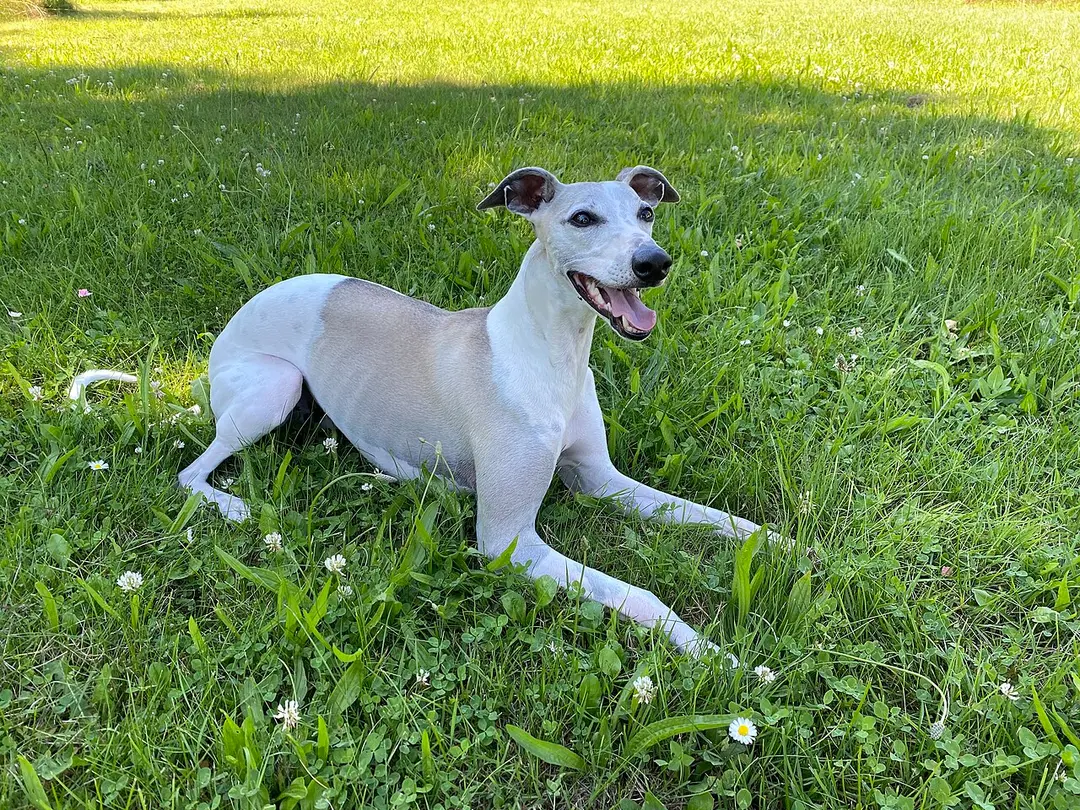
Whippet

Quiet and gentle indoors, quick to chase outdoors.
Adult weight
11–18 kg
25–40 lb
Lifespan
13.4 yrs
Handler demand
Suits a first-time owner
Class · Companion
also Sport, Family

What it's like

Indoors the Whippet is usually quiet, gentle and fond of comfort, and it often seeks out soft bedding and close contact with its people. Outdoors it is playful and quick to chase anything small that runs. It tends to be sensitive and does not respond well to harsh handling.

Day to day
Activity
A good daily walk and play
Intelligence
Learns readily, likes games
Handler demand
Suits a first-time owner
With people
Affection
A lap or leaning dog
Loyalty
Bonded to its family
Independence
Cooperative, with its own ideas
Around the home
Sensitivity
Needs a calm, predictable home
Voice
Quiet
Prey drive
Likely to chase small pets
Breed explains only about 9% of how individual dogs differ in behaviour1. Meet the dog. A good breeder breeds for temperament as well as health, and matches each puppy's personality to the right home2,3.
Is a Whippet right for you?
Take the breed matcher

Living with one

Young Whippets can jump and climb, so they need safe confinement when nobody is watching. Save off-lead sprints for a safely fenced area. Bred to sprint rather than run all day, it needs a moderate amount of exercise.

Size and growth

A Whippet is a medium dog, about the weight of a grown Staffordshire Bull Terrier. It is one of the lightest medium breeds.

The breed is built for short bursts of speed. It has a long, fine head, small folded ears, a long neck, a deep chest and a firm back with a definite arch over the loin above strong, muscular hindquarters. The coat is short, fine and close, and breed standards accept almost any colour or pattern, so fawn, brindle, black, blue and white-patched dogs are all seen.

Two types

The two types differ in height only, so there is one growth curve, on the record's own band (breed club figure)6.

UK / FCI type

FCI 162
Height at the withers
Males
47–51 cm
Females
44–47 cm5
Publishes no weight.

American type

AKC standard
Height at the withers
Males
48.3–55.9 cm
Females
45.7–53.3 cm7
Publishes no weight.

Puppy growth

Reference curve · community data appears as owners log
Whippets reach half their adult weight at about 5 months. They grow fastest between 3 and 4 months old.
Fully grown
10 mo
Both sexes, at 99% of adult weight9
Male
Female
Shaded: expected range
051015202m4m6m9m12m18m
051015202m3m4m6m9m12m18m
Age
Male
Female
2 months
2.9–4.6 kg 6.4–10.1 lb
3.2–5.1 kg 7.1–11.2 lb
3 months
3.9–6.2 kg 8.6–13.7 lb
4.1–6.6 kg 9.0–14.6 lb
4 months
5.5–8.8 kg 12.1–19.4 lb
5.5–8.9 kg 12.1–19.6 lb
5 months
6.8–10.9 kg 15.0–24.0 lb
6.7–10.7 kg 14.8–23.6 lb
6 months
7.9–12.6 kg 17.4–27.8 lb
7.6–12.2 kg 16.8–26.9 lb
7 months
8.6–13.8 kg 19.0–30.4 lb
8.3–13.3 kg 18.3–29.3 lb
8 months
9.2–14.8 kg 20.3–32.6 lb
8.9–14.2 kg 19.6–31.3 lb
9 months
9.7–15.5 kg 21.4–34.2 lb
9.3–14.9 kg 20.5–32.8 lb
10 months
10.0–16.1 kg 22.0–35.5 lb
9.7–15.5 kg 21.4–34.2 lb
11 months
10.3–16.5 kg 22.7–36.4 lb
10.0–16.0 kg 22.0–35.3 lb
12 months
10.5–16.8 kg 23.1–37.0 lb
10.2–16.4 kg 22.5–36.2 lb
15 months
10.9–17.5 kg 24.0–38.6 lb
10.8–17.2 kg 23.8–37.9 lb
18 months
11–18 kg 25–40 lb
11.2–17.9 kg 24.7–39.5 lb

Health and lifespan

Vets record gum disease (moderate) slightly more often in Whippets than in crossbreeds. In lab-confirmed cases, blood-vessel cancer of the skin (serious) is more likely, though lab figures run higher than vet-record ones. These are figures for the breed as a whole, not a prediction for your dog.
Listed by likelihood level, highest first, then by how serious it is, then by name.
  • Blood-vessel cancer of the skin
    Lab-confirmed cases
    More likely
    Impact: serious
  • Gum disease
    Slightly more likely
    Impact: moderate
Lab-confirmed: compares dogs whose tumour samples went to a lab with dogs seen in general practice, so the figures run higher than vet-record ones.

Lifespan

In UK vet records, the typical Whippet lived to about 13 and a half years, about average for a medium breed.

Where it comes from

The Whippet comes from the Greyhound, and in 19th-century Britain it earned its keep catching small game and vermin. Victorian owners bet on it, and Whippet racing later won a following in mining communities in the North and in Wales, and in London and the Midlands too. Early standards called it "a Greyhound in miniature", though the two have since grown apart in build14.

The Whippet was recognised by the Kennel Club in the late nineteenth century, by which time it had become a fixture of working-class sport. Its early breeders are generally thought to have crossed small Greyhounds with terriers, and perhaps the Italian Greyhound, though no exact record survives. It was often called the poor man's racehorse, and in rag racing each dog sprinted down a straight track towards its owner, who waved a cloth at the finish.

Breed standard

The American standard asks for a taller dog than the UK and international ones.

Questions people ask

General guidance for dogs rather than a measured Whippet figure: most females have a first season somewhere between six and fifteen months, and cycles then settle to roughly every 180 days. Smaller breeds tend to start earlier and larger ones later, so a medium-sized breed is most likely somewhere in the middle.
Track your own Whippet
Log a minute a day and watch them sit on these curves. Free.

Sources

Something wrong on this page?
Parts of this page were written by AI ·