Wirehaired Vizsla
What it's like
In temperament the breed is gentle and lively, with plenty of stamina and a keen nose. It attaches closely to its people and is known for preferring company to being left alone. It responds to calm, consistent handling rather than harshness, and it tends to be willing and quick to learn in the field.
Living with one
Size and growth
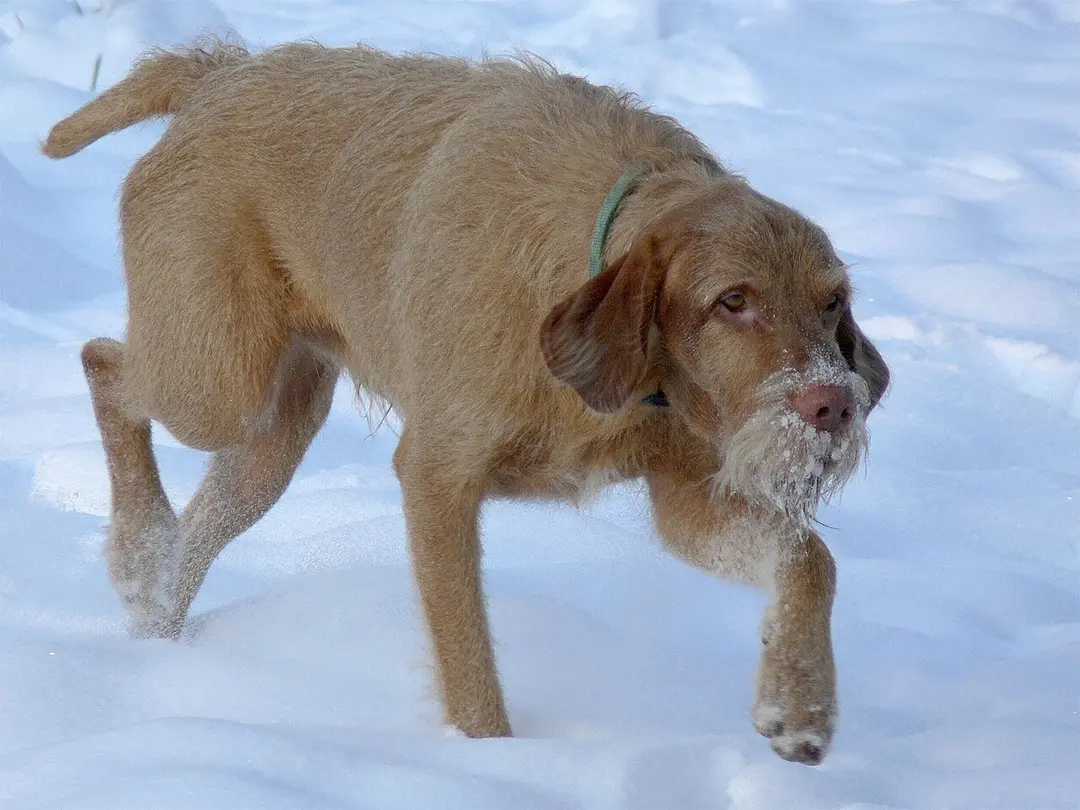
In outline it resembles the smooth Vizsla but is a little sturdier, with a dense, harsh coat lying close to the body over a water-resistant undercoat. The wiry hair forms a short beard and bushy eyebrows, which give the face a serious, whiskered look. The coat is a shade of russet or golden sand, and the nose, eye rims and claws tone with it rather than showing black. Small white patches on the chest or toes are allowed.
Puppy growth
Lifespan
Where it comes from
The Wirehaired Vizsla, known in Hungary as the drótszőrű magyar vizsla, took some decades to settle into a recognised breed. Its early breeders, among them József Vasas, had to rebuild their small stock after the Second World War, and the Fédération Cynologique Internationale accepted the breed in the nineteen-sixties. It later reached Britain and North America. It is a versatile gundog, bred to find game, point and retrieve on land or water.
Breed standard
Questions people ask
Compare with related
Sources
- 1Morrill et al., 2022. Ancestry-inclusive dog genomics challenges popular breed stereotypes. Science 376: eabk0639 (Darwin's Ark). ↑
- 2Dogs Trust. Finding a good, responsible breeder. ↑
- 3American Kennel Club. Screening puppy buyers: how top breeders find the best homes. ↑
- 4
- 5American Kennel Club. Wirehaired Vizsla breed page. ↑
- 6
- 7Hawthorne et al., 2004. Body-weight changes during growth in puppies of different breeds. Journal of Nutrition 134(8 Suppl): 2027S–2030S (WALTHAM). ↑
- 8American Kennel Club. Wirehaired Vizsla breed history. ↑