Yorkshire Terrier
What it's like
In temperament the breed keeps much of the terrier in a small frame: alert, bold and quick to bark at strangers, yet affectionate with its household. One Yorkshire Terrier, Smoky, found in New Guinea during the Second World War, is recorded as having later pulled a telegraph wire through a narrow pipe beneath an airstrip in the Philippines, sparing the soldiers a great deal of digging.
Living with one
Size and growth
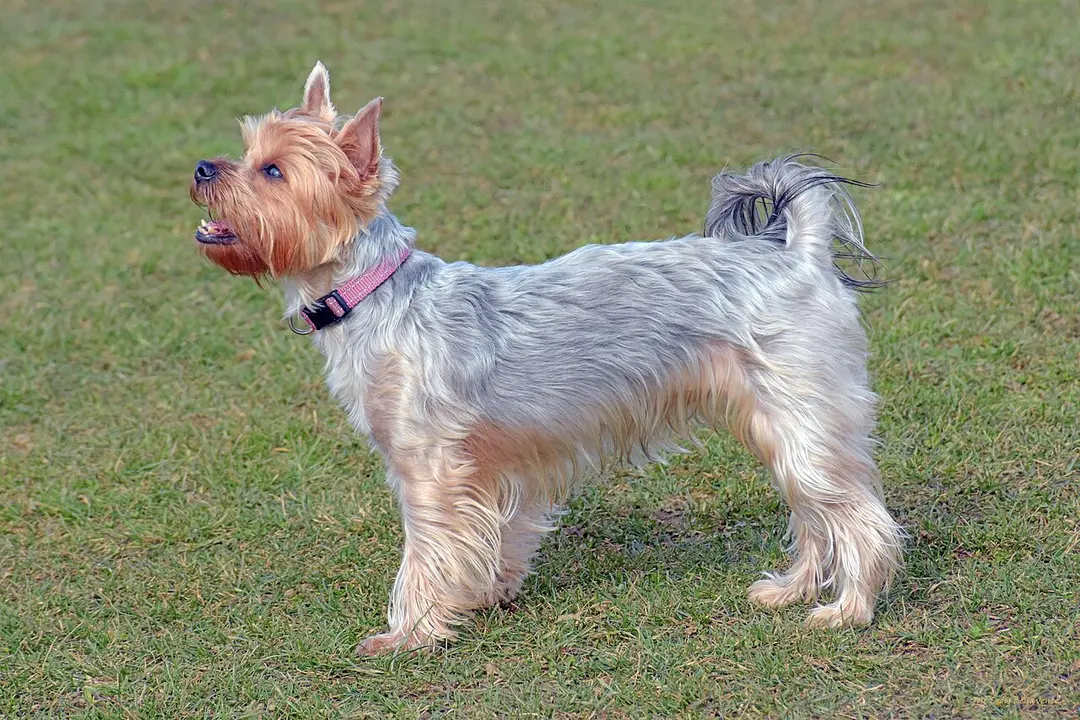
The Yorkshire Terrier today is a compact toy terrier with an upright, confident bearing. Its coat is straight and silky, with no woolly undercoat, and in show dogs it falls to the ground like a curtain parted along the back. The body is a dark steel blue and the head, chest and legs a rich golden tan. Puppies are born black and tan, and the blue develops as they mature.
Puppy growth
Health and lifespan
- Dry eyeMuch more likelyImpact: moderate
- Kneecap slipping out of placeMuch more likelyImpact: moderate
- Gum diseaseMore likelyImpact: moderate
- Cushing's syndromeSlightly more likelyImpact: serious
- Torn cruciate ligament in one kneeSlightly more likelyImpact: serious
Lifespan
Where it comes from
The Yorkshire Terrier's shift from working ratter to companion came quickly in the later nineteenth century. Breeders selected for small size and an ever longer coat, and the dog was soon shown widely and kept as a lap dog in fashionable Victorian households. The breed is often traced to Huddersfield Ben, a show winner and prolific sire of the late eighteen-sixties whose offspring helped fix the type.
Breed standard
Questions people ask
Compare with related
Sources
- 1Morrill et al., 2022. Ancestry-inclusive dog genomics challenges popular breed stereotypes. Science 376: eabk0639 (Darwin's Ark). ↑
- 2Dogs Trust. Finding a good, responsible breeder. ↑
- 3American Kennel Club. Screening puppy buyers: how top breeders find the best homes. ↑
- 4American Kennel Club. Yorkshire Terrier: Dog Breed Information (Grooming / Exercise / Training). ↑
- 5
- 6
- 7VetCompass UK. Primary-care veterinary records. ↑
- 8
- 9Hawthorne et al., 2004. Body-weight changes during growth in puppies of different breeds. Journal of Nutrition 134(8 Suppl): 2027S–2030S (WALTHAM). ↑
- 10
- 11
- 12
- 13
- 14
- 15
- 16
- 17United Kennel Club. Yorkshire Terrier standard (history). ↑