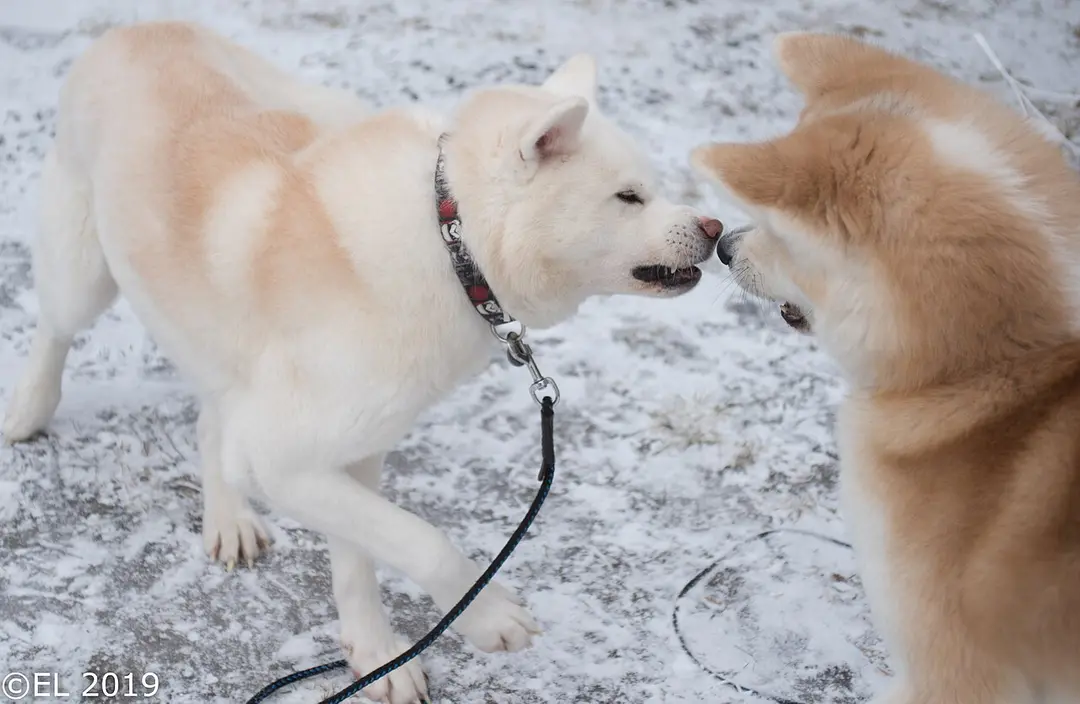
Akita

Quiet and reserved; can be intolerant of other dogs.
Adult male
45–59 kg
100–130 lb
Adult female
32–45 kg
70–100 lb
Lifespan
11.4 yrs
Class · Watchdog
also Companion

What it's like

In temperament the Akita is dignified, quiet and reserved with strangers, and closely attached to its own household. It is independent and can be intolerant of other dogs, particularly those of the same sex.

Day to day
Activity
A good daily walk and play
Intelligence
Learns readily, likes games
Handler demand
Needs an experienced owner
With people
Affection
Likes its own space
Loyalty
Sticks close to its people
Independence
Decides for itself
Around the home
Sensitivity
Hardy, takes a busy home in its stride
Voice
Quiet
Prey drive
Likely to chase small pets
Breed explains only about 9% of how individual dogs differ in behaviour1. Meet the dog. A good breeder breeds for temperament as well as health, and matches each puppy's personality to the right home2,3.
Is an Akita right for you?
Take the breed matcher

Living with one

The double coat moults most as the seasons change.

Size and growth

An Akita is a large dog, about the weight of a grown Rottweiler. Males end up clearly heavier than females. It is one of the heaviest large breeds.

It is a heavily built spitz with a broad head, small erect triangular ears, small deep-set eyes and a thick tail curled over the back. The double coat combines a harsh, straight outer layer with a soft, dense undercoat. The Akita recognised by The Kennel Club may be any colour, including pinto and brindle, with or without a mask.

Puppy growth

Reference curve · community data appears as owners log
By about 3 months, a male Akita puppy is already as heavy as a grown Staffordshire Bull Terrier. They grow fastest between 4 and 5 months old. They keep growing past their first birthday, longer than a Beagle does. Most males grow into the size large-breed puppy foods are made for.
Fully grown
13 mo
Both sexes, at 99% of adult weight6
Male
Female
Shaded: expected range
02040602m4m6m9m12m18m
02040602m3m4m6m9m12m18m
Age
Male
Female
2 months
7.9–10.3 kg 17.4–22.7 lb
7.3–10.4 kg 16.1–22.9 lb
3 months
12.7–16.5 kg 28.0–36.4 lb
10.6–15.1 kg 23.4–33.3 lb
4 months
18.8–24.5 kg 41.4–54.0 lb
15.3–21.9 kg 33.7–48.3 lb
5 months
25.6–33.2 kg 56.4–73.2 lb
19.5–27.8 kg 43.0–61.3 lb
6 months
31.7–41.2 kg 69.9–90.8 lb
22.9–32.7 kg 50.5–72.1 lb
7 months
36.5–47.4 kg 80.5–104.5 lb
25.4–36.3 kg 56.0–80.0 lb
8 months
39.9–51.8 kg 88.0–114.2 lb
27.2–38.8 kg 60.0–85.5 lb
9 months
42.0–54.6 kg 92.6–120.4 lb
28.5–40.6 kg 62.8–89.5 lb
10 months
43.4–56.4 kg 95.7–124.3 lb
29.4–41.9 kg 64.8–92.4 lb
11 months
44.2–57.5 kg 97.4–126.8 lb
30.0–42.8 kg 66.1–94.4 lb
12 months
44.7–58.1 kg 98.5–128.1 lb
30.5–43.5 kg 67.2–95.9 lb
15 months
45.2–58.8 kg 99.6–129.6 lb
31.3–44.7 kg 69.0–98.5 lb
18 months
45.4–58.9 kg 100.1–129.9 lb
32–45 kg 70–100 lb

Health and lifespan

For your vet

In one small group tested, six of eight Akitas had red blood cells unusually rich in potassium, so a blood sample that is haemolysed, or left in contact with its red cells for hours, can read falsely high. If an Akita's potassium comes back high, ask whether the sample could explain it before looking for disease.

Lifespan

In UK vet records, the typical Akita lived to about 11 and a half years, shorter than the typical large breed.

Where it comes from

The Akita comes from northern Japan's Akita region, where Matagi bear-hunting dogs were set to fight from the 1600s and given Tosa and Mastiff blood from 1868. After the Second World War, Japanese fanciers bred back to the Matagi type, while Dewa-line dogs taken to America founded a line cut off from Japanese pedigrees. The FCI keeps separate standards for the two, and The Kennel Club split them in 20064,11,12.

The Akita's survival owes much to a preservation movement in early twentieth-century Japan. After fighting and crossbreeding had diluted the native type, fanciers in Odate founded a society to protect it, and in the nineteen-thirties the breed was declared a national natural monument. Its fame grew through Hachikō, an Akita who kept returning to Shibuya station in Tokyo for years after his owner's death. Helen Keller is credited with taking the first Akita to the United States in the late nineteen-thirties. The breed was used to hunt large game such as bear, boar and deer, and also served as a guard.

Breed standard

Kennel clubs do not all register this breed the same way.

Questions people ask

General guidance for dogs rather than a measured Akita figure: most females have a first season somewhere between six and fifteen months, and cycles then settle to roughly every 180 days. Smaller breeds tend to start earlier and larger ones later, so a large breed is most likely at the later end.
Track your own Akita
Log a minute a day and watch them sit on these curves. Free.

Sources

Something wrong on this page?
Parts of this page were written by AI ·