Alaskan Malamute
What it's like
Malamutes are affectionate and playful with people, strangers included, and make poor guard dogs. They are independent and strong-willed, can be assertive with other dogs, and tend to howl or make a muttering, talking sound rather than bark much.
Living with one
Size and growth
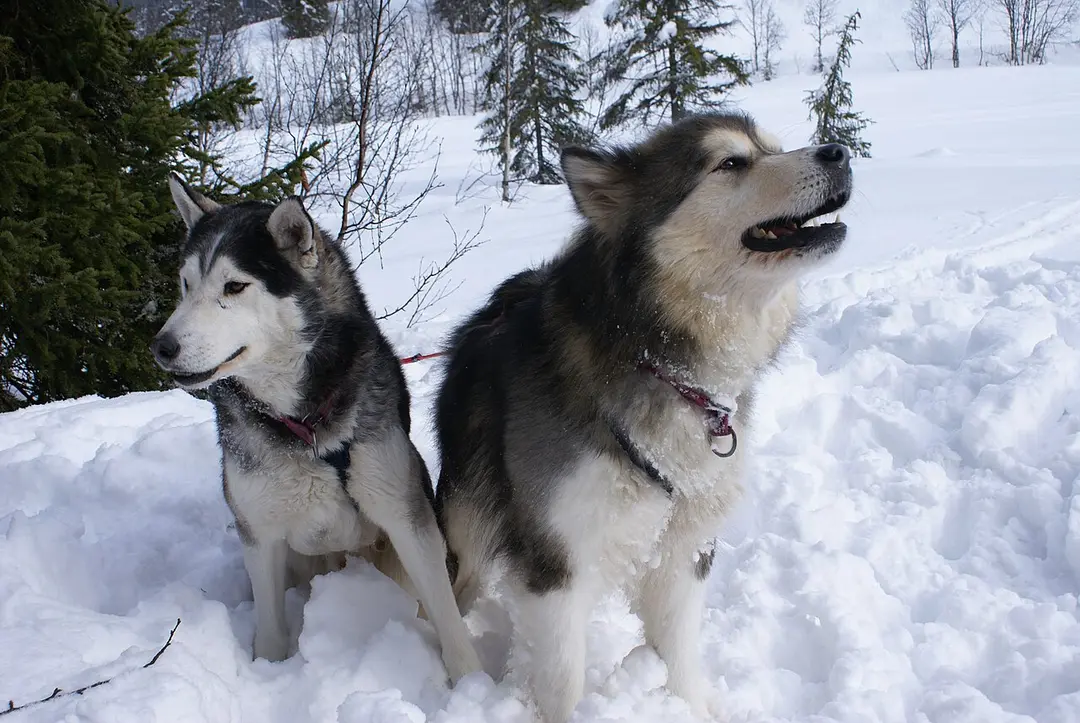
It was bred as a freighting dog, built to pull heavy loads over long distances rather than to race, and its build reflects this: heavy bone, a deep chest and large, well-cushioned feet. The head is broad, with erect triangular ears and dark almond-shaped eyes, and the plumed tail is carried over the back. A coarse outer coat stands off from a thick, oily, woolly undercoat. Colours range from light grey through black, sable and red, always with white underparts and often with a cap or mask marking on the face.
Puppy growth
Health and lifespan
- Mouth melanomaLab-confirmed casesMuch more likelyImpact: life-limiting
- Underactive thyroidMuch more likelyImpact: moderate
Lifespan
Where it comes from
The Alaskan Malamute was recognised by the American Kennel Club in the nineteen-thirties. The modern breed grew from a blend of strains usually called Kotzebue, M'Loot and Hinman-Irwin. During the Second World War, Malamutes worked as freight and pack dogs and in search and rescue, and losses during the war left the breed with few registered dogs. It has since been adopted as Alaska's official state dog.
Breed standard
Questions people ask
Compare with related
Sources
- 1Morrill et al., 2022. Ancestry-inclusive dog genomics challenges popular breed stereotypes. Science 376: eabk0639 (Darwin's Ark). ↑
- 2Dogs Trust. Finding a good, responsible breeder. ↑
- 3American Kennel Club. Screening puppy buyers: how top breeders find the best homes. ↑
- 4
- 5
- 6AAFCO, 2016. AAFCO Dog and Cat Food Nutrient Profiles. Association of American Feed Control Officials. ↑
- 7Hawthorne et al., 2004. Body-weight changes during growth in puppies of different breeds. Journal of Nutrition 134(8 Suppl): 2027S–2030S (WALTHAM). ↑
- 8
- 9
- 10
- 11Alaskan Malamute Club of America. History. ↑