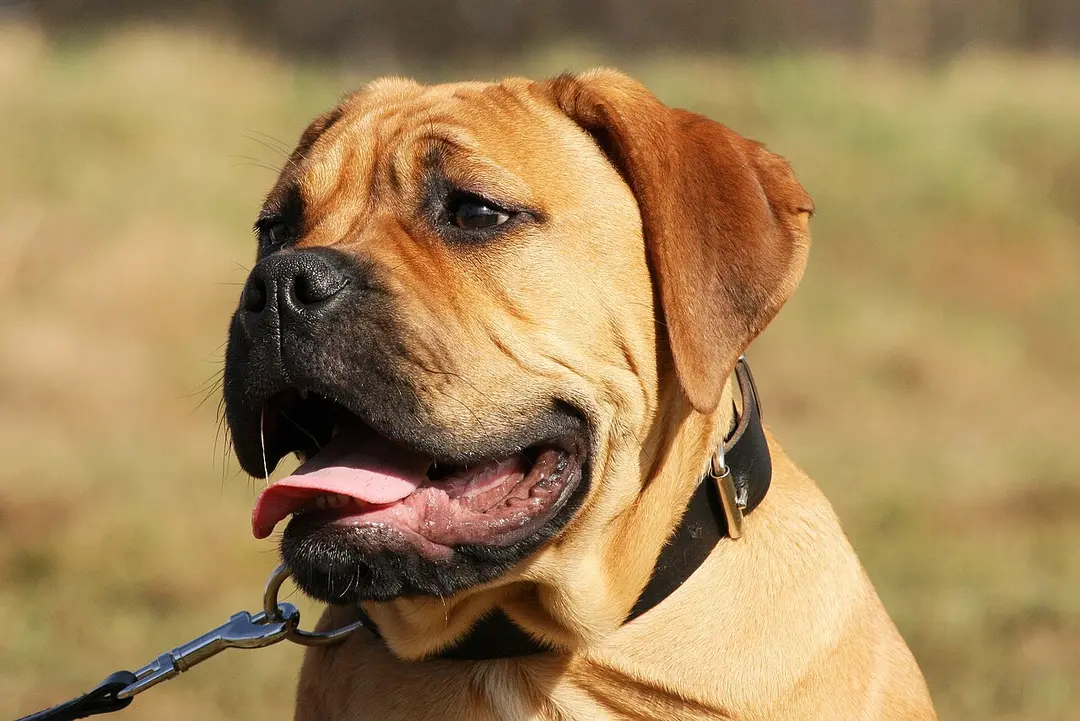
Bullmastiff

Quiet and devoted; reserved and watchful with strangers.
Adult male
50–59 kg
110–130 lb
Adult female
41–50 kg
90–110 lb
Lifespan
10.2 yrs
Class · Watchdog
also Companion

What it's like

Bullmastiffs are calm, steady and devoted to their household, and reserved and watchful with strangers. They are generally described as quiet dogs, a trait popularly traced to their night work, when a dog that gave voice would have warned its quarry. In the nineteen-twenties the diamond company De Beers is reported to have used them to guard its mines in South Africa.

Day to day
Activity
Happy with modest walks
Intelligence
Easy-going, simple routines
Handler demand
Needs an experienced owner
With people
Affection
A lap or leaning dog
Loyalty
Sticks close to its people
Independence
Decides for itself
Around the home
Sensitivity
Hardy, takes a busy home in its stride
Voice
Quiet
Prey drive
Chases; needs managing
Breed explains only about 9% of how individual dogs differ in behaviour1. Meet the dog. A good breeder breeds for temperament as well as health, and matches each puppy's personality to the right home2,3.
Is a Bullmastiff right for you?
Take the breed matcher

Living with one

It has a short coat. It sheds through the year rather than in big seasonal moults. Plan on a brush once a week. It needs a moderate amount of exercise compared with other breeds.

Size and growth

A Bullmastiff is a giant dog, heavier than a Rottweiler and lighter than a Great Dane. Males end up clearly heavier than females.

The breed is large, powerful and nearly square in outline, built to combine strength with activity. It has a broad, wrinkled head, a short muzzle and a dark mask around the face. The coat is short, dense and close-lying, in fawn, red or brindle, sometimes with a small white mark on the chest.

Two types

The growth curve, the weight table and the size class on this page use the UK / FCI type's weights.

UK / FCI type

FCI 157
Adult weight
Males
50–59 kg
Females
41–50 kg4
Height at the withers
Males
64–69 cm
Females
61–66 cm4
Its weights are the ones used on this page.

American type

AKC standard
Adult weight
Males
50–59 kg
Females
45–54 kg6
Height at the withers
Males
63.5–68.6 cm
Females
61–66 cm6
Its weights are not the ones this page uses.

Puppy growth

Reference curve · community data appears as owners log
By about 5 months, a male Bullmastiff puppy is already as heavy as a grown Labrador. They grow fastest between 4 and 5 months old. They keep growing past their first birthday, longer than a Beagle does. Most males grow into the size large-breed puppy foods are made for.
Fully grown
13 mo
Both sexes, at 99% of adult weight7
Male
Female
Shaded: expected range
02040602m4m6m9m12m18m
02040602m3m4m6m9m12m18m
Age
Male
Female
2 months
8.7–10.3 kg 19.2–22.7 lb
7.1–8.7 kg 15.7–19.2 lb
3 months
14.0–16.5 kg 30.9–36.4 lb
11.5–14.0 kg 25.4–30.9 lb
4 months
20.8–24.5 kg 45.9–54.0 lb
17.0–20.8 kg 37.5–45.9 lb
5 months
28.1–33.2 kg 61.9–73.2 lb
23.1–28.1 kg 50.9–61.9 lb
6 months
34.9–41.2 kg 76.9–90.8 lb
28.6–34.9 kg 63.1–76.9 lb
7 months
40.2–47.4 kg 88.6–104.5 lb
33.0–40.2 kg 72.8–88.6 lb
8 months
43.9–51.8 kg 96.8–114.2 lb
36.0–43.9 kg 79.4–96.8 lb
9 months
46.3–54.6 kg 102.1–120.4 lb
38.0–46.3 kg 83.8–102.1 lb
10 months
47.8–56.4 kg 105.4–124.3 lb
39.2–47.8 kg 86.4–105.4 lb
11 months
48.7–57.5 kg 107.4–126.8 lb
39.9–48.7 kg 88.0–107.4 lb
12 months
49.3–58.1 kg 108.7–128.1 lb
40.4–49.3 kg 89.1–108.7 lb
15 months
49.8–58.8 kg 109.8–129.6 lb
40.9–49.8 kg 90.2–109.8 lb
18 months
50.0–58.9 kg 110.2–129.9 lb
41–50 kg 90–110 lb

Health and lifespan

Vets record these more often in Bullmastiffs than in crossbreeds. An inward-rolling eyelid (moderate) is far more likely. Bone cancer and lymph node cancer, both life-limiting, are much more likely, and limb arthritis (serious) slightly more likely. One listed condition comes from lab-confirmed cases rather than vet records: blood-vessel cancer of the skin (serious) is far more likely there, though lab figures run higher than vet-record ones. These are figures for the breed as a whole, not a prediction for your dog.
Listed by likelihood level, highest first, then by how serious it is, then by name. These are 5 of 8 measured; lab-confirmed figures only fill places the vet-record studies leave empty.
  • Blood-vessel cancer of the skin
    Lab-confirmed cases
    Far more likely
    Impact: serious
  • Inward-rolling eyelid
    Far more likely
    Impact: moderate
  • Bone cancer
    Much more likely
    Impact: life-limiting
  • Lymph node cancer
    Much more likely
    Impact: life-limiting
  • Joint wear-and-tear arthritis in the limbs
    Slightly more likely
    Impact: serious
Lab-confirmed: compares dogs whose tumour samples went to a lab with dogs seen in general practice, so the figures run higher than vet-record ones.

Flat face and breathing

The Bullmastiff is one of the flat-faced breeds. In UK vet records, flat-faced dogs were more likely to have breathing and airway problems than dogs with a medium-length muzzle, and lived shorter lives on average. Noisy breathing at rest is worth raising with a vet.

Lifespan

In UK vet records, the typical Bullmastiff lived to about 10 years, about average for a giant breed.

Where it comes from

Nineteenth-century English gamekeepers wanted a dog to deal with poachers, and crossed the Old English Mastiff with the Bulldog to get one: big enough to intimidate, brave and athletic enough to see intruders off. Brindle was the keepers' colour of choice because it blended into the dark; today fawn is seen more often17.

The Bullmastiff was known in its early days as the gamekeeper's night dog, and for much of the nineteenth century it remained a working cross rather than a fixed breed. Breeders gradually standardised its type in the early twentieth century, and the Kennel Club recognised it as a pure breed in the nineteen-twenties. Its job was specific: to track a poacher through the dark, then knock him down and hold him without savaging him until the keeper arrived.

Breed standard

The American standard asks for a heavier dog than the UK and international ones.

Questions people ask

General guidance for dogs rather than a measured Bullmastiff figure: most females have a first season somewhere between six and fifteen months, and cycles then settle to roughly every 180 days. Smaller breeds tend to start earlier and larger ones later, so a giant breed is most likely at the late end.
Track your own Bullmastiff
Log a minute a day and watch them sit on these curves. Free.

Sources

Something wrong on this page?
Parts of this page were written by AI ·