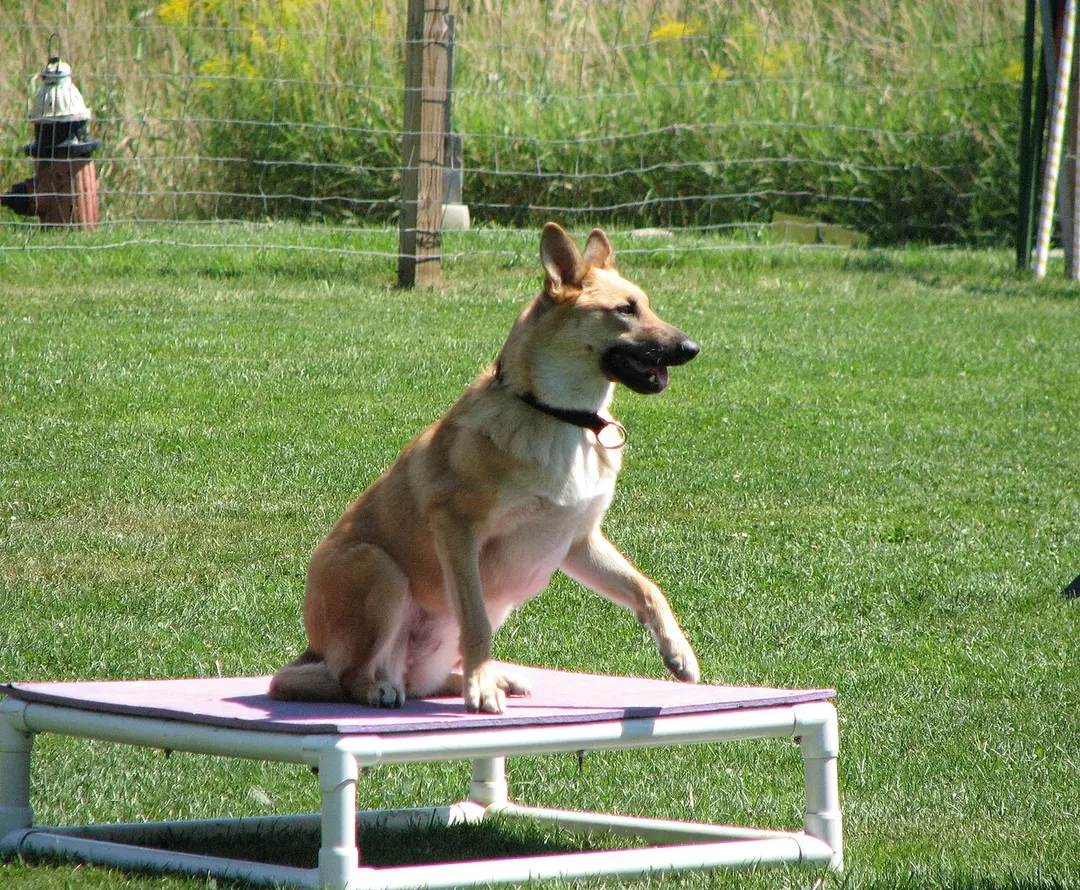
Chinook

Calm and gentle; usually patient with children.
Adult male
25–41 kg
55–90 lb
Adult female
23–29 kg
50–65 lb
Lifespan
12–15 yrs
Class · Family
also Working, Sport

What it's like

In temperament the Chinook is calm, gentle and affectionate, generally patient with children and with little urge to guard. It is closely devoted to its household, can be reserved with strangers, and still willingly pulls sleds, carts and other loads.

Day to day
Activity
A good daily walk and play
Intelligence
Learns readily, likes games
Handler demand
Needs steady training
With people
Affection
Affectionate on its own terms
Loyalty
Bonded to its family
Independence
Keen to work with you
Around the home
Sensitivity
Average
Voice
Barks to alert, then settles
Prey drive
Usually fine with small pets
Breed explains only about 9% of how individual dogs differ in behaviour1. Meet the dog. A good breeder breeds for temperament as well as health, and matches each puppy's personality to the right home2,3.
Is a Chinook right for you?
Take the breed matcher

Size and growth

A Chinook is a large dog, about the weight of a grown Golden Retriever. Males end up clearly heavier than females. It is one of the lightest large breeds.

The colour ranges from pale honey to a deep reddish gold, often with darker shading on the muzzle and around the almond-shaped eyes. The double coat is close-lying and of medium length, the ears may hang or stand erect, and the tail sweeps in a gentle sabre curve.

Puppy growth

Reference curve · community data appears as owners log
By about 5 months, a male Chinook puppy is already as heavy as a grown Border Collie. They grow fastest between 3 and 4 months old. Most males grow into the size large-breed puppy foods are made for.
Fully grown
12 mo
Both sexes, at 99% of adult weight7
Male
Female
Shaded: expected range
02040602m4m6m9m12m18m
02040602m3m4m6m9m12m18m
Age
Male
Female
2 months
5.2–8.6 kg 11.5–19.0 lb
5.5–7.1 kg 12.1–15.7 lb
3 months
7.9–12.9 kg 17.4–28.4 lb
7.7–10.1 kg 17.0–22.3 lb
4 months
11.7–19.1 kg 25.8–42.1 lb
11.1–14.4 kg 24.5–31.7 lb
5 months
14.9–24.4 kg 32.8–53.8 lb
14.0–18.2 kg 30.9–40.1 lb
6 months
17.8–29.2 kg 39.2–64.4 lb
16.4–21.3 kg 36.2–47.0 lb
7 months
20.1–32.9 kg 44.3–72.5 lb
18.2–23.6 kg 40.1–52.0 lb
8 months
21.8–35.7 kg 48.1–78.7 lb
19.4–25.2 kg 42.8–55.6 lb
9 months
22.9–37.5 kg 50.5–82.7 lb
20.3–26.4 kg 44.8–58.2 lb
10 months
23.6–38.6 kg 52.0–85.1 lb
21.0–27.2 kg 46.3–60.0 lb
11 months
24.0–39.3 kg 52.9–86.6 lb
21.4–27.8 kg 47.2–61.3 lb
12 months
24.3–39.7 kg 53.6–87.5 lb
21.7–28.2 kg 47.8–62.2 lb
15 months
24.6–40.3 kg 54.2–88.8 lb
22.4–29.1 kg 49.4–64.2 lb

Lifespan

No vet study has measured how long Chinooks live yet. The 12–15 years shown is a general figure without a published source.

Where it comes from

The Chinook's owners' association traces the breed to one dog: Chinook, born in 1917 on Arthur Walden's farm at Wonalancet, New Hampshire. He was mated with Canadian Eskimo dogs, German Shepherds, Belgian Sheepdogs and perhaps other breeds, and his descendants were bred for a sled dog quick enough to race and strong enough to haul freight. Chinook went to Antarctica with Admiral Byrd's expedition and was lost there8,9.

The Chinook survived its founder's era only through a few committed breeders. When Walden left Wonalancet, his kennel passed to Milton and Eva Seeley. The Seeleys later turned mainly to Alaskan Malamutes, and the line was then kept going largely by Perry Greene in Maine, who used his dogs for sledding and work. Numbers stayed so low that by the nineteen-sixties the Guinness Book of World Records reportedly singled it out for its rarity. Breed clubs slowly rebuilt it, the American Kennel Club eventually admitted it to the Working Group, and New Hampshire has adopted it as its state dog. The Chinook is an athletic, well-muscled sled dog with a tawny coat.

Breed standard

No FCI standard covers it; its group here is AKC Working group.

Questions people ask

General guidance for dogs rather than a measured Chinook figure: most females have a first season somewhere between six and fifteen months, and cycles then settle to roughly every 180 days. Smaller breeds tend to start earlier and larger ones later, so a large breed is most likely at the later end.
Track your own Chinook
Log a minute a day and watch them sit on these curves. Free.

Sources

Uncited on this page: Lifespan — no reviewed source yet, so it is a general reference figure rather than a published one.
Something wrong on this page?
Parts of this page were written by AI ·