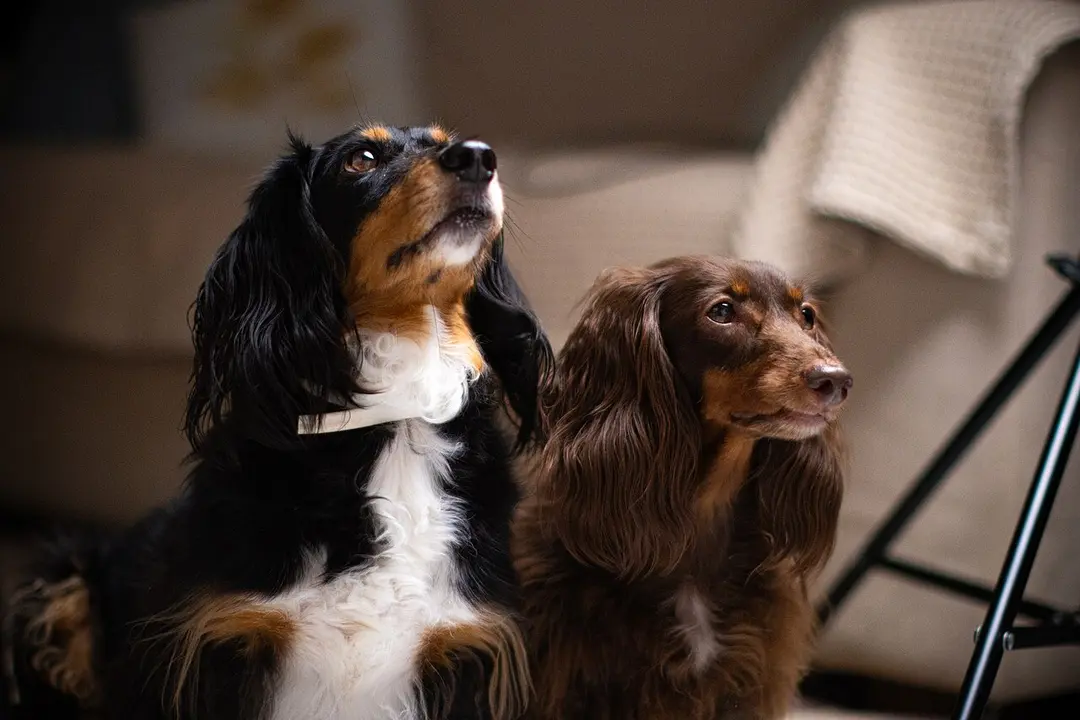
Dachshund

Bold and curious, with a deep bark for its size.
Adult weight
4.5–14.5 kg
9.9–32 lb
Lifespan
13.2 yrs
Class · Companion
also Field

What it's like

In character the Dachshund is bold, curious and lively, with a deep bark for its size and an independent streak suited to a dog meant to work alone underground. A striped dachshund named Waldi became the first official Olympic mascot, at the Munich Games.

Owners who rated their dogs' everyday behaviour found Dachshunds calmer and more independent-minded than most. They were also less often among the friendliest with people, and much less often with other dogs. Breed is only a small part of any one dog's personality, so meet the dog before you decide.
Day to day
Activity
A good daily walk and play
Intelligence
Learns readily, likes games
Handler demand
Needs steady training
With people
Affection
A lap or leaning dog
Loyalty
Sticks close to its people
Independence
Decides for itself
Around the home
Sensitivity
Average
Voice
Very vocal
Prey drive
Likely to chase small pets
Breed explains only about 9% of how individual dogs differ in behaviour1. Meet the dog. A good breeder breeds for temperament as well as health, and matches each puppy's personality to the right home2,3.
Is a Dachshund right for you?
Take the breed matcher

Living with one

Dachshunds come in smooth, wire and long coats, each groomed differently. Bred to hunt below ground, they need a modest amount of exercise, and owners say they seek constant activity less often than most.

Size and growth

A Dachshund is a small dog, about the weight of a grown Pug.

The Kennel Club recognises only the standard and miniature sizes, whereas the FCI also recognises a smaller rabbit size and measures each by chest girth rather than height. The dog is long and low, with a deep chest, short sturdy legs, a long tapering head and broad hanging ears. The smooth coat is short and glossy, the wire harsh with a beard and bushy eyebrows, and the long soft and feathered. Colours include red, black and tan, and dapple.

Varieties

FCI 148 divides this breed by chest girth. Pick the variety your dog is for a band that fits. The 3 coat varieties are the same size — only the coat differs.
Variety
Weight
Height
Rabbit
4.5–5 kg (breed club figure)6,7
Standard
7.3–15 kg (breed club figure)8,9

Puppy growth

Reference curve · community data appears as owners log
By about 5 months, a male Dachshund puppy is already as heavy as a grown Jack Russell. They grow fastest between 3 and 4 months old.
Fully grown
10 mo
Both sexes, at 99% of adult weight11
Male
Female
Shaded: expected range
0510152m4m6m9m12m18m
0510152m3m4m6m9m12m18m
Age
Male
Female
2 months
1.1–3.7 kg 2.4–8.2 lb
1.3–4.1 kg 2.9–9.0 lb
3 months
1.6–5.0 kg 3.5–11.0 lb
1.6–5.3 kg 3.5–11.7 lb
4 months
2.2–7.0 kg 4.9–15.4 lb
2.2–7.1 kg 4.9–15.7 lb
5 months
2.7–8.7 kg 6.0–19.2 lb
2.7–8.6 kg 6.0–19.0 lb
6 months
3.1–10.1 kg 6.8–22.3 lb
3.0–9.8 kg 6.6–21.6 lb
7 months
3.4–11.1 kg 7.5–24.5 lb
3.3–10.7 kg 7.3–23.6 lb
8 months
3.7–11.9 kg 8.2–26.2 lb
3.5–11.4 kg 7.7–25.1 lb
9 months
3.9–12.5 kg 8.6–27.6 lb
3.7–12.0 kg 8.2–26.5 lb
10 months
4.0–12.9 kg 8.8–28.4 lb
3.9–12.4 kg 8.6–27.3 lb
11 months
4.1–13.2 kg 9.0–29.1 lb
4.0–12.8 kg 8.8–28.2 lb
12 months
4.2–13.5 kg 9.3–29.8 lb
4.1–13.1 kg 9.0–28.9 lb
15 months
4.4–14.0 kg 9.7–30.9 lb
4.3–13.8 kg 9.5–30.4 lb
18 months
4.5–14.5 kg 9.9–32 lb
4.5–14.4 kg 9.9–31.7 lb

Lifespan

In UK vet records, the typical Dachshund lived to about 13 years, about average for a small breed.

Where it comes from

The Dachshund, called Dackel or Teckel in its native Germany, was bred to hunt underground, and above ground the FCI credits it with flushing game, hunting while giving tongue and tracking wounded animals. Its oldest breed club, the Deutsche Teckelklub, was founded in 1888. Three sizes crossed with three coats, smooth, wire and long, give nine varieties4.

The Dachshund's name is German for 'badger dog', recalling its original quarry. The breed took its modern form during the nineteenth century, and the wire and long coats are often thought to owe something to crosses with terriers and, perhaps, spaniels. It became popular in Britain in the Victorian period, helped by Queen Victoria's fondness for it, but lost favour during the First World War because of its German associations.

Breed standard

Kennel clubs do not all register this breed the same way. One registry divides it into three varieties by chest girth, each with its own weight range.

Questions people ask

General guidance for dogs rather than a measured Dachshund figure: most females have a first season somewhere between six and fifteen months, and cycles then settle to roughly every 180 days. Smaller breeds tend to start earlier and larger ones later, so a small breed is most likely at the early end.
Track your own Dachshund
Log a minute a day and watch them sit on these curves. Free.

Sources

Something wrong on this page?
Parts of this page were written by AI ·