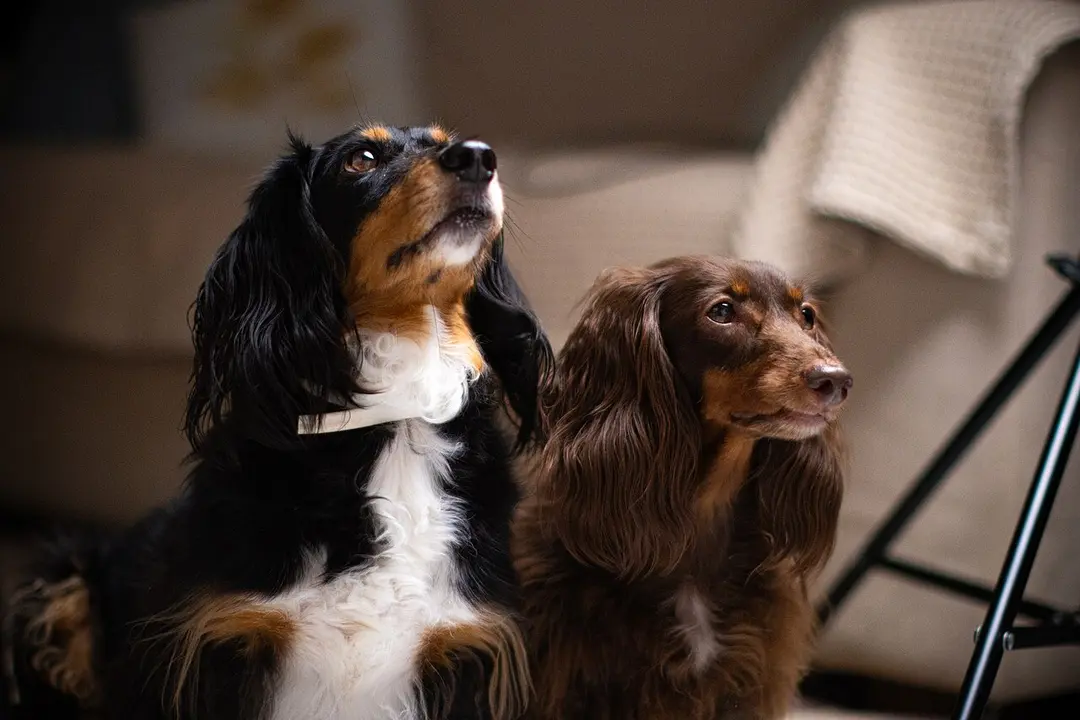
What it's like
Miniatures are lively, curious and bold, with the confidence of a much larger dog and a strong urge to dig and chase. They are usually affectionate with their own people but can be independent-minded, and many have a surprisingly deep bark. Waldi, a striped dachshund, was the first official Olympic mascot, created for the Munich Games.
Living with one
Size and growth
The body is long and low, with a deep chest, short sturdy legs, a long tapering head and ears that hang close to the cheeks. Three coats are recognised: smooth, which is short and glossy; long-haired, which is soft and silky with feathering on the ears, legs and tail; and wire-haired, which is harsh, with a beard and bushy eyebrows. Colours include red, black and tan, chocolate, and a mottled pattern known as dapple.
Puppy growth
Lifespan
Where it comes from
The Miniature Dachshund is the smaller of the two Dachshund sizes recognised in Britain. It has the same shape, coats and character as the larger dog in a more compact form. The Dachshund, whose German name means 'badger dog', was standardised by German breeders in the late nineteenth century. Smaller dogs were also bred, partly for following rabbits into narrow burrows, and the miniature later became a separate show variety in Britain.
Breed standard
Questions people ask
Compare with related
Sources
- 1Morrill et al., 2022. Ancestry-inclusive dog genomics challenges popular breed stereotypes. Science 376: eabk0639 (Darwin's Ark). ↑
- 2Dogs Trust. Finding a good, responsible breeder. ↑
- 3American Kennel Club. Screening puppy buyers: how top breeders find the best homes. ↑
- 4
- 5American Kennel Club. Miniature Dachshund breed page. ↑
- 6The Kennel Club. Miniature Dachshund breed page. ↑
- 7
- 8Hawthorne et al., 2004. Body-weight changes during growth in puppies of different breeds. Journal of Nutrition 134(8 Suppl): 2027S–2030S (WALTHAM). ↑
- 9
- 10The Kennel Club. Miniature Smooth-Haired Dachshund. ↑
- 11National Dachshund Council of Australia (via Dachshund Club of Queensland). Breed history. ↑
- 12The Kennel Club. Breed list. ↑
- 13American Kennel Club. Dachshund breed page. ↑