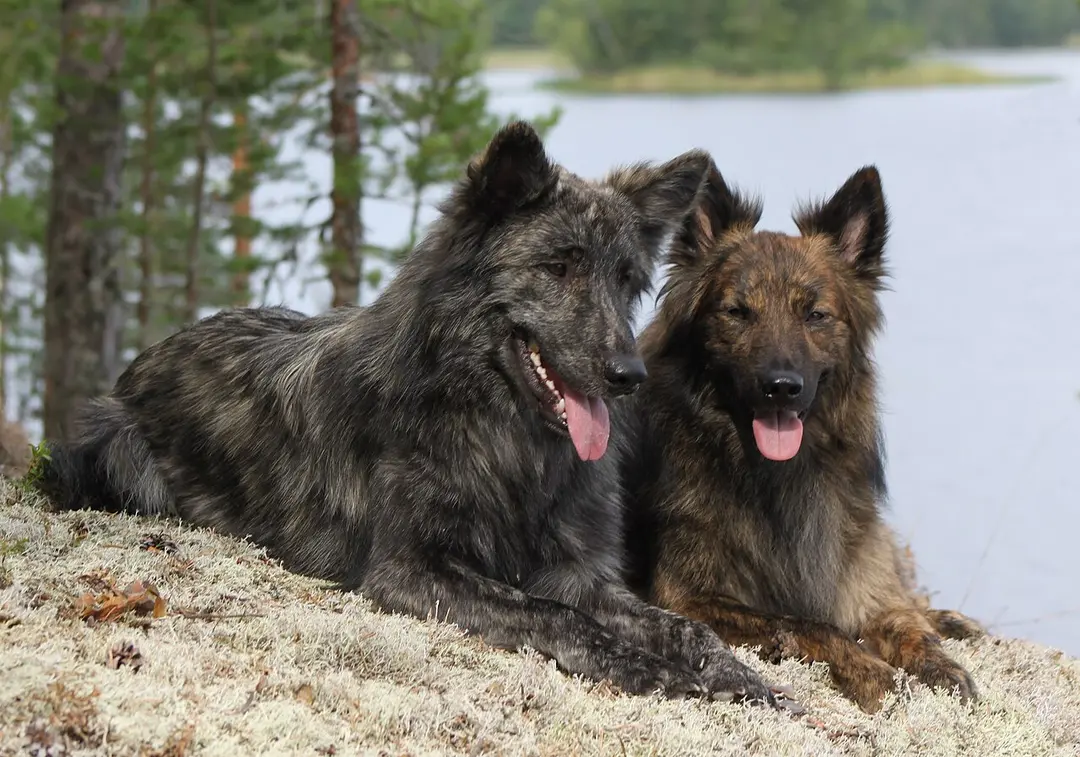
Dutch Shepherd

Lively and quick to learn, with an independent streak.
Adult weight
19–34 kg
42–75 lb
Lifespan
11–14 yrs
Class · Working
also Sport, Watchdog

What it's like

In temperament the Dutch Shepherd is lively, watchful and quick to learn, with a strong drive to work alongside its handler. It is usually affectionate and loyal with its own people and reserved with strangers. It also has an independent streak, which is sometimes attributed to its past on farms, where it worked without constant direction.

Day to day
Activity
Needs lots of exercise
Intelligence
Needs daily brain work
Handler demand
Needs an experienced owner
With people
Affection
Affectionate on its own terms
Loyalty
Sticks close to its people
Independence
Keen to work with you
Around the home
Sensitivity
Average
Voice
Barks to alert, then settles
Prey drive
Likely to chase small pets
Breed explains only about 9% of how individual dogs differ in behaviour1. Meet the dog. A good breeder breeds for temperament as well as health, and matches each puppy's personality to the right home2,3.
Is a Dutch Shepherd right for you?
Take the breed matcher

Living with one

How it sheds and the grooming it needs depend on the coat. It needs plenty of exercise compared with other breeds.

Size and growth

A Dutch Shepherd is a medium dog, about the weight of a grown Golden Retriever. It is one of the heaviest medium breeds.

It is a lean, athletic shepherd with a wedge-shaped head, upright ears and a body slightly longer than it is tall. The coat is usually brindle on a gold or silver ground, and comes in short-haired, long-haired and rough-haired forms. The rough-haired variety, which may also be blue-grey or pepper-and-salt, has a tousled, wiry coat, bushy brows and a beard that give it a scruffy look.

Puppy growth

Reference curve · community data appears as owners log
By about 5 months, a male Dutch Shepherd puppy is already as heavy as a grown Staffordshire Bull Terrier. They grow fastest between 3 and 4 months old. The biggest males grow into the size large-breed puppy foods are made for.
Fully grown
11 mo
Both sexes, at 99% of adult weight8
Male
Female
Shaded: expected range
0102030402m4m6m9m12m18m
0102030402m3m4m6m9m12m18m
Age
Male
Female
2 months
4.2–7.4 kg 9.3–16.3 lb
4.6–8.2 kg 10.1–18.1 lb
3 months
6.1–10.9 kg 13.4–24.0 lb
6.5–11.6 kg 14.3–25.6 lb
4 months
8.9–15.8 kg 19.6–34.8 lb
9.3–16.6 kg 20.5–36.6 lb
5 months
11.4–20.3 kg 25.1–44.8 lb
11.8–20.9 kg 26.0–46.1 lb
6 months
13.6–24.3 kg 30.0–53.6 lb
13.8–24.5 kg 30.4–54.0 lb
7 months
15.3–27.2 kg 33.7–60.0 lb
8 months
16.5–29.3 kg 36.4–64.6 lb
16.3–29.1 kg 35.9–64.2 lb
9 months
17.3–30.8 kg 38.1–67.9 lb
17.1–30.4 kg 37.7–67.0 lb
10 months
17.8–31.8 kg 39.2–70.1 lb
17.6–31.4 kg 38.8–69.2 lb
11 months
18.2–32.5 kg 40.1–71.7 lb
18.0–32.1 kg 39.7–70.8 lb
12 months
18.5–32.9 kg 40.8–72.5 lb
18.3–32.5 kg 40.3–71.7 lb
15 months
19.0–33.8 kg 41.9–74.5 lb
18.9–33.6 kg 41.7–74.1 lb

Lifespan

No vet study has measured how long Dutch Shepherds live yet. The 11–14 years shown is a general figure without a published source.

Where it comes from

The Dutch Shepherd was the Dutch farmer's dog of all trades, keeping flocks out of the crops, herding cows for milking and pulling milk carts. When the sheep flocks had largely gone by around 1900, it turned to police, tracking and guide-dog work. By 1914 the breed had been restricted to brindle, to tell it apart from the German and Belgian Shepherds4,9.

The Dutch Shepherd, known in its homeland as the Hollandse Herdershond, came close to disappearing during the twentieth century. As farming modernised, there was less need for an all-round farm dog, and the Second World War cut its numbers further. Breeders rebuilt it from the dogs that were left, and it has kept a steady following in the Netherlands as a working dog for police, protection and search work, as well as in dog sports.

Breed standard

The Dutch Shepherd is judged against standard no. 223, in group 1, Sheepdogs and Cattledogs4.

Questions people ask

General guidance for dogs rather than a measured Dutch Shepherd figure: most females have a first season somewhere between six and fifteen months, and cycles then settle to roughly every 180 days. Smaller breeds tend to start earlier and larger ones later, so a medium-sized breed is most likely somewhere in the middle.
Track your own Dutch Shepherd
Log a minute a day and watch them sit on these curves. Free.

Sources

Uncited on this page: Lifespan — no reviewed source yet, so it is a general reference figure rather than a published one.
Something wrong on this page?
Parts of this page were written by AI ·