Flat-Coated Retriever
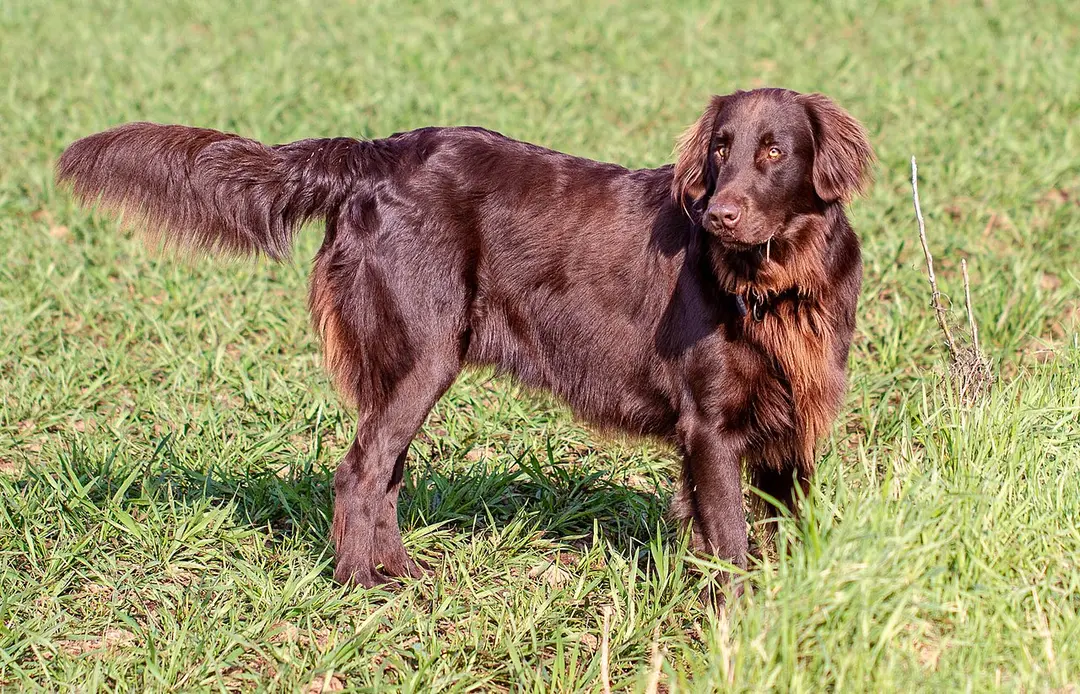
Cheerful and outgoing, playful well into adulthood.
Adult male
27–36 kg
60–79 lb
Adult female
25–32 kg
55–71 lb
Lifespan
11.7 yrs
Class · Family
also Field, Sport

What it's like

In temperament it is cheerful, outgoing and friendly with strangers, and its enthusiastic tail action is noted in the breed standard. It matures slowly and keeps a playful, puppyish manner well into adulthood, which has earned it the informal nickname of Peter Pan.

Day to day
Activity
Needs lots of exercise
Intelligence
Learns readily, likes games
Handler demand
Needs steady training
With people
Affection
A lap or leaning dog
Loyalty
Friendly with everyone
Independence
Keen to work with you
Around the home
Sensitivity
Average
Voice
Barks to alert, then settles
Prey drive
Chases; needs managing
Breed explains only about 9% of how individual dogs differ in behaviour1. Meet the dog. A good breeder breeds for temperament as well as health, and matches each puppy's personality to the right home2,3.
Is a Flat-Coated Retriever right for you?
Take the breed matcher

Living with one

It has a coat with feathering. It sheds through the year rather than in big seasonal moults. Plan on brushing a few times a week. It needs plenty of exercise compared with other breeds.

Size and growth

A Flat-Coated Retriever is a medium dog, about the weight of a grown Golden Retriever. Males end up a little heavier than females. It is one of the heaviest medium breeds.

Its build is lithe and athletic, with a long, clean head in which skull and muzzle flow smoothly together. The coat is dense, fine and lies flat, with feathering on the legs and tail. It comes in solid black or liver; yellow sometimes appears but is not accepted for showing.

Puppy growth

Reference curve · community data appears as owners log
By about 5 months, a male Flat-Coated Retriever puppy is already as heavy as a grown Border Collie. They grow fastest between 3 and 4 months old. The biggest males grow into the size large-breed puppy foods are made for.
Fully grown
12 mo
Both sexes, at 99% of adult weight10
Male
Female
Shaded: expected range
0102030402m4m6m9m12m18m
0102030402m3m4m6m9m12m18m
Age
Male
Female
2 months
5.7–7.6 kg 12.6–16.8 lb
6.0–7.7 kg 13.2–17.0 lb
3 months
8.5–11.4 kg 18.7–25.1 lb
8.5–10.9 kg 18.7–24.0 lb
4 months
12.6–16.8 kg 27.8–37.0 lb
12.2–15.6 kg 26.9–34.4 lb
5 months
16.2–21.6 kg 35.7–47.6 lb
15.4–19.7 kg 34.0–43.4 lb
6 months
19.3–25.7 kg 42.5–56.7 lb
18.1–23.1 kg 39.9–50.9 lb
7 months
21.8–29.1 kg 48.1–64.2 lb
20.0–25.6 kg 44.1–56.4 lb
8 months
23.6–31.5 kg 52.0–69.4 lb
21.4–27.4 kg 47.2–60.4 lb
9 months
24.8–33.1 kg 54.7–73.0 lb
22.4–28.6 kg 49.4–63.1 lb
10 months
25.6–34.1 kg 56.4–75.2 lb
23.1–29.5 kg 50.9–65.0 lb
11 months
26.0–34.7 kg 57.3–76.5 lb
23.6–30.2 kg 52.0–66.6 lb
12 months
26.3–35.1 kg 58.0–77.4 lb
23.9–30.6 kg 52.7–67.5 lb
15 months
26.7–35.6 kg 58.9–78.5 lb
24.7–31.6 kg 54.5–69.7 lb

Health and lifespan

In UK vet and lab records, the conditions below turn up more often in Flat-Coated Retrievers than in crossbreeds. Blood-vessel cancer, toe melanoma and inward-rolling eyelid stand out as much more likely. The most serious are blood-vessel cancer (much more likely), bone cancer (more likely) and mouth melanoma (more likely), and all can shorten a life. These are figures for the breed as a whole, not a prediction for your dog.
Listed by likelihood level, highest first, then by how serious it is, then by name. These are the first 5 of 6 measured.
  • Blood-vessel cancer
    Much more likely
    Impact: life-limiting
  • Toe melanoma
    Lab-confirmed cases
    Much more likely
    Impact: serious
  • Inward-rolling eyelid
    Much more likely
    Impact: moderate
  • Bone cancer
    Lab-confirmed cases
    More likely
    Impact: life-limiting
  • Mouth melanoma
    Lab-confirmed cases
    More likely
    Impact: life-limiting
Lab-confirmed: compares dogs whose tumour samples went to a lab with dogs seen in general practice, so the figures run higher than vet-record ones.

Lifespan

In UK vet records, the typical Flat-Coated Retriever lived to about 11 and a half years, shorter than the typical medium breed.

Where it comes from

The Flat-Coated Retriever was made on 19th-century British shooting estates, where the shotgun created demand for a dog to bring back game from land and water. Its makers are said to have used water dogs from North America, possibly with some collie and setter, and S. E. Shirley did most to fix its look. By the end of the Second World War so few were left that its survival was in doubt16,17.

The Flat-Coated Retriever, first known as the Wavy-coated Retriever, became the favoured working retriever of British gamekeepers in the late nineteenth century, and it is still sometimes called the gamekeeper's dog. After the First World War the Labrador Retriever overtook it in numbers. Following the Second World War a small group of breeders, among them Stanley O'Neill, rebuilt the breed from the few dogs that remained. It was bred to find and carry shot game, both fallen birds on land and ducks from water, working close to the guns and delivering with a soft mouth.

Breed standard

The Flat-Coated Retriever is judged against standard no. 121, in group 8, Retrievers, Flushing Dogs and Water Dogs6.

Questions people ask

General guidance for dogs rather than a measured Flat-Coated Retriever figure: most females have a first season somewhere between six and fifteen months, and cycles then settle to roughly every 180 days. Smaller breeds tend to start earlier and larger ones later, so a medium-sized breed is most likely somewhere in the middle.
Track your own Flat-Coated Retriever
Log a minute a day and watch them sit on these curves. Free.

Sources

Something wrong on this page?
Parts of this page were written by AI ·